Publications /
Policy Brief

Back
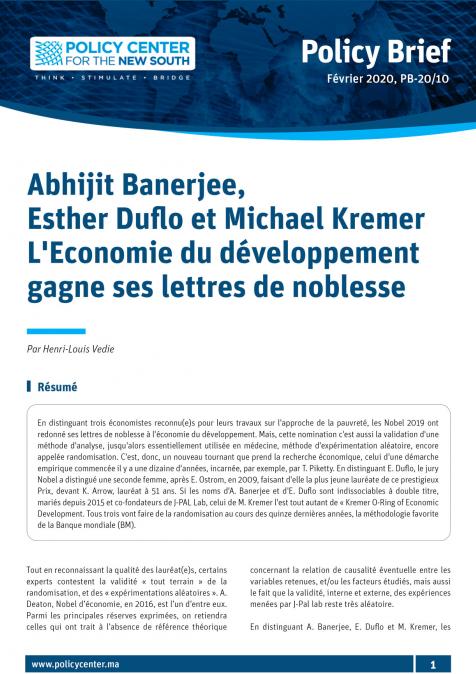
Abhijit Banerjee, Esther Duflo et Michael Kremer L'Economie du développement gagne ses lettres de noblesse
February 21, 2020

En distinguant trois économistes reconnu(e)s pour leurs travaux sur l'approche de la pauvreté, les Nobel 2019 ont redonné ses lettres de noblesse à l'économie du développement. Mais, cette nomination c'est aussi la validation d'une méthode d'analyse, jusqu'alors essentiellement utilisée en médecine, méthode d'expérimentation aléatoire, encore appelée randomisation. C'est, donc, un nouveau tournant que prend la recherche économique, celui d'une démarche empirique commencée il y a une dizaine d'années, incarnée, par exemple, par T. Piketty. En distinguant E. Duflo, le jury Nobel a distingué une seconde femme, après E. Ostrom, en 2009, faisant d'elle la plus jeune lauréate de ce prestigieux Prix, devant K. Arrow, lauréat à 51 ans. Si les noms d'A. Banerjee et d'E. Duflo sont indissociables à double titre, mariés depuis 2015 et co-fondateurs de J-PAL Lab, celui de M. Kremer l'est tout autant de « Kremer O-Ring of Economic Development. Tous trois vont faire de la randomisation au cours des quinze dernières années, la méthodologie favorite de la Banque mondiale (BM).

RELATED CONTENT

  • Authors
    July 31, 2026
    Ethiopia continues to struggle to lay the economic foundations of food security for all, more than 30 years after first adopting the East Asian Developmental State Model (EADS) under Zenawi (1911-2012), continued under Hailemariam Desalegn (2012-April 2018), and later shifting toward a neo-liberal, Washington consensus-oriented approach under Abiy Ahmed (2018-present). The achievements recorded under the EADS approach—particularly double-digit annual growth, substantial poverty ...
  • Authors
    July 28, 2026
    The term “K-shaped recovery” was introduced to describe the economic recovery from the recession triggered by the Covid-19 pandemic. It refers to the uneven and divergent growth pattern between leading industries or sectors (the upper arm of the letter K—mainly the high-technology sector) and laggards, or the rest of the economy (the lower arm—the traditional industries). Since then the term has become popular in portraying divergent growth patterns within and between countries, esp ...
  • June 26, 2026
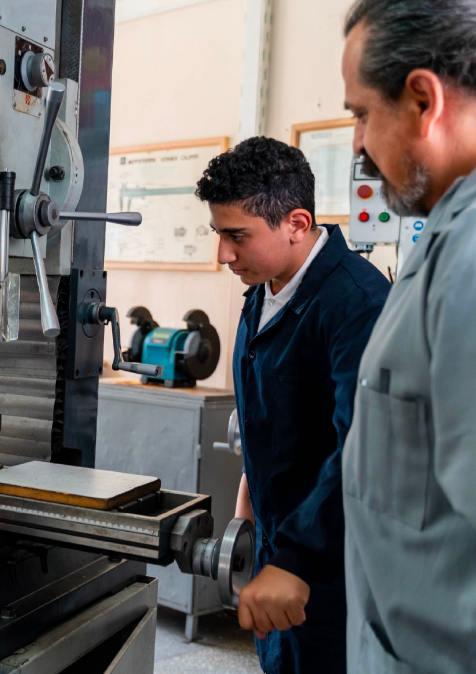
    In Morocco, the issue of young NEETs (Not in Employment, Education, or Training) is a national emergency, fueled by 300,000 students dropping out of school each year. In response to this challenge, the “New Generation Second Chance School” (E2C-NG) model has proven its effectiveness by achieving an exceptional employment rate of 81%.However, this institutional success rests entirely on a local network of organizations that is now under strain. A previously unpublished analysis of da ...
  • June 26, 2026
    Au Maroc, la problématique des jeunes NEETs (Ni en emploi, ni en études, ni en formation) constitue une urgence nationale, alimentée par 300 000 abandons scolaires annuels. Face à ce défi, le modèle de l'École de la Deuxième chance nouvelle génération (E2C-NG) a démontré sa pertinence en affichant un taux d'insertion exceptionnel de 81 %.Cependant, ce succès institutionnel repose intégralement sur un tissu associatif local aujourd'hui fragilisé. L'analyse inédite des donné ...
  • Authors
    Karim El Mokri
    Idriss El Abbassi
    June 8, 2026
    Le monde du travail est engagé dans un processus de mutation sans précédent. La quatrième révolution industrielle, portée par l’intelligence artificielle (IA) et la robotisation, a été le point de commencement d’une ère nouvelle où les repères économiques et sociaux se redéfinissent à une vitesse inédite. Ces technologies suscitent un engouement légitime et offrent des perspectives prometteuses, mais requièrent une vigilance accrue face aux incertitudes qui les entourent.Bien que, à ...
  • Authors
    April 8, 2026
    This report was originally published on the website of the Middle East Institute ( mei.edu) The following study discusses the role of Lebanon’s gold reserves in the establishment of a currency board and evaluates four policy options: a true currency board, constrained central bank reform, full dollarization, and a unified managed float. Gold reserves are relevant under all four. The conclusion is consistent across them: no monetary framework, however carefully designed and howe ...
  • Authors
    Ahmed Ouhnini
    December 5, 2025
    L’« uberisation », terme né du nom de l’entreprise américaine Uber au début des années 2010, désigne initialement un modèle économique fondé sur la mise en relation directe entre offre et demande via des plateformes numériques. Rapidement popularisé, le concept s’est élargi, avec Airbnb dans l’hébergement, puis à une multitude d’autres secteurs : livraison de repas, services à domicile, commerce en ligne, voire des métiers traditionnellement régulés ou corporatistes. Ce néologisme t ...
  • Authors
    Ahmed Ouhnini
    December 5, 2025
    “Uberization,” a term derived from the American company Uber in the early 2010s, initially refers to an economic model based on directly matching supply and demand through digital platforms. Rapidly popularized, the concept has expanded with Airbnb in accommodation, and then to a wide range of other sectors: food delivery, home services, e-commerce, and even traditionally regulated or corporatist professions. This neologism thus reflects a transformation of economic and social relat ...
  • Authors
    December 3, 2025
     Global GDP growth has proven resilient in 2025, despite the shocks caused by the trade policies implemented by United States President Donald Trump in the first year after his return to office. The gloomy projections offered by multilateral and private institutions in the first quarter of 2025 have given way to revised levels mostly in the 2.5% to 3% range for the year. ...
  • November 25, 2025
    This Policy Paper analyses the Fourth Industrial Revolution (4IR) through the critical lens of technological colonialism. It argues that the fusion of physical, digital, and biological technologies is not merely a technical phenomenon but a civilizational shift reshaping the foundations of global power. The article traces a historical continuum from previous industrial revolutions, demonstrating how patterns of inequality and extraction persist, now transposed into the digital realm ...