Publications /
Policy Brief

Back
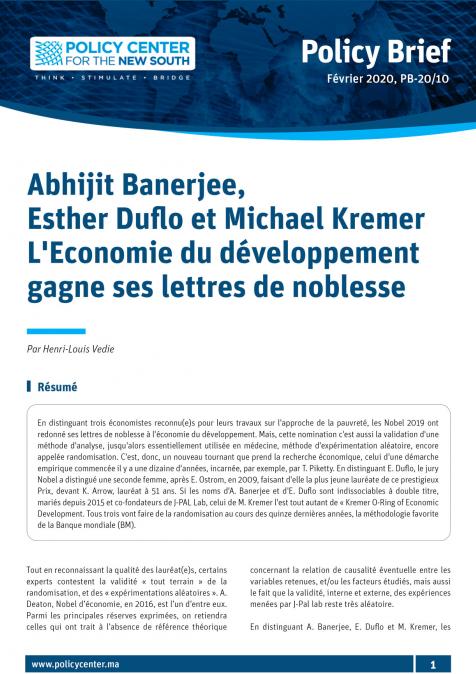
Abhijit Banerjee, Esther Duflo et Michael Kremer L'Economie du développement gagne ses lettres de noblesse
February 21, 2020

En distinguant trois économistes reconnu(e)s pour leurs travaux sur l'approche de la pauvreté, les Nobel 2019 ont redonné ses lettres de noblesse à l'économie du développement. Mais, cette nomination c'est aussi la validation d'une méthode d'analyse, jusqu'alors essentiellement utilisée en médecine, méthode d'expérimentation aléatoire, encore appelée randomisation. C'est, donc, un nouveau tournant que prend la recherche économique, celui d'une démarche empirique commencée il y a une dizaine d'années, incarnée, par exemple, par T. Piketty. En distinguant E. Duflo, le jury Nobel a distingué une seconde femme, après E. Ostrom, en 2009, faisant d'elle la plus jeune lauréate de ce prestigieux Prix, devant K. Arrow, lauréat à 51 ans. Si les noms d'A. Banerjee et d'E. Duflo sont indissociables à double titre, mariés depuis 2015 et co-fondateurs de J-PAL Lab, celui de M. Kremer l'est tout autant de « Kremer O-Ring of Economic Development. Tous trois vont faire de la randomisation au cours des quinze dernières années, la méthodologie favorite de la Banque mondiale (BM).
RELATED CONTENT

  • Authors
    Prakash Loungani
    November 9, 2016
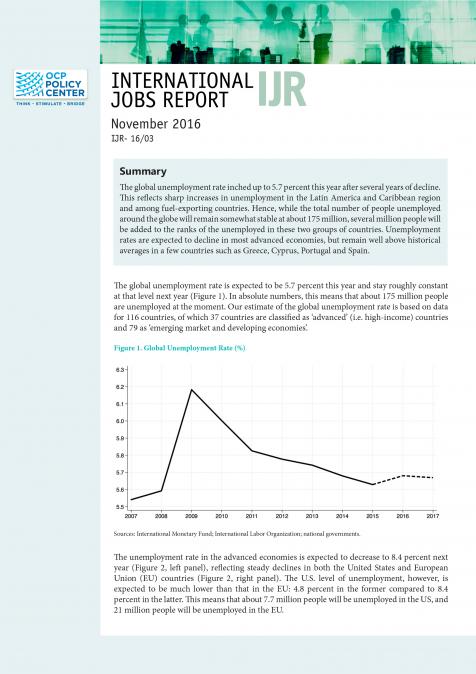
    The global unemployment rate inched up to 5.7 percent this year after several years of decline. This reflects sharp increases in unemployment in the Latin America and Caribbean region and among fuel-exporting countries. Hence, while the total number of people unemployed around the globe will remain somewhat stable at about 175 million, several million people will be added to the ranks of the unemployed in these two groups of countries. Unemployment rates are expected to decline in m ...
  • July 13, 2016
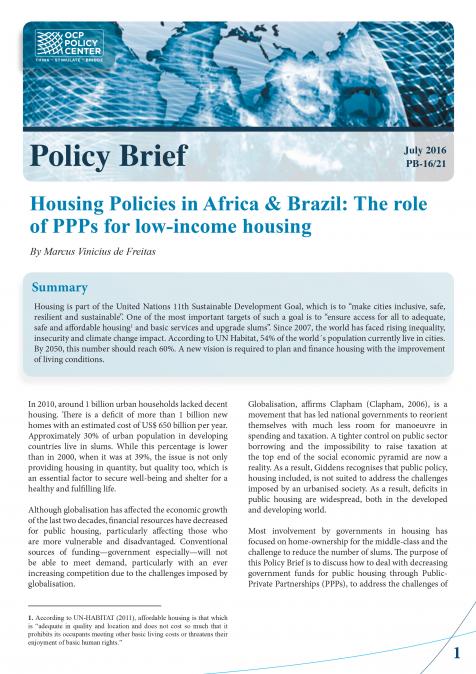
    Housing is part of the United Nations 11th Sustainable Development Goal, which is to “make cities inclusive, safe, resilient and sustainable”. One of the most important targets of such a goal is to “ensure access for all to adequate, safe and affordable housing1 and basic services and upgrade slums”. Since 2007, the world has faced rising inequality, insecurity and climate change impact. According to UN Habitat, 54% of the world´s population currently live in cities. By 2050, this n ...
  • Authors
    Russel Dinh
    January 27, 2016
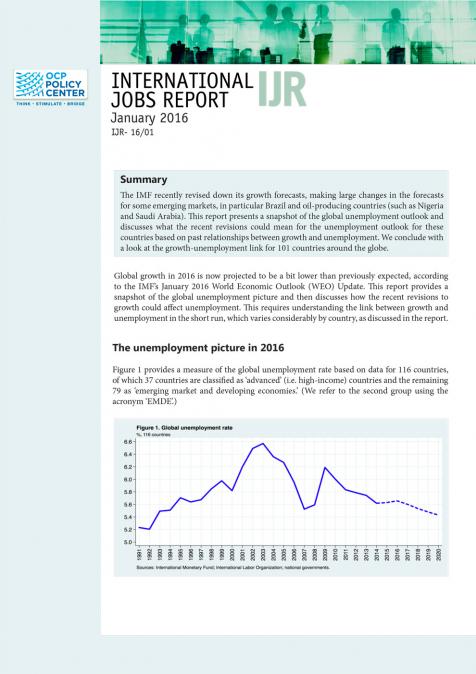
    The IMF recently revised down its growth forecasts, making large changes in the forecasts for some emerging markets, in particular Brazil and oil-producing countries (such as Nigeria and Saudi Arabia). This report presents a snapshot of the global unemployment outlook and discusses what the recent revisions could mean for the unemployment outlook for these countries based on past relationships between growth and unemployment. We conclude with a look at the growth-unemployment link f ...