Podcasts

Back

The New South as a Frontline of the U.S.-China Technological Rivalry

20
May 2026
By Helmut Sorge & Otaviano Canuto

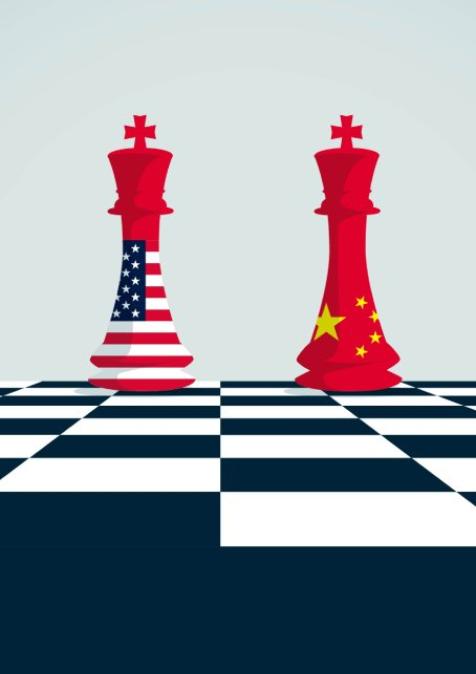
In this podcast, Otaviano Canuto discusses how the U.S.-China technological rivalry is increasingly shaped not only by innovation, but also by the ability to integrate technology into energy systems, infrastructure, and industrial production. The conversation highlights the growing strategic importance of the Global South, where countries can leverage their energy resources and critical minerals to strengthen their position in global supply chains. The discussion also underlines how energy availability and infrastructure capacity may become decisive factors in determining future technological leadership

RELATED CONTENT

  • April 10, 2025
      Marcus Vinicius De Freitas Professor, China Foreign Affairs University Senior Fellow, Policy Center for the New South The Chinese government’s white paper, ‘China’s Position on Some Issues Concerning China-US Economic and Trade Relations,[1]’ issued on April 9, 2025, in response to the escalating tariffs imposed by President Donald Trump, is not just a diplomatic response to the escalating tensions with the United States. It is a meticulously crafted strategic document th ...
  • Authors
    September 27, 2024
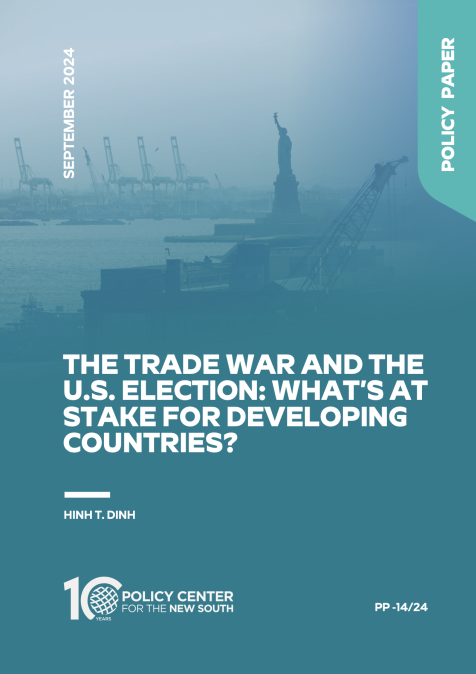
    This paper examines the implications of the U.S.-China trade war for developing countries, particularly in light of the 2024 U.S. presidential election. The study traces the origins and escalation of the trade conflict, analyzing its multiple impacts on global trade patterns and economic growth. While some developing countries have benefited from trade diversion and supply-chain shifts, others, especially resource-exporting nations and the least-developed countries, have faced signi ...
  • June 19, 2024
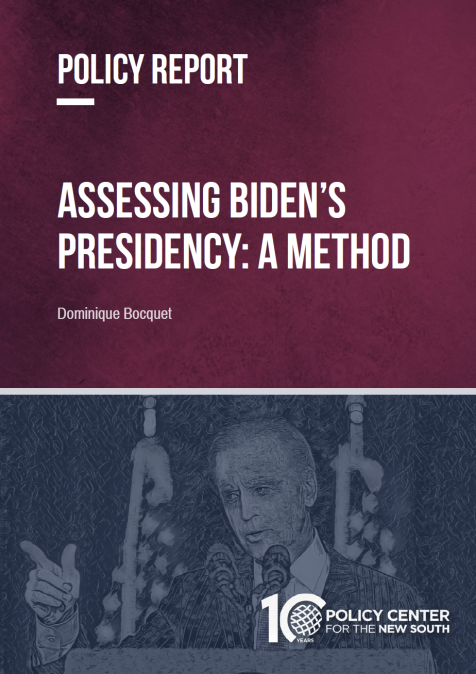
    Our Senior Fellow, Mr. Dominique Bocquet, presents his report, "Assessing Biden’s Presidency: A Method," offering a thorough analysis of President Joe Biden's administration. The report evaluates Biden's domestic and international policies, highlights key challenges and opportunities, a...
  • April 18, 2024
    The writing of this Report started in november 2023 and benefited during six months from the quality of discussions in the Policy center. Paul Isbel, Professor at UM6P, was a relentless proofreader who generously brought his outstanding competence in economy and political economy. Stephen Gardner went beyond his role as linguistic proofreader and showed an admirable understanding of the substance at stake. Under the direct supervision of Professor Abdelaziz Aitali, the Economic Depa ...
  • Authors
    December 30, 2020
    According to this month’s OECD economic outlook, global GDP --- which took a huge hit from the pandemic and is still 3% below its level of a year ago – will not recover its pre-pandemic level until the end of 2021. In a downside scenario, the return could take almost a year longer. The OECD predictions, which imply high and protracted unemployment, are in line with the view of many other official and private organizations. The arrival of effective vaccines such as Pfizer-BioNTech wa ...
  • Authors
    June 12, 2020
    The United States has suffered more COVID-19 casualties than any other country and continues to report large numbers of new cases and deaths, and – as evident recently in stock markets – investors remain extremely sensitive to the epidemic’s shifting trends. As every state reopens, including most recently the New York epicenter, the fates of the American economy and of the global economy depend on whether the United States has put the worst of the epidemic behind it, or whether it w ...
  • Authors
    November 8, 2019
    The Trump government has been imposing restrictions on access to technologies by Chinese telecommunications firms. Why and what are the consequences? The Federal Communications Commission is about to ban carriers from using government funds to buy equipment from Huawei and ZTE. Other government agencies are expected to take similar measures. This is just the latest episode of a gradual squeeze that the Trump government has been giving over China's telecommunications giant Huawei, ...
  • Authors
    September 30, 2019
    Despite some short-term benefits, trade deviation to the region shouldn’t be expected to last. Has the U.S. trade war with China been good for Latin America? An increase in Chinese demand for primary products from the region, as well as recent news of production transfers from China to Mexico, might give the impression that it has. But any positive short-term effects of the confrontation should also take into account its negative medium- and long-term impacts on the region and on gl ...
  • Authors
    Laurence Kotlikoff
    August 15, 2019
    Thirty months into President Trump's radical trade policy, it is time to take stock. American firms tend to give the President the benefit of the doubt - that the aim is not protection (which most don't want) but opening up markets overseas, striking better trade deals, and reducing the nation's big trade deficit. So far, however, none of this has happened. Instead, there is virulent uncertainty, barriers against American firms are going up, Europe, Japan and China have struck impor ...