Podcasts

Back

Liberalism, Pan-Atlanticism and the Atlantic Basin

11
December 2024
Kidane Kiros & Paul Isbell
Related topics: 

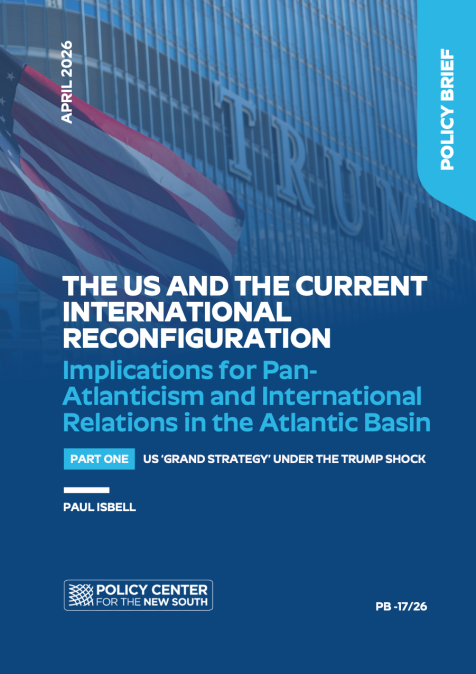
The Atlantic Basin holds unique promise as a space for fostering liberal international cooperation amidst growing global fragmentation. Historically dominated by the Northern Atlantic, the basin's potential now extends southward, encompassing Africa, Latin America, and the Caribbean. From a liberal perspective, this region offers an opportunity to renew international order through equitable partnerships, rooted in mutual economic benefit and pan-Atlantic cooperation.

The Southern Atlantic, in particular, provides a platform for economic integration and regional development that challenges traditional North-South divides. This perspective underscores liberalism's emphasis on market-based prosperity and the power of rules-based frameworks to mitigate conflict through interconnected trade and cooperation. Yet, this ambition faces challenges, including the waning influence of global liberal institutions and the rise of alternative blocs like BRICS.

Rather than persisting with unattainable global liberal dominance, pragmatic liberalism advocates for focusing on regional cooperation. By addressing historical inequalities and ensuring meaningful inclusion of Southern Atlantic states, a pan-Atlantic framework can stimulate and articulate Northern Atlantic nearshoring into the Southern Atlantic. This vision reframes the Atlantic Basin as not just a geographic entity but a pivotal arena for liberal resilience and reform in an increasingly multipolar world.
 

RELATED CONTENT

  • January 23, 2026
    The post-1945 international order, an architecture born of war-weariness and colonial twilight, is now a majestic but empty shell. Its foundational promise—a universal system of rules administered impartially—has been hollowed out by decades of selective enforcement, instrumentalized law, and a chasm between the rhetorical ideals of its custodians and their geopolitical practice. This is not a temporary dysfunction, but a systemic failure of legitimacy. From the invasion of Iraq und ...
  • Authors
    January 21, 2026
    In response to developing countries’ dissatisfaction with the New Collective Quantified Goal (NCQG) of $300 billion, which was decided at the Twenty-Ninth Conference Of the Parties (COP29) to the United Nations Framework Convention on Climate Change, in 2024 in Baku, Azerbaijan, the COP29 and COP30 presidencies promised to develop a roadmap to achieve $1.3 trillion in external climate finance that developing countries need, and to present it at COP30 in Belém, Brazil[1]. The two pre ...
  • Authors
    Stephan Klingebiel
    Andy Sumner
    January 9, 2026
    Global cooperation is under stress. It hardly requires detailed analysis: the international system is in a profound crisis, when seen from many Northern vantage points. What if we see the same turbulence but from a different vantage point? For many in the Global South the current period signals risk, but also opportunity. That the same events could spark a sense of crisis in one group but opportunity in another is nothing new. However, the sheer scale, speed, and scope of recen ...
  • Authors
    December 1, 2025
    This Paper was originally published on transatlantic.org The contemporary maritime domain is increasingly recognized as a geopolitical and economic space, but also as an environment intertwined with human, social, ecological, and governance systems ashore. The United Nations Institute for Disarmament Research (UNIDIR 2024) report argues that maritime security has evolved from a narrow naval and state-centered concern into a multidimensional issue embedded in global human s ...
  • Authors
    September 22, 2025
    Le Processus des États de l’Afrique atlantique (PEAA), lancé par Sa Majesté le Roi Mohammed VI en novembre 2023, ambitionne de transformer la façade atlantique africaine — jusqu’ici morcelée et vulnérable — en un espace géopolitique cohérent, intégré et prospère. L’Initiative s’appuie sur les provinces du Sud marocain comme pont stratégique vers les vingt- trois pays riverains de l’Atlantique, et sur une vision d’ouverture Sud-Sud et euro-africaine.Malgré des disparité ...
  • Authors
    Patricia Ahanda
    September 18, 2025
    L’autrice de cette opinion, Patricia Ahanda, est une alumna du programme Atlantic Dialogues Emerging Leaders 2018. Cette opinion a été publiée initialement sur patriciaahanda.paris Dans un monde marqué par l’émergence d’une instabilité géopolitique globale, par la non-linéarité et l’imprévisibilité croissante des rapports de force, le Maroc s’impose comme un leader pivot du Sud global. Un acteur incontournable capable de relier continents, blocs et cultures dans un mo ...
  • Authors
    Fadoua Ammari
    September 12, 2025
    The Atlantic Initiative, announced by King Mohammed VI in November 2023 to provide landlocked Sahelian countries with access to the Atlantic Ocean via Moroccan territory, promises to profoundly reshape the bilateral relationship between Rabat and Nouakchott. This research paper examines how this unprecedented project creates new strategic opportunities while raising shared challenges for Morocco and Mauritania. Diplomatically, the rapprochement around the Atlantic Initiative unfolds ...
  • Authors
    Loubna Eddallal
    September 8, 2025
    This paper explores the evolving legal, geopolitical, and technical dynamics surrounding the extension of the coastal shelf of Atlantic African states beyond 200 nautical miles under the United Nations Convention on the Law of the Sea (UNCLOS). As several coastal states pursue rights over seabed areas beyond their exclusive economic zones, the paper highlights the growing strategic importance of these claims for resource access, particularly hydrocarbons and minerals, and maritime b ...
  • Authors
    September 2, 2025
    In 2019 - well before the onslaught of COVID-19 and the wars in Europe and the Middle East - the central thesis of a policy paper by this author, analyzing the relationship between Africa and the Caribbean, characterized it as one of missed opportunity due to the lack of consistent, meaningful engagement between the two regions - despite the relationship’s special significance given their shared history. Underinvested: The Caribbean African Relationship (PCNS 2019) chronicled the li ...
  • Authors
    Fadoua Ammari
    August 28, 2025
    L’Initiative Atlantique, annoncée par le Roi Mohammed VI en novembre 2023, visant à offrir aux pays sahéliens enclavés un accès à l’océan Atlantique via le territoire marocain, promet de redessiner en profondeur la relation bilatérale entre Rabat et Nouakchott. Cet article examine comment ce projet inédit crée de nouvelles opportunités stratégiques tout en soulevant des défis partagés pour le Maroc et la Mauritanie. Sur le plan diplomatique, le rapprochement autour de l’Initiative A ...