Publications /
Opinion

With no hesitation, Daniela Varela describes herself as a “good-listener, and a perseverant person with a positive-attitude”. Born and raised in Posadas, Misiones, a province of North-East Argentina bordering Paraguay and Brazil, she knew from a young age she wanted to work in international relations.
Today, she is an International affairs advisor in the Ministry of Education of Argentina. She also holds the position of Secretary for International Affairs of the Latin American Association for Energy Economics (ALADEE), the regional chapter of the International Association for Energy Economics (IAEE).
“My job at the ministry of Education is about international cooperation, she explains. I am a delegate in the G20 Education Working Group, and the main issue is to bring forward the position of Argentina: how to deepen the educational agenda at the G20, fight against educational poverty during the Covid-19 pandemic, promote a more inclusive blended education for all and share experiences among countries on the transitions from school to work ”.
Last but not least, she is co-coordinator of the Global Scenarios Working Group of the prestigious Argentinian Council for International Relations (CARI), one of the main Latin American think tanks, based in Buenos Aires. After her participation in the Atlantic Dialogues Emerging Leaders (ADEL) program in 2018 in Marrakesh, she was instrumental in developing cooperation between the Policy Center for the New South and CARI. “Think tanks have a unique role today in bringing up issues that are not on the agenda of many other actors, she explains. One of the panels of the last Atlantic Dialogues Talks was about “the geography of discontent in the Global South”. The discussion happened before the demonstrations that are shaking the Atlantic, in South Africa, Nigeria, Colombia, Cuba and so many other countries”.
From energy to education
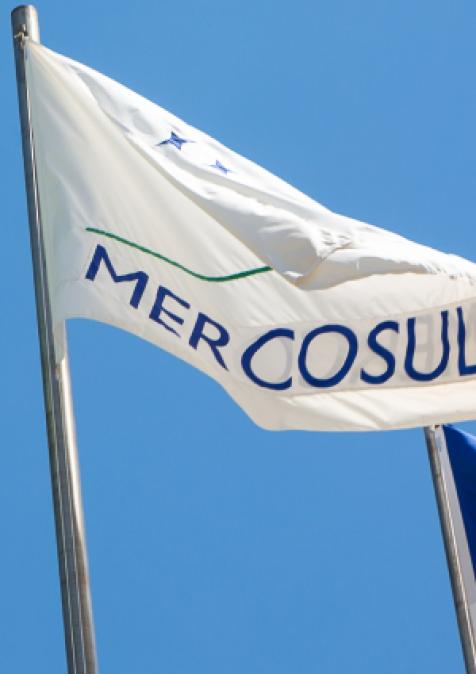
In her province Misiones, “the national capital of biodiversity”, she grew up in what she calls a “very Mercosur environment” and a strong mix of cultures. “Misiones is a green and beautiful place with indigenous population roots, cultural heritage, and the spectacular Iguazú waterfalls”. She developed a passion for Guaraní, one of the languages of the Amerindian people, which she is currently learning.
As a child, her dream was to become a clown in a circus, but when she was 17, an exchange program during her highschool years led her to Newport Beach, California, and gave her a taste for travel and an international perspective.
She went for a BA in Government and International Relations (Universidad Argentina de la Empresa) and a Masters in Energy from the Center for the Study of Energy Regulatory Activity (Universidad de Buenos Aires). She then gained experience at the Secretariat of Energy for seven years, working in the field of international cooperation, before switching to education.
How did it happen ? “In 2018, Argentina held de G20 Presidency, and the government of Argentina decided to create for the first time in history the G20 Education Working Group. The Chair of this group knew I carried this agenda in energy and offered me the opportunity to join and create this group from scratch”.
A convinced member of the Atlantic community
In 2018, the ADEL program attracted her because of its Atlantic approach. “In my studies and career, I worked on the Question of the Malvinas Islands (Falkland Islands) particularly in energy issues, where there is a dispute sovereignty between Argentina and United Kingdom. I was interested in learning how to develop strategies for Argentina regarding the Atlantic basin, with a Latin American and African perspective”.
What she brought back from Marrakesh to Buenos Aires was “even more than expected”, she says. “I could interact and find consensus with people from very diverse backgrounds, but also get a cultural experience in Morocco, where I never went before”.
A keen reader of history books about her region, she mentions her parents as her main roles models. Both are forest engineers, her mother being also engaged in real estate and her father in teaching. She is interested in the paths of “great women in history such as Marie Skłodowska-Curie, a brilliant scientist and a strong personality, and other known and unknown women in Argentina”.
For now, her personal longings are to keep working in the domain of international affairs, in order to “put Argentina in the highest position possible in many organizations, and move towards a more sustainable and inclusive world”, an ambition strongly linked to the general interest and a brighter global future.
You can consult Daniela’s portrait along with others on the ADEL Alumni Portrait page.