Tatiana KASTOUEVA-JEAN, Responsable du centre Russie NEI, Ifri

December 4, 2014
Speakers
Tatiana Kastouéva-Jean
Director, Russia/NIS Center, Ifri
Tatiana Kastouéva-Jean holds a degree from the State University of Ekaterinbourg, a Franco-Russian Master in International Relations from the University of Sciences Po/MGIMO in Moscow, and a DEA (Diplôme d'études approfondies) in International Relations. Among her research areas: evolution of Russian domestic and foreign policies, soft power, Ukraine, education and human capital. She directs the Russie.Nei.Visions. Recent publications include:  « Pourquoi la société russe soutient-elle la politique actuelle du Kremlin ? », Les Études du CERI, Sciences Po, n° 228-229, Regards sur l'Eurasie, février 2017 ; « La Russie après les crises ukrainienne et syrienne », RAMSES 2017, Ifri/Dunod, 2016 ; « Le système Poutine : bâti pour durer ? », Politique étrangère, n°2, 2015 and « R ...
RELATED CONTENT

  • August 3, 2026
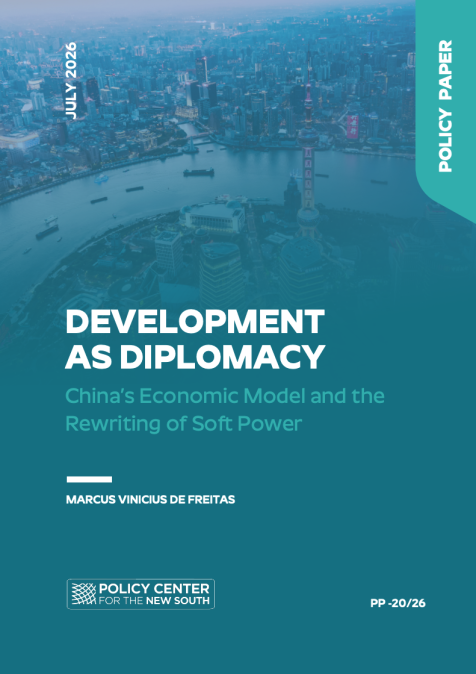
    This policy paper explores how China’s economic development model—rooted in pragmatism, long-term planning, and civilizational renewal—has become its most compelling soft power asset, particularly in the eyes of the Global South. While critically engaging with Joseph Nye’s original conception of soft power as a primarily cultural and normative force, the paper argues that China’s ability to transform itself from an impoverished postimperial state into the world’s largest trading nat ...
  • July 3, 2026
    Este Policy Paper también ha sido publicado en inglés y francés por Le Grand Continent La economía marroquí constituye un caso ilustrativo entre las economías de renta media, en un contexto marcado por una creciente fragmentación del entorno internacional, un crecimiento mundial anémico y una desaceleración de la convergencia. Desde 2022, su trayectoria se caracteriza por una relativa solidez, con un crecimiento superior a la media de las economías de la misma categoría. Superi ...
  • July 3, 2026
    Ce Policy Paper a également été publiée en anglais et en espagnol par Le Grand Continent Le Maroc offre un exemple éclairant parmi les pays à revenu intermédiaire, dans un contexte marqué par une fragmentation croissante de l’environnement international, une croissance mondiale atone et un ralentissement de la convergence. Depuis 2022, sa trajectoire se distingue par une certaine robustesse, avec un rythme d’expansion supérieur à celui des autres économies de même catégorie. Dé ...
  • July 3, 2026
    This Policy Paper has also been published in French and Spanish by Le Grand Continent Morocco offers a compelling example of how a middle-income economy can navigate a more fragmented global environment, characterized by weak growth and slower convergence. Since 2022, economic activity has remained relatively strong, with growth exceeding that of many comparable economies. Non-agricultural growth has averaged 4.4% since 2022, around 1.3 percentage points above its historical av ...
  • Authors
    February 11, 2026
    The U.S.–China technological rivalry has become a central axis of global economic and geopolitical competition. While the United States continues to lead in frontier innovation—most notably in advanced semiconductors and artificial intelligence (AI)—China has consolidated strengths in large-scale implementation, manufacturing capacity, and control over critical segments of global supply chains. These advantages are especially visible in clean energy technologies and in the processin ...
  • Authors
    January 30, 2026
    The 2026 World Economic Forum (WEF) Annual Meeting took place in an environment of elevated economic uncertainty and structural risk repricing. According to the Global Risks Report (GRR) 2026, geoeconomic confrontation and economic downturn rank among the most severe near-term risks, while inflation-related risks and economic volatility have risen sharply in perceived severity compared with the previous edition. Notably, 50% of respondents to the Global Risks Perception Survey ...
  • January 29, 2026
    Le Mali, le Burkina Faso et le Niger, réunis au sein de l’Alliance des États du Sahel (AES), affirment l’ambition de bâtir une souveraineté nationale qui leur permettrait de s’émanciper de la domination et des influences extérieures et de se doter d’une liberté d’action dans les choix de développement politique et économique. Cependant, cette ambition se heurte à de nombreuses contraintes économiques et sécuritaires.La souveraineté ne peut se construire sans une base économique soli ...
  • Authors
    Jorge Arbache
    October 9, 2025
    Conventional wisdom holds that the United States has undergone massive deindustrialization in recent decades, with the country's manufacturing sector supposedly withering as it lost ground to China. This narrative has fueled debates about industrial policy, economic nationalism, and the reshoring of manufacturing production. But what if this story is only partially true? What if, instead of disappearing, American industry simply changed its address?  ...
  • Authors
    June 18, 2025
    In 2000, The Economist dismissed Africa as the “Hopeless Continent”—a label reflecting a broader system of marginalization rooted in colonial legacy and post-Cold War neglect. This essay offers a realist reappraisal, arguing that Africa’s growing strategic relevance is not the result of benevolence, but of structural necessity.Amid a fracturing global order and the rise of transactional geopolitics under Trump 2.0’s Bessent Doctrine, Africa has become indispensable: rich in critical ...