
This episode explores the evolving African defense strategies in response to emerging security threats. We discuss the shift toward regional cooperation, modernization of military capabilities, and integration of technology. The conversation highlights the role of governance, economic resilience, and diplomacy in sustaining security. It underscores Africa’s push for self-reliance and strategic autonomy in defense policy.
RELATED CONTENT
-
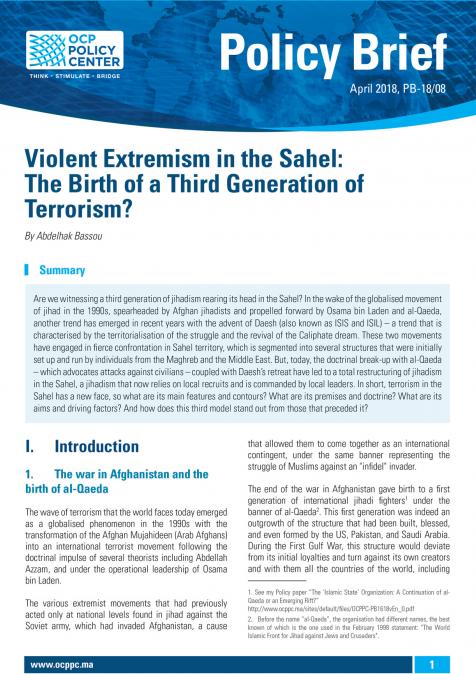 April 5, 2018Are we witnessing a third generation of jihadism rearing its head in the Sahel? In the wake of the globalised movement of jihad in the 1990s, spearheaded by Afghan jihadists and propelled forward by Osama bin Laden and al-Qaeda, another trend has emerged in recent years with the advent of Daesh (also known as ISIS and ISIL) – a trend that is characterised by the territorialisation of the struggle and the revival of the Caliphate dream. These two movements have engaged in fierce conf ...
 -
 March 30, 2018L’OCP Policy Center a eu la primeur de la présentation, par l’historien Jean Pierre Filiu, de son dernier livre « Généraux, gangsters et jihadistes. Histoire de la contre-révolution arabe », la toute première hors de son pays, la France. Une première dont il se réjouira au début du débat-échange autour de son ouvrage, tenue le 28 mars 2018, en partenariat avec l’Institut Français du Maroc. Habitué à faire appel à plusieurs disciplines scientifiques à la fois, telles que l ...
 -
March 29, 2018The Soviet crew faced death in the depth of the Caribbean. Their submarine of the diesel powered “Foxtrott” class, registered as “B -52”, had been transformed into a gigantic metal coffin. It was in October 1962, the month when the world stopped breathing. The end, nuclear war, seemed near. Human civilization has never faced such an APOCALYPSE in history. The unthinkable was likely to happen. Washington and Moscow, here the leaders of the free capitalistic world, and there the repre ...
-
March 13, 2018S’adressant à l’Occident en 1989, Alexandre Arbatov, conseiller diplomatique de Mikhaïl Gorbatchev avait dit : "nous allons vous rendre le pire des services, nous allons vous priver d'ennemi ". Ce que le russe n’avait pas prévu à ce moment, c’est que la disparition de l’Union Soviétique allait priver l’occident de bien plus que d’un ennemi : elle allait le priver de son identité. Durant la guerre froide, il existait un camp de l’Est et un camp de l’Ouest. Cet antagonisme donnait à ...
-
 January 23, 2018Dans ce briefing, Céline Pajon, chercheur au centre Asie de l’Institut Français des Relations Internationales (IFRI), expose la politique de sécurité du Japon en Afrique, qui connaît une ...
 -
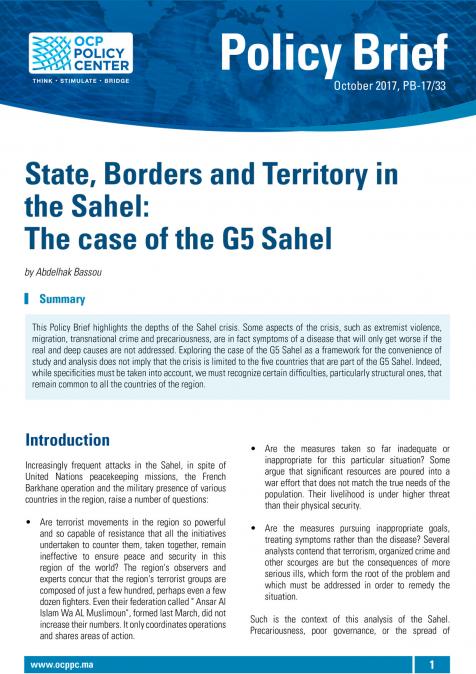 October 6, 2017This Policy Brief highlights the depths of the Sahel crisis. Some aspects of the crisis, such as extremist violence, migration, transnational crime and precariousness, are in fact symptoms of a disease that will only get worse if the real and deep causes are not addressed. Exploring the case of the G5 Sahel as a framework for the convenience of study and analysis does not imply that the crisis is limited to the five countries that are part of the G5 Sahel. Indeed, while specificitie ...
 -
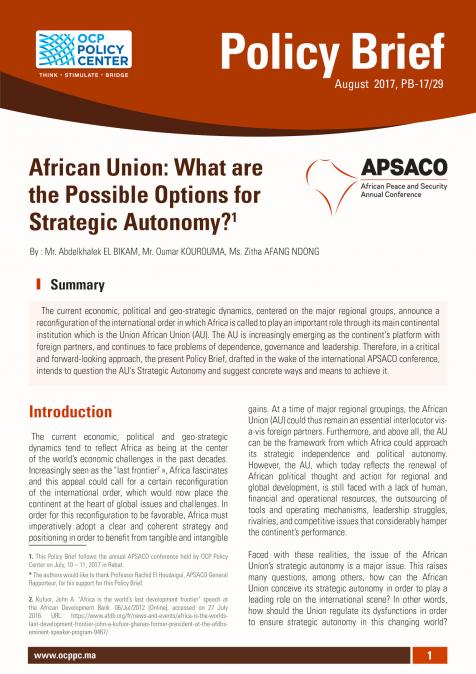 August 25, 2017The current economic, political and geo-strategic dynamics, centered on the major regional groups, announce a reconfiguration of the international order in which Africa is called to play an important role through its main continental institution which is the Union African Union (AU). The AU is increasingly emerging as the continent's platform with foreign partners, and continues to face problems of dependence, governance and leadership. Therefore, in a critical and forward-looking a ...
 -
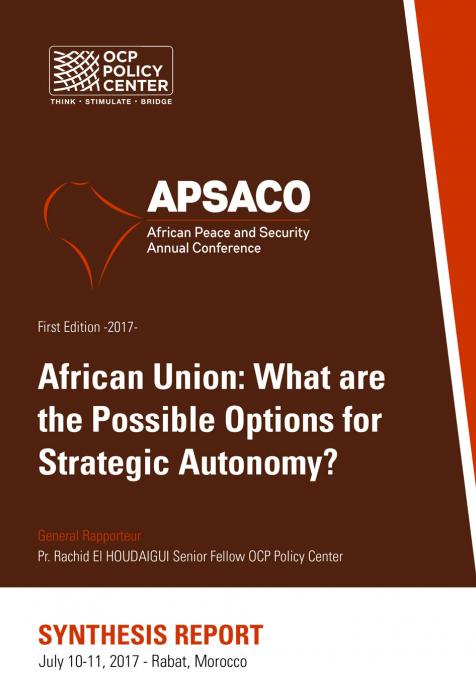 July 31, 2017The African Peace and Security Annual Conference (APSACO), organized by the OCP Policy Center, was held from July 10 – 11, 2017 in Rabat. This first edition, focusing on the African Union’s (AU) strategic autonomy, aimed to facilitate a serious and constructive consideration of the various probable and realistic options for the rise of this international organization as an autonomous entity that is globally interdependent. The conference also aimed at launching a deep African debate ...
 -
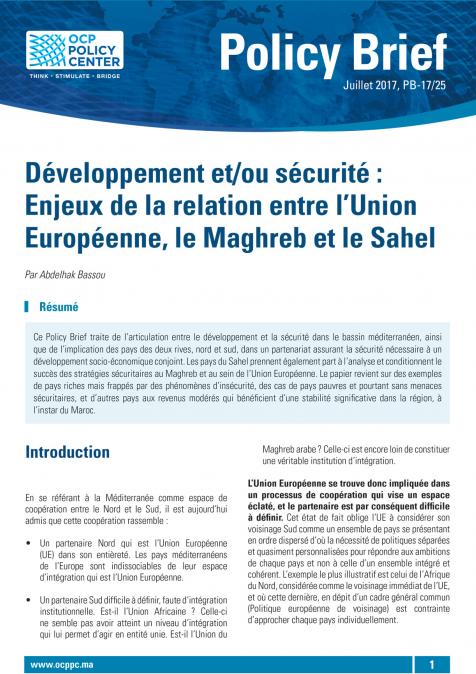 July 7, 2017Ce Policy Brief traite de l’articulation entre le développement et la sécurité dans le bassin méditerranéen, ainsi que de l’implication des pays des deux rives, nord et sud, dans un partenariat assurant la sécurité nécessaire à un développement socio-économique conjoint. Les pays du Sahel prennent également part à l’analyse et conditionnent le succès des stratégies sécuritaires au Maghreb et au sein de l’Union Européenne. Le papier revient sur des exemples de pays riches mais frappé ...
 -
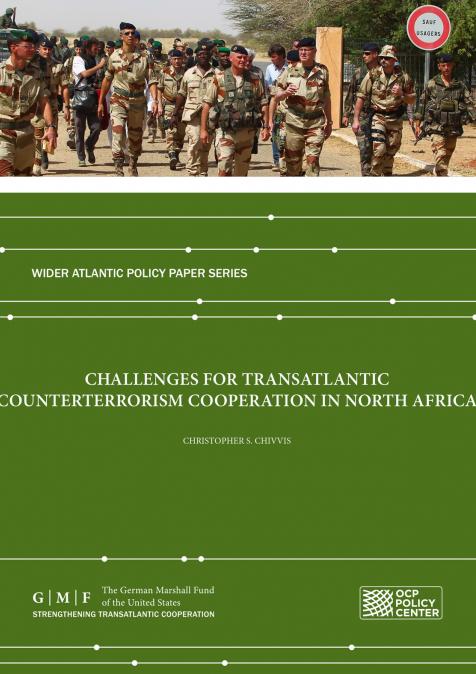 June 20, 2017The United States and Europe share a common interest in addressing the growing terrorist threats from North Africa. The emergence of ISIL as a force in the region — notably in Libya, but also in Egypt and to a lesser degree in Tunisia, Algeria, and Mali — is cause for genuine concern. The ISIL challenge is compounded by the persistence of older terrorist organizations, both local ones such as the region’s various Ansar al Sharias as well as al Qaeda in the Islamic Maghreb (AQIM), al ...

