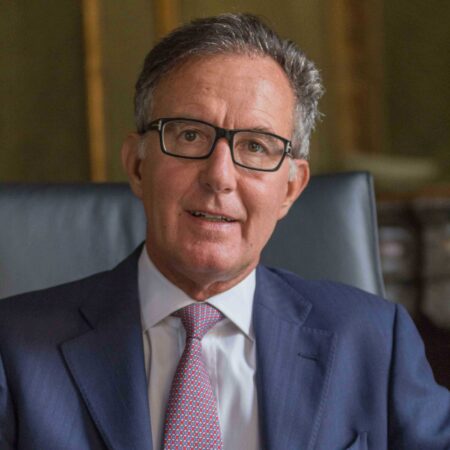
Paolo Magri - Africa Think Tank Conference 2016

May 10, 2016
Speakers
Paolo Magri
Executive Vice President and Director, Italian Institute for International Political Studies (ISPI)
Paolo Magri is Executive Vice President of the Italian Institute for International Political Studies (ISPI) and Professor of International Relations at Bocconi University. He is member of the Strategic Committee of the Italian Ministry of Foreign Affairs and International Cooperation, member of the Europe Policy Group of the World Economic Forum (Davos) and member of the Board of Directors of the Italy-China Foundation. He is also member of the Scientific Committees of the Elcano Royal Institute, the Center of Excellence for Stability Police Units (CoESPU) and of the Military Center for Strategic Studies (Ce.Mi.S.S.). He is a regular speaker, writer and commentator to diverse media outlet on global issues, US foreign policy, Iran and Middle East. Previously, he served as Pr ...
RELATED CONTENT

  • October 9, 2023
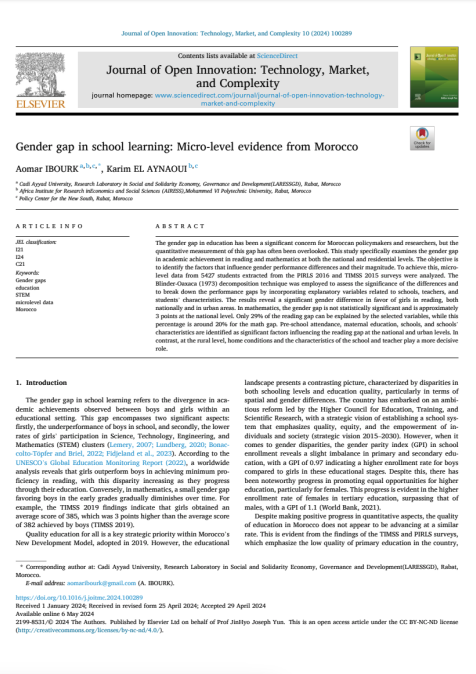
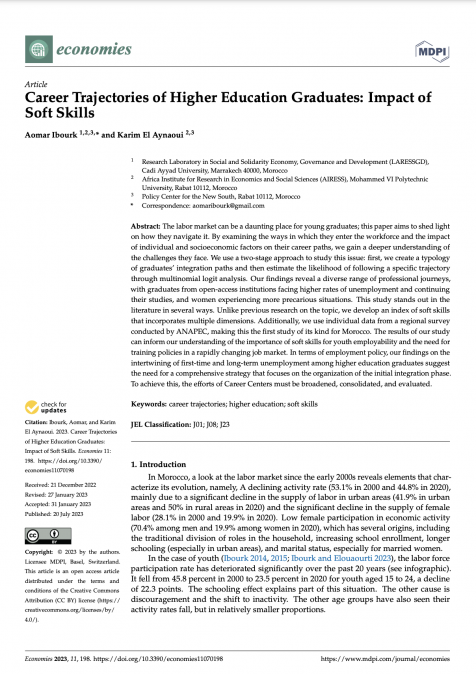
    This paper was originally published on mdpi.com   The labor market can be a daunting place for young graduates; this paper aims to shed light on how they navigate it. By examining the ways in which they enter the workforce and the impact of individual and socioeconomic factors on their career paths, we gain a deeper understanding of the challenges they face. We use a two-stage approach to study this issue: first, we create a typology of graduates’ integration paths ...
  • August 16, 2023
    L’amélioration de la qualité des apprentissages constitue un défi majeur pour le système éducatif marocain, qui, d'après de nombreuses évaluations qualitatives et quantitatives, se positionne parmi les moins performants en termes de compétences scolaires. Les résultats des tests internationaux tels que TIMSS et PIRLS mettent en évidence des scores préoccupants en mathématiques, sciences et lecture, démontrant que plus de 40 % des élèves ne parviennent pas à atteindre ...
  • July 14, 2023
    L'éducation et le patrimoine culturel sont interconnectés. L'éducation permet la transmission et la préservation du patrimoine culturel, tandis que le patrimoine culturel enrichit l'éduca ...
  • June 26, 2023
    L’amélioration de la qualité des apprentissages constitue un défi majeur pour le système éducatif marocain. D’après de nombreuses évaluations, aussi bien qualitatives que quantitatives, le Maroc se place parmi les pays les moins performants en matière de qualité des acquis scolaires. Un autre aspect des faibles réalisations du pays au niveau des tests internationaux est le poids des élèves dits « peu performants1 », et considérés comme particulièrement à risque. L’importance de ce ...
  • Authors
    Sabine Cessou
    July 12, 2022
    The Atlantic Dialogues Emerging Leaders Alumni (ADEL) Portraits are a series of journalistic insights that delve into the stories and backgrounds of impactful young leaders of the ADEL community, now 350 alumni strong. These portraits are more than a biography as they capture the motives, success stories, career shifts, and vision behind each emerging leader’s pursuit of positive impact. From Morocco to South Africa, Germany to Canada, Brazil and the United States, these young leade ...
  • April 25, 2022
    Retrouvez en exclusivité l’interview de Abdelhak Bassou, Senior Fellow au Policy Center for the New South, qui se livre à Helmut Sorge, Columnist au Policy Center for the New South, au sujet des multi-disparités présentes en Afrique. Abdelhak Bassou est l’auteur du Chapitre 5 du rapport...
  • Authors
    Abdelmounaim Fanidi
    April 19, 2022
    Suivant une analyse réaliste des relations internationales, des ‘facteurs objectifs’ ont été longtemps mis en avant pour expliquer le blocage de l’intégration régionale au Maghreb (e.g. le conflit du Sahara). Par une approche constructiviste, cet article a pour vocation d’analyser un facteur subjectif susceptible de freiner ou favoriser l’intégration maghrébine, en l’occurrence les identités nationales. Il se focalisera sur « les discours primordialistes ». Autrement dit, les discou ...
  • Authors
    Alessandro Minuto-Rizzo
    Bernardo Sorj
    Frannie Léautier
    Iskander Erzini Vernoit
    Kassie Freeman
    Nathalie Delapalme
    J. Peter Pham
    March 7, 2022
    The COVID-19 pandemic has had a huge impact on the global economy and has challenged the best minds to rethink how to design and implement an effective recovery. Countries in the wider Atlantic region have exhibited differential trajectories in traversing the pandemic. A number of countries in Europe succeeded in vaccinating most of their eligible populations, enabling life to return somewhat to normal. A smaller group of countries in Europe could manage infection rates even more ti ...
  • Authors
    Nassim Hajouji
    February 15, 2022
    Using education and elite configurations as the main variables of analysis, this Policy Paper aims to show how higher levels of popular sector incorporation during elite conflicts, namely in the process of formulating and implementing policies related to education reforms, can negatively affect the economic complexity of developing countries. To do so, it analyzes the experiences of Mauritius and Singapore and links foundational political economy theories, particularly developmental ...
  • Authors
    March 10, 2020
    Le mouvement des femmes marocaines est issu de l’histoire récente de la société depuis la période précoloniale. La trame du débat autour de l’élaboration et de la réforme de la Moudawana, qui s’est imposé dans la vie politique marocaine depuis les premières années de l’indépendance jusqu’à nos jours, traduit, en fait, un processus amplifié et récurrent des enjeux autour du statut et du rôle de la femme dans la société marocaine qui remonte loin dans l’histoire. Produit moderne d’un ...