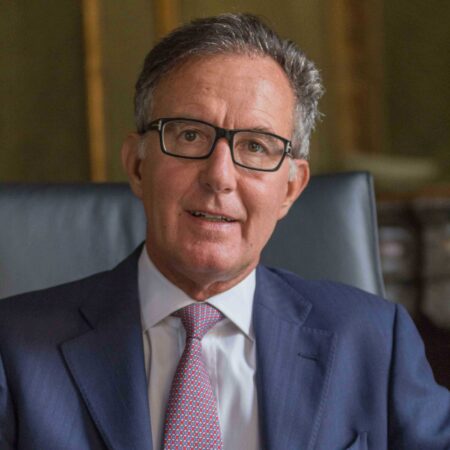
Paolo Magri - Africa Think Tank Conference 2016

May 10, 2016
Speakers
Paolo Magri
Executive Vice President and Director, Italian Institute for International Political Studies (ISPI)
Paolo Magri is Executive Vice President of the Italian Institute for International Political Studies (ISPI) and Professor of International Relations at Bocconi University. He is member of the Strategic Committee of the Italian Ministry of Foreign Affairs and International Cooperation, member of the Europe Policy Group of the World Economic Forum (Davos) and member of the Board of Directors of the Italy-China Foundation. He is also member of the Scientific Committees of the Elcano Royal Institute, the Center of Excellence for Stability Police Units (CoESPU) and of the Military Center for Strategic Studies (Ce.Mi.S.S.). He is a regular speaker, writer and commentator to diverse media outlet on global issues, US foreign policy, Iran and Middle East. Previously, he served as Pr ...

RELATED CONTENT

  • April 14, 2026
    في هذه الحلقة يتم تناول دور الجامعات المغربية في تعزيز الدبلوماسية العلمية للمغرب على المستويين الإقليمي والدولي، وإمكانية تحولها إلى فاعل أساسي في القوة الناعمة الوطنية، كما يناقش أهمية الشراكات الأكاديمية والبحثية الدولية في تعزيز الإشعاع العلمي ونقل المعرفة، ويتطرق كذلك إلى أبرز التح...
  • Authors
    Khalid R. Temsamani
    February 26, 2026
    La multiplication des crises systémiques à l’échelle mondiale – qu’elles soient environnementales, sanitaires, énergétiques ou liées aux enjeux de sécurité globale – impose une évolution profonde des modes d’action diplomatique. Dans ce contexte, l’intégration structurée des connaissances scientifiques dans les relations internationales apparaît comme une condition déterminante pour la formulation de réponses collectives efficaces et légitimes. La diplomatie scientifique s’inscrit a ...
  • Authors
    Khalid R. Temsamani
    February 26, 2026
    The multiplication of systemic crises on a global scale - whether environmental, health-related, energy-related or linked to global security issues - calls for a profound change in diplomatic modes of action. In this context, the structured integration of scientific knowledge into international relations appears to be a decisive condition for the formulation of effective and legitimate collective responses. Science diplomacy is thus a strategic field of intervention, at the interfac ...
  • January 5, 2026
    This Paper was originally published on sciencedirect.com This study provides an original and significant contribution to evaluating educational service quality in Morocco by leveraging, for the first time, microdata from the Service Delivery Indicators (SDI) survey. The survey covers a nationally representative sample of 300 public and private primary schools across rural and urban areas. The use of SDI data represents a major methodological advancement, shifting away from perc ...
  • September 19, 2025
    Pierre Nguimkeu, Director of the Africa Growth Initiative at Brookings, examines Africa’s digital transformation and its impact on work, education, and the economy. From mobile technology ...
  • September 16, 2025
    مع انطلاق الموسم الدراسي 2025، تواجه المدرسة المغربية تحديات جديدة تتعلق بتحسين جودة التعليم وتوسيع فرص التلاميذ في مختلف المناطق، وسط جهود مستمرة لتنفيذ الإصلاحات التربوية. في حلقة اليوم، نستضيف الأستاذ عبد اللطيف اليوسفي، خبير التعليم والمدير السابق للأكاديمية الجهوية لجهة الغرب الشرا...
  • Authors
    September 16, 2025
    Les questions des inégalités sociales et des inégalités territoriales sont profondément liées.  Les politiques publiques ne peuvent réduire l’une sans s’attaquer à l’autre.  Le phénomène des inégalités peut s’accentuer avec la fragilité de la situation socio-économique de certains territoires d’autant que le développement territorial n’est pas spontanément équitable. La réduction de ces inégalités, un des enjeux majeurs des politiques publiques, oblige à con ...
  • Authors
    Soukaina Raoui
    September 12, 2025
    This Paper was originally published on springer.com This paper provides an in-depth analysis of socio-economic convergence across communes in Morocco, focusing on monetary poverty and educational inequalities. This research investigates the impact of the well-known territorial and inclusive development policies of the National Initiative for Human Development on the catch-up process. We explore the data from the last two general population and housing censuses (2004 and 20 ...
  • September 11, 2025
    Ce travail apporte un éclairage critique sur l'alignement des dispositifs publics d'orientation des étudiants marocains à l'étranger avec les ambitions de développement du pays. Il interroge la capacité de ces mécanismes à transformer la mobilité étudiante d'une potentielle "fuite des cerveaux" en un véritable "gain de cerveaux". S'appuyant sur une étude de cas qualitative, nous avons mené une analyse de contenu systématique (cartographie) de 204 programmes promus par le ministère d ...
  • August 28, 2025
    This Paper was originally published on tandfonline.com The gender gap in education remains a concern for Moroccan policymakers and researchers, yet it is rarely measured quantitatively. This study examines differences in reading and mathematics performance between girls and boys, both at the national level and by place of residence, using PIRLS (2016, 2021) and TIMSS (2015, 2019) data covering 21,129 students. The Blinder-Oaxaca decomposition method is applied to distingui ...