Jean-Pierre FILIU - les élections présidentielles en Egypte

April 4, 2018
Speakers
Jean-Pierre FILIU
Professeur des universités
Jean-Pierre Filiu est professeur des universités en histoire du Moyen-Orient contemporain, à Sciences Po depuis 2006. Membre du département d’histoire, il enseigne au sein de l’Ecole de Paris des affaires internationales(Paris School of International Affairs/PSIA).  Lauréat de Sciences Po en 1981, il est diplômé de l’Institut national de langues et civilisations orientales(INALCO) (DULCO de chinois en 1983 et d’arabe littéral en 1985). Il a obtenu à Sciences Po un doctorat en histoire (1985) et l’habilitation à diriger des recherches (2008) et a été professeur invité dans les universités américaines de Columbia et de Georgetown.  Jean-Pierre Filiu rejoint le CERI en 2009. De 1988 à 2006, il a servi comme conseiller des Affaires étrangères dans les ambassades de Fra ...

RELATED CONTENT

  • Authors
    May 15, 2026
    This paper is the third in a series of country and comparative studies that together comprise a research program on services as drivers of economic growth and structural transformation in the Global South. The paper analyzes the pattern of Tunisia's services-led economic growth from 2012- 2022 using a specialized three-category framework: knowledge services (KS), enabling services (ES), and local services (LS). Using data from the OECD Trade in Value Added (TiVA), Trade in Employmen ...
  • April 29, 2026
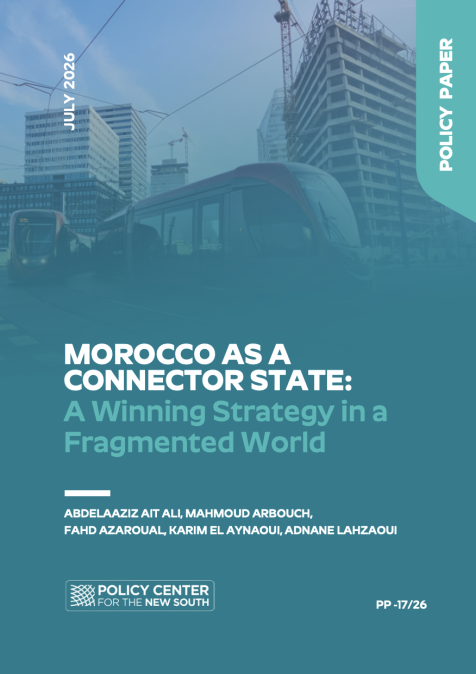
    Cet oped a été publié initialement dans la revue afkar/ideas 77 (IEMed).  La politique étrangère du Maroc traverse une transition structurelle, sous l’effet de la polycrise mondiale, de la diversification de ses partenariats et de l’affirmation de nouveaux choix stratégiques. La centralité accordée aux notions de « hub », de « plateforme »ou de « corridor » traduit un glissement sémantique et fonctionnel dans le narratif national, accordant une priorité majeure aux considé ...
  • Authors
    April 20, 2026
    This paper was published as a book chapter in “The Economic Potential of Islamic Countries, Part B: Sustainability, Governance, Energy and Digital Transformation,” released by Emerald Publishing. The COVID-19 pandemic exposed significant deficiencies within social protection systems worldwide, especially in Middle Eastern and North African (MENA) countries. This underscores the urgent need to fortify these social protection schemes to ensure resilience in the face of crises (Sa ...
  • April 16, 2026
    Gulf countries are increasingly shaping Africa’s political and economic landscape through investments in infrastructure, energy, and strategic sectors. Their flexible, capital-driven approach and strong political ties distinguish them from traditional partners. While creating opportunit...
  • Authors
    January 23, 2026
    Introduction: COP30 as a Test of Reality, Not AmbitionCOP30 in Belém was never going to be a breakthrough. In a world marked by fiscal exhaustion, geopolitical rivalry, and eroding trust in multilateralism, expecting transformational climate cooperation bordered on denial. The choice of the Amazon as host carried symbolic weight, but symbolism does not override power, interests, or institutional capacity.The outcome of COP30 confirms a deeper truth: the global climate regime has ent ...
  • Authors
    December 1, 2025
    This Paper was originally published on transatlantic.org The contemporary maritime domain is increasingly recognized as a geopolitical and economic space, but also as an environment intertwined with human, social, ecological, and governance systems ashore. The United Nations Institute for Disarmament Research (UNIDIR 2024) report argues that maritime security has evolved from a narrow naval and state-centered concern into a multidimensional issue embedded in global human s ...
  • Authors
    Zakaria Elouaourti
    August 7, 2025
    This paper was originally published on tandfonline.comYouth’s life paths have become increasingly challenging, especially for those classified as ‘Not in Education, Employment, or Training’ (NEET), who comprise 31.2% of North Africa’s youth population. This paper contributes to the growing discourse on the NEET phenomenon by exploring its structural and psychosocial dimensions in North Africa, with a specific focus on gender. Using a rich micro-level dataset of 7,815 individuals age ...
  • February 10, 2025
    Depuis 1956, l’économie égyptienne est en crise. Durant la période entre 1956 et 2024, elle a connu douze dévaluations et huit crises majeures de sa balance des paiements. Avec un déficit récurrent de sa balance courante, le pays est exposé au plus grand des risques : le risque souverain. Ce qui est une première faiblesse. Mais ce pays, qui a toujours réussi à s’épargner ce risque, témoigne aussi de certaines forces, ce qui constitue sa première force. De ce constat est ...