RELATED CONTENT

  • Authors
    Will Martin
    March 23, 2018
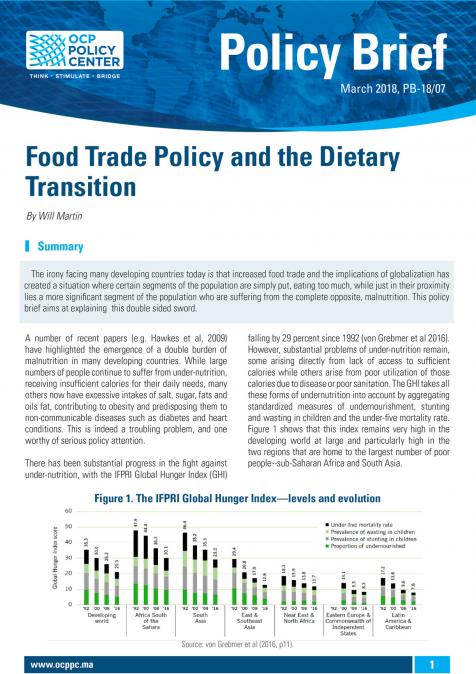
    The irony facing many developing countries today is that increased food trade and the implications of globalization has created a situation where certain segments of the population are simply put, eating too much, while just in their proximity lies a more significant segment of the population who are suffering from the complete opposite, malnutrition. This policy brief aims at explaining this double sided sword. ...
  • Authors
    Mohammed Rachid Doukkali
    Tharcisse Guèdègbé
    December 22, 2017
    L’agriculture africaine a connu dernièrement une croissance relativement élevée, quoique peu résiliente et tirée principalement par l’extensification. Malgré sa diversité, les niveaux de production restent insuffisants pour autonomiser le continent surtout pour ce qui est des produits alimentaires de base. En misant sur l’intégration, des marges de progrès se présentent aux pays africains pour améliorer l’écosystème de l’agriculture africaine et ses performances. Il s’agit de puiser ...
  • Authors
    Will Martin
    December 5, 2017
    The second United Nations Sustainable Development Goal (SDG2) includes the goal to: “End hunger and achieve food security and improved nutrition” by 2030. While such an ambitious goal will clearly involve a wide range of policies and actors, this policy brief focuses on the role of trade policies in affecting food and nutrition security. Extensive and frequently contentious, debate swirls about whether trade in agricultural products is beneficial or detrimental for food security, pa ...
  • Authors
    June 9, 2017
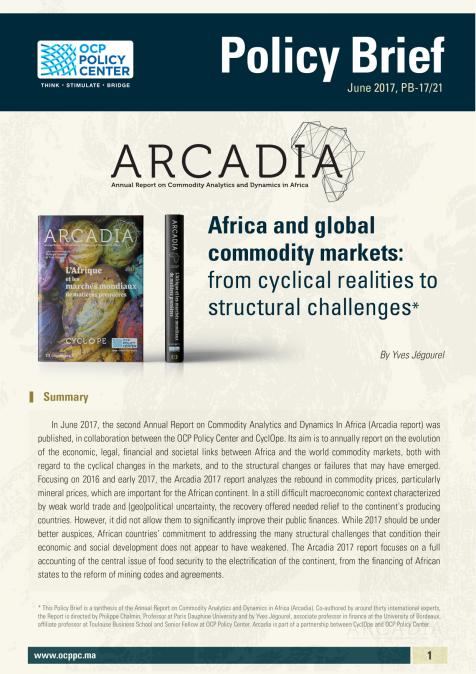
    In June 2017, the second Annual Report on Commodity Analytics and Dynamics In Africa (Arcadia report) was published, in collaboration between the OCP Policy Center and CyclOpe. Its aim is to annually report on the evolution of the economic, legal, financial and societal links between Africa and the world commodity markets, both with regard to the cyclical changes in the markets, and to the structural changes or failures that may have emerged. Focusing on 2016 and early 2017, the Arc ...
  • Authors
    Volume 69, Issue 3
    Introduction by Rabah Arezki
    Yaw Nyarko
    July 14, 2016
    OCP Policy Center and its partners, the International Monetary Fund (IMF), and the Center for Technology and Economic Development (CTED) at the New York University are pleased to announce the publication of a Special Issue on "Food Price Volatility and its Consequences" in Oxford Economic Papers. The papers selected in this special issue were first presented in February 2014 at an international conference organized in Rabat in collaboration with the IMF's Research Department and &n ...
  • Authors
    Under the Supervision of
    Philippe Chalmin
    July 4, 2016
    Guinea’s bauxite, Moroccan phosphates, Nigerian Bonny Light, Zambian copper, Côte d'Ivoire’s cocoa, Ethiopian coffee or Madagascar’s vanilla: all are examples demonstrating that raw materials have a dimension that is as global as it is local. Global by the markets on which they are traded, local by their quality, a key element of their price, and their macroeconomic impact, particularly for Africa. In line with the 2016 CyclOpe report, which celebrates three decades of existence thi ...
  • July 21, 2015
    The 16th Annual Global Development Conference has been dedicated this year to the theme of ‘Agriculture for Sustainable Growth: Challenges and Opportunities for a New ‘Green Revolution’.  One of the sub-themes that has been addressed during this event is related to the design of the optimal agricultural policy supposed to lead towards development, especially in low-income countries. The objective of this blog is to cover the key elements that make an agricultural policy su ...
  • Authors
    Eckart Woertz
    April 10, 2015
    1970s : Oil and wheat are strategic commodities, their prices are skyrocketing, Arab countries declare an oil boycott against the US and the US contemplates to retaliate with a grain embargo. Gulf countries are alarmed and look into a plan to develop Sudan as an Arab breadbasket.  This plan, however, unravels by the 1980s amidst political instability, misguided project designs and alleged corruption amongst the Sudanese (Nimeiri) regime. Instead, Saudi Arabia embarks on a ...