Publications /
Policy Brief

Back
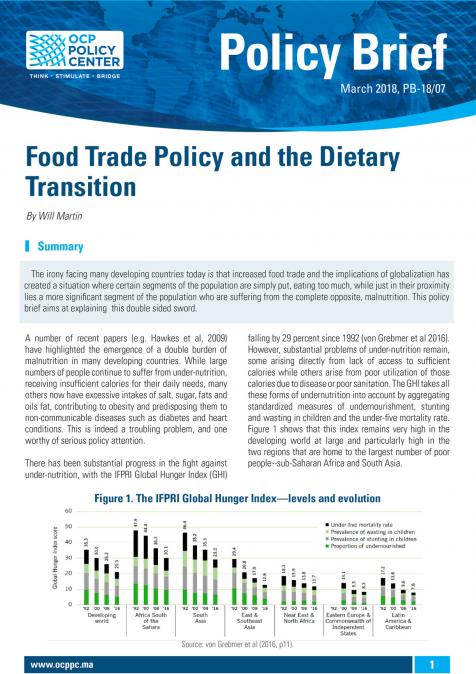
Food Trade Policy and the Dietary Transition
Authors
Will Martin
March 23, 2018

The irony facing many developing countries today is that increased food trade and the implications of globalization has created a situation where certain segments of the population are simply put, eating too much, while just in their proximity lies a more significant segment of the population who are suffering from the complete opposite, malnutrition. This policy brief aims at explaining this double sided sword.

RELATED CONTENT

  • Authors
    Mehran Haghirian
    June 15, 2026
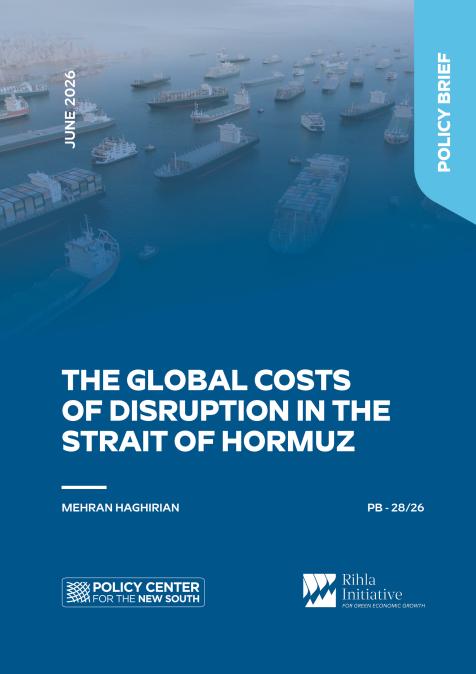
    This article draws in part on perspectives shared by members of the Rihla Initiative for Green Economic Growth, whose regional insights helped inform the sections on how the costs of the war are being felt across the Global South. The war on Iran and in the Gulf has made it impossible to treat the Strait of Hormuz as a regional issue. The disruption around the Strait has moved through the world economy in concrete ways, from higher fuel bills and pressure on food and fertilizer ...
  • June 5, 2026
    Driven by its mission to reflect on and analyze the major geopolitical, economic, and societal transformations shaping the contemporary world, and with a view to contributing to knowledge-sharing and disseminating the main outcomes of its research program, the Policy Center for the New South regularly publishes collective volumes addressing issues of particular importance to Morocco, Africa, and the broader Global/New South. In this spirit, the Center has recently released two volum ...
  • April 10, 2023
    This policy paper examines India’s growing engagement in North Africa, focusing on five countries: Morocco, Algeria, Tunisia, Libya, and Egypt. Despite lacking a distinct regional policy for North Africa, India has amplified its bilateral engagement with these countries, underpinned by a steadfast commitment to the principle of South-South cooperation. Through its strategic moves in North Africa, India has established a powerful southern-west axis for its foreign policy that stretch ...
  • Authors
    November 11, 2022
    If the recent peaceful transfer of power in Madagascar heralds a new trend, then the Malagasy people can dream big. For decades, the exercise of economic-cum-political power in the hands of a tiny elite has held the entire nation hostage. Today, the high poverty rate—around 80% (2021) stands in stark contrast to the natural resource abundance of this huge enormous island. There is hope, however, that with political stability, the Plan d’Émergence Madagascar (PEM) President Andry R ...
  • Authors
    August 30, 2022
    Rwanda is famous for its remarkable socio-economic performance after the ravages of the Genocide against the Tutsis and moderate Hutus in 1994. Under the leadership of President Paul Kagame, Rwanda has followed a state-led development model with stunning results. Despite these substantial accomplishments, Rwanda is still a low-income country with extensive poverty. Its agriculture is still of low productivity and highly vulnerable to climate change. Structural transformation has we ...
  • Authors
    Said El Hachimi
    July 27, 2022
    Sleepless nights and the tireless search for compromise allowed WTO members to agree on concrete deliverables during the WTO 12th Ministerial Conference held last June. Those results reinforce Multilateralism. And this is a significant gain given the multiplicity of global crises that surround us. The Outcome include 6 Agreements, Declarations and Ministerial Decisions that respond to some of today's challenges, notably on Fisheries and Ocean Sustainability as well as responses to P ...
  • May 20, 2022
    Traders have worried that the war involving Russia and Ukraine could stoke inflation, further disrupt supply chains and derail the global economic recovery. Scarcity of food has led ...
  • Authors
    May 18, 2022
    The world food price index collected for the last 60 years by the United Nations Food and Agriculture Organization (FAO) hit its highest record in March, declining gently in April. Pandemic, war and death in Ukraine, and droughts in the last 2 years… Such a combination looks apocalyptical. Now it is adding global hunger risks, because of the food price crisis. The rise in global food prices started in mid-2020 because supply chain disruptions triggered food stockpiling. Mobility r ...
  • Authors
    November 26, 2020
    Food security for all requires (i) sustained productivity growth and competitiveness, not only of agriculture but of the entire economy; (ii) a social safety net; and (iii) resilience in the face of periodic shocks. This is the central message of this review. Two popular concepts in food security for all are food self-sufficiency (FSS) and food sovereignty (FSY). While countries have pursued different policies to achieve FSS, the common element in their approaches is the misguided ...
  • August 1, 2018
    “This article has been originally published in 'Morocco in Focus 2018,' the magazine of the Moroccan Embassy in New Delhi, India on the occasion of the Morocco National Day 2018.” Introduction In an article published last year, the author stressed the role of partnership between Morocco and India for the inclusive growth of small farmers. There is no doubt that agriculture remains a major instrument for human development both in India and in Africa. Several international reports&n ...