( FR ) Plenary III: Energy and Climate

December 13, 2019

Moderator Uduak Amimo, Uduak Amimo Coaching and Consulting Speakers André Caillé, Senior Strategic Advisor, Junex R. Andreas Kraemer, Founder and Director Emeritus, Ecologic Institute Thione Niang, Co-Founder and Co-CEO, Akon Lighting Africa Francis Perrin, Senior Fellow, Policy Center for the New South

Speakers
Francis Perrin
Senior Fellow
Francis Perrin is a Senior Fellow at the Policy Center for the New South who focuses on energy.  Following studies in economics and political science at the University Pierre Mendès France (UPMF – today University Grenoble Alpes) at Grenoble (France), Francis Perrin worked for several years as a journalist and freelance consultant on energy and mining resources before joining in 1991 the Paris-based Arab Petroleum Research Center (APRC). He was editor in chief of Arab Oil & Gas (AOG) and Pétrole et Gaz Arabes (PGA) between 1991 and 2000 and editorial manager of the publications of the APRC from 2001 to the end of 2011. Francis Perrin set up at the beginning of 2012 Stratégies et Politiques Energétiques (SPE) and later Energy Industries Strategies Information (EISI).& ...

  • June 15, 2026
    As part of the OECD Multilateral Development Finance Week 2026 (MDF Week), the Policy Center for the New South (PCNS) is organizing a webinar entitled “Rethinking Development Finance: African Agency and the Future of Multilateral Development Co-operation after ODA Retrenchment.” The dis...
  • June 3, 2026
    Cet épisode met en lumière les défis et perspectives du secteur halieutique marocain à travers l’analyse du Pr. Abdelkabir Kamili. Il souligne que la durabilité des ressources marines n’est pas un frein à la croissance économique, mais une condition essentielle pour garantir la performa...
  • May 29, 2026
    This Paper was originally published on tandfonline.com This paper examines how reductions in transportation costs reshape regional economic and environmental outcomes in Morocco. We simulate a reduction in delivered (purchasers’) costs via a transport-margin efficiency improvement – implemented as a margin-saving technical change in the transport sector – within a province-level Spatial Computable General Equilibrium (SCGE) framework. Simulating a 1% decline in transport costs, ...
  • Authors
    Jorge Arbache
    May 14, 2026
    Decarbonization is reconfiguring global relative prices. As clean energy, natural capital, and location-specific assets become dominant industrial inputs, the relative cost of producing low-carbon goods is increasingly determined by geography. Two systematic distortions explain why the expected reallocation of investment toward renewable-rich economies remains incomplete. First, industrial policy interventions, including subsidies, trade barriers, and certification systems, disconne ...
  • Authors
    April 28, 2026
    Climate policy is increasingly reshaping the conditions under which firms participate in international markets. As some jurisdictions introduce carbon border adjustments, lifecycle emissions standards, and supply-chain traceability requirements, market access is starting to be made conditional on verifiable characteristics of production processes, such as carbon intensity, embedded emissions, and input sourcing, rather than solely on product characteristics or prices. This paper exa ...
  • Authors
    April 23, 2026
    The call for private finance mobilization received an answer in 2024, with private capital accounting for 66% of total flows in climate finance, while still reaching a record level. This flow of private finance represents a structural shift that can both be considered as a significant achievement and an underexamined governance risk. This paper argues that the growth of private climate finance, while real and consequential, does not always directly serve climate objectives. Pri ...
  • Authors
    April 17, 2026
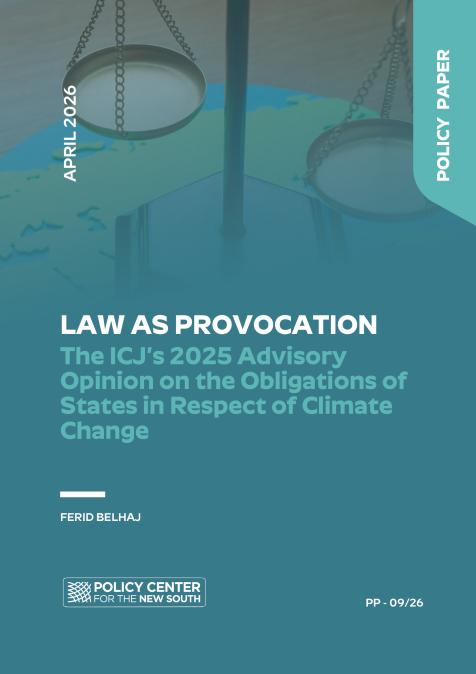
    The International Court of Justice’s (ICJ) 2025 advisory opinion on climate change marks a significant expansion of international law into the governance of global public goods. By framing climate inaction as a potential violation of international law and human rights, the Court advances a progressive legal agenda that extends beyond existing political consensus and enforcement capacity. This article develops a realist critique of the ruling that avoids both legal romanticism and ni ...
  • April 9, 2026
    Cet entretien explore le Nexus Eau-Énergie-Alimentation comme un défi systémique majeur pour le Maroc, dans un contexte de rareté croissante des ressources et de pressions sur la souveraineté. Il met en lumière les interdépendances critiques entre ces trois secteurs et les limites d’app...
  • March 30, 2026
    L’épisode explore les mutations profondes du secteur énergétique mondial, marqué par une transition complexe entre crise des prix et crise des systèmes. Après une période de tensions extrêmes sur les coûts de l’énergie (pétrole, charbon, gaz), 2025-2026 marque un tournant : les prix se ...