(FR) Phosphate and Fertilizer Industry in Morocco

April 15, 2026

Cet épisode explore l’industrie des phosphates au Maroc, qui abrite 70 % des réserves mondiales et est portée par le Groupe OCP. De son leadership mondial dans les engrais à un repositionnement stratégique vers l’Afrique, OCP soutient la transformation agricole et la création de valeur. Les investissements dans l’ammoniac vert, les énergies renouvelables et les technologies illustrent des efforts en faveur de la durabilité et de l’indépendance énergétique. À travers la Fondation OCP, l’innovation et la recherche à l’Université Mohammed VI Polytechnique renforcent davantage l’empreinte économique et scientifique du Maroc.

Speakers
Henri-Louis Védie
Senior Fellow
Henri Louis Vedie is a Senior Fellow at Policy Center for the New South. Holding a doctorate in economic sciences from Dauphine University Paris, and a graduate in Law from Université Paris I, Henri-Louis Vedie is also Professor Emeritus at HEC Paris, where he teaches in the Paris campus as well as Moscow, Varsovia, Belgrade, Abu Dhabi, Rabat, and more.  Author of sixteen books, of which the last few concerned Morocco and sovereign funds, hundreds of articles (of which some where translated in English, French, Arabic, Polish and Russian), Henri-Louis Vedie was also a consultant for the European Council and a member of the Economic, Social and Environmental board in Paris. ...
Sabrine Emran
Senior Economist
Sabrine Emran is a Senior Economist at the Policy Center for the New South (PCNS).At the PCNS, Sabrine Emran conducts research on the Energy Transition, Climate Finance, and Critical Minerals, focusing on the energy priorities of developing countries in the context of sustainable development, just energy transition, and global climate commitments.Before joining the PCNS in 2022, Sabrine Emran worked as a Commodities Analyst and Risk Management Consultant, specializing in agricultural and energy commodities as well as foreign exchange risk. She also held a position at Lyxor Asset Management as Request for Proposal and Product Specialist, where she focused on alternative investment asset classes and collaborated closely with institutional investors.Sabrine Emran holds a master’s ...

RELATED CONTENT

  • Authors
    Chami Abdelilah
    Derj Atar
    Hammi Ibtissem
    Morazzo Mariano
    Naciri Yassine
    with the technical support of AFRY
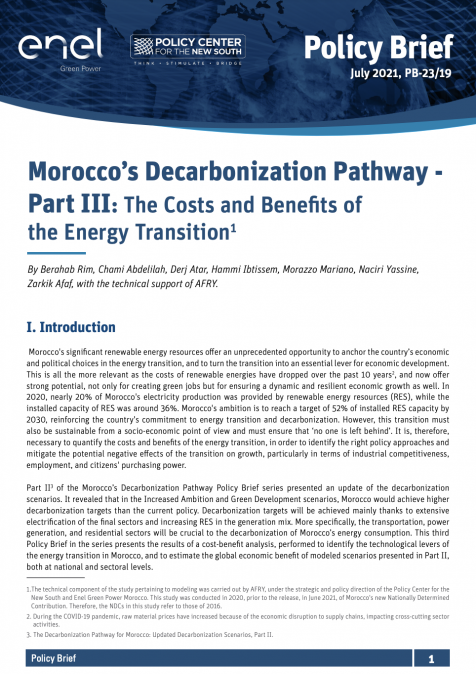
    July 9, 2021
    Les importantes ressources en énergies renouvelables du Maroc offrent une opportunité sans précédent d’ancrer les choix économiques et politiques du pays dans la transition énergétique, et de faire de cette transition un levier essentiel du développement économique. Ceci est d’autant plus important que le coût des énergies renouvelables a baissé au cours des 10 dernières années2 et présente désormais un fort potentiel, non seulement de création d’emplois verts mais aussi de croissan ...
  • Authors
    Chami Abdelilah
    Derj Atar
    Hammi Ibtissem
    Morazzo Mariano
    Naciri Yassine
    with the technical support of AFRY
    July 9, 2021
    Les conséquences du changement climatique sont de plus en plus visibles au Maroc. Le schéma changeant des précipitations et de la sécheresse, l'augmentation des températures moyennes et des canicules, les inondations et l'augmentation du niveau de la mer affectent de plus en plus de nombreuses régions. Et pourtant, le taux d'émission de gaz à effet de serre (GES) du Maroc est relativement faible, comparé à celui d'autres pays. En 20162, les émissions totales de GES du Maroc ont atte ...
  • Authors
    Chami Abdelilah
    Derj Atar
    Hammi Ibtissem
    Morazzo Mariano
    Naciri Yassine
    with the technical support of AFRY
    July 9, 2021
    The consequences of climate change are becoming progressively more visible in Morocco. Changes in rainfall patterns and drought, increases in average temperatures and heatwaves, flooding, and rising sea levels are increasingly affecting several regions. Yet, Morocco has a relatively low greenhouse gas (GHG) emission rate, compared to other countries. In 20162, Morocco’s total GHG emissions reached 86127.7 gigagram of carbon dioxide equivalent (Gg CO2-eq), totaling around 0.2% of glo ...
  • Authors
    Chami Abdelilah
    Derj Atar
    Hammi Ibtissem
    Morazzo Mariano
    Naciri Yassine
    with the technical support of AFRY
    June 28, 2021
    Lors de la Conférence des Parties à la Convention-cadre des Nations unies sur les changements climatiques (CCNUCC) qui s'est tenue à Paris en 2015, les gouvernements se sont engagés à limiter l'augmentation de la température mondiale à un niveau bien inférieur à 2°C par rapport aux niveaux préindustriels. Ils se sont également engagés à atteindre, dès que possible, un pic de leurs émissions et à parvenir à la neutralité carbone au cours de la seconde moitié du siècle. Pour autant, m ...
  • Authors
    Chami Abdelilah
    Derj Atar
    Hammi Ibtissem
    Morazzo Mariano
    Naciri Yassine
    with the technical support of AFRY
    June 28, 2021
    During the 2015 Paris Conference of the Parties to the United Nations Framework Convention on Climate Change (UNFCCC), governments pledged to limit the global temperature increase to well below 2°C above pre- industrial levels, to peak emissions as soon as possible, and to achieve carbon neutrality in the second half of the century. Yet, even assuming full implementation of the commitments made by governments in Paris, the global concentration of greenhouse-gas (GHG) emissions will ...
  • June 2, 2021
    Otaviano Canuto, Policy Center for the New South The conceptual framework of natural wealth that we approached in the previous video may be illustrated with cases drawn from Sub-Saharan Africa. With at least 250 million inhabitants in resource-rich African countries, natural assets are ...
  • Authors
    In collaboration with Chelsea Johnson
    May 19, 2021
    Africa is endowed with abundant mineral resources, including gold, silver, copper, uranium, cobalt, and many other metals which are key inputs to manufacturing processes around the world. The mining and extractive sector has contributed and continues to contribute a significant share of Africa’s exports, revenue and GDP annually. In 2019, minerals and fossil fuels accounted for over a third of exports from at least 60% of African countries. Additionally, 42 out of 54 African countri ...
  • Authors
    April 27, 2021
    With a population of approximately 200 million, Nigeria accounts for about half of West Africa's population and has one of the largest concentrations of young people in the world. Endowed with abundant natural resources, Nigeria is one of Africa's largest oil exporters, with an estimated 37 billion barrels of proven crude oil reserves, the majority of which are found in the Niger River Delta and offshore in the Bight of Benin, the Gulf of Guinea and the Bight of Bonny. Nigeria also ...
  • March 17, 2021
    Cette étude concerne la Communauté économique des Etats d'Afrique de l'Ouest (CEDEAO), rappelant, tout d'abord, leur diversité géographique, démographique et économique. Montrant ce que ces Etats ont en commun mais, aussi, ce qui les différencie. La CEDEAO, qui réunit quinze pays parmi les plus pauvres de la planète, si on se réfère à leur PIB par habitant, en dollar courant ou en parité de pouvoir d'achat/PPA/. Ce qui explique une démographie explosive, sans que l'on puisse dire si ...
  • Authors
    December 7, 2020
    The pandemic is accelerating history, in the sense that it is leading to the speeding up of some recent trends. In the case of globalization, the pandemic will not reverse it, but it will reshape it. Here we take a bird’s eye view of global trade during the pandemic, relate it to previous trends, and guess how global value chain managers and government trade policymakers are likely to react. A Bird’s Eye View of Global Trade during the Pandemic World trade took a deep dive during ...