
As the African continent grapples with a new generation of complex and interconnected threats, ranging from violent extremism and transnational crime to governance-related tensions and climate-induced insecurity, Southern Africa is also called upon to reinforce its contribution to continental peace and security. While the region has traditionally maintained a strong reputation for stability, emerging challenges are testing the limits of existing mechanisms and requiring renewed political engagement. This conversation will explore the strategic role of Southern African leadership in shaping and operationalizing the African Peace and Security Architecture (APSA). It will examine how SADC, alongside national governments, can further align with APSA’s core pillars, early warning, preventive diplomacy, peace support operations, and post-conflict reconstruction, while upholding the principles of subsidiarity and regional ownership. Special attention will be given to how diplomacy, cooperation, and institutional coordination can help translate commitments into concrete impact on the ground.
Speakers
RELATED CONTENT
-
 February 03, 2023Les dirigeants de l’Union européenne et de l’Union africaine ont posé lors du 6ème sommet UE-Afrique qui avait eu lieu à Bruxelles en février 2022 les jalons d’une relation renouvelée, ba ...
 -
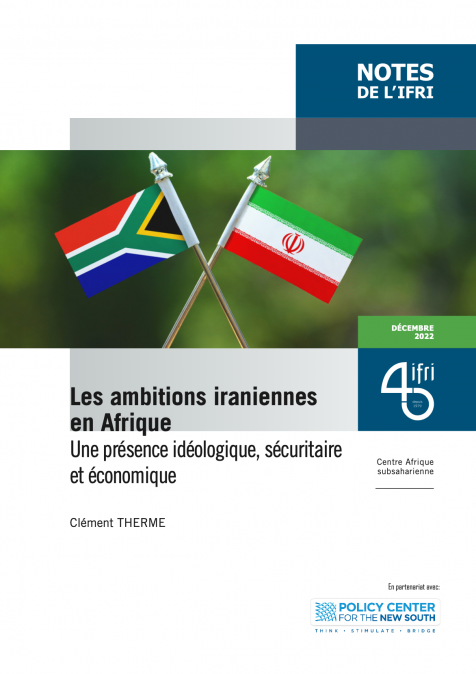 December 23, 2022La présence iranienne en Afrique est une question à la fois idéologique, économique et sécuritaire. La politique africaine de l’Iran a connu un nouvel élan avec la Révolution de 1979. Dans le cas de la politique africaine, on peut qualifier ce tiers-mondisme militant d’arrogant. Eneffet, dans l’imaginaire des élites politiques révolutionnaires khomeynistes, les relations avec les pays du Sud global sont à comprendre non seulement dans le cadre d’un anti-impérialisme de fa ...
 -
 December 9, 2022The global wave of democratic retrenchment has not spared North Africa as seen in the cases of Tunisia and Sudan, where democratic transitions have stalled or regressed into autocracy. How do to explain Tunisia and Sudan’s troubled transitions from authoritarian rule? Both states are attempting to transition from single-party authoritarianism. In both cases, economic crises exacerbated by COVID, the Russian-Ukraine war, and involvement by external actors stymied the fragile transiti ...
 -
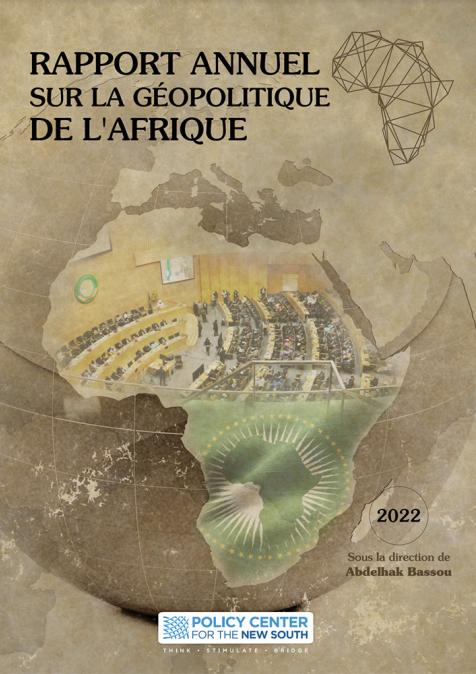 November 1, 2022Dans cette nouvelle édition du Rapport annuel sur la géopolitique de l’Afrique, et à l’instar des éditions précédentes, le maître-mot est la richesse dans la diversité. Une diversité dans les visions et les opinions que des auteurs africains, habitués de cette tribune où qui la découvrent, alimentent en exprimant leurs réflexions sur des questions clés qui intéressent leur continent : l’Afrique. Du cadre social, à celui militaire en passant par les contextes historiques, anthropolo ...
 -
 October 27, 2022Dans cette édition spéciale, le Général Mohamed Znagui Sid’Ahmed Ely décrypte les approches de contre terrorisme au niveau national et régional et appuie sur l'importance des approches collectives tel que le G5 Sahel pour l'endiguement de l'expansion de la menace terroriste. ...
 -
 October 21, 2022The sixth African Peace and Security Annual Conference (APSACO) was held on July 20-21, 2022, under the theme 'African Security in Times of Uncertainties'. The two-day event was composed of five panels and one report discussion. • Panel 1: The Impact of the Russia-Ukraine War on Africa • Panel 2: Conflict Resolution and w in Africa • Panel 3: The Worsening of the Food-Security Challenge in Africa • Panel 4: Security Implications of Climate Change in Afr ...
 -
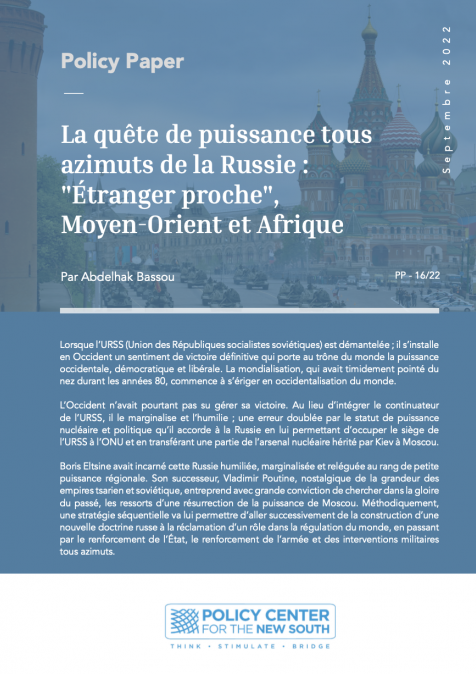 September 30, 2022Lorsque l’URSS (Union des Républiques socialistes soviétiques) est démantelée ; il s’installe en Occident un sentiment de victoire définitive qui porte au trône du monde la puissance occidentale, démocratique et libérale. La mondialisation, qui avait timidement pointé du nez durant les années 80, commence à s’ériger en occidentalisation du monde. L’Occident n’avait pourtant pas su gérer sa victoire. Au lieu d’intégrer le continuateur de l’URSS, il le marginalise et l’ ...
 -
September 20, 2022 أصدر مركز السياسات من أجل الجنوب الجديد النسخة الخامسة للتقرير السنوي للجيوسياسة الإفريقية بنقاط قوتها ومعيقاتها، بمميزاتها وعيوبها، ما يجب تصحيحه وإعادة تنظيمه، وما يجب صيانته وتقويته وتوطيده. تدور الأسئلة التي تم تناولها من خلال التقرير حول جهات القارة الافريقية بين الأمن و ال...
-
August 12, 2022Maritime security in Africa is evolving rapidly and is therefore driving innovations in the maritime security architecture, offering itself to increased regional coordination. More than 9 ...
-
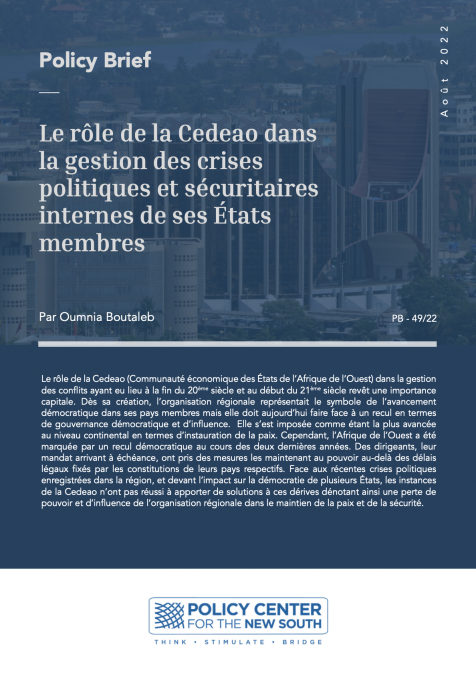 August 11, 2022Le rôle de la Cedeao (Communauté économique des États de l’Afrique de l’Ouest) dans la gestion des conflits ayant eu lieu à la fin du 20ème siècle et au début du 21ème siècle revêt une importance capitale. Dès sa création, l’organisation régionale représentait le symbole de l’avancement démocratique dans ses pays membres mais elle doit aujourd’hui faire face à un recul en termes de gouvernance démocratique et d’influence. Elle s’est imposée comme étant la plus av ...

