Publications /
Policy Paper

Back
The Economic and Human Cost of the War on Iran: The Arab Countries Pay More
Authors
October 13, 2026

“Every gun that is made, every warship launched, every rocket fired signifies in the final sense, a theft from those who hunger and are not fed, those who are cold and are not clothed.”

President Dwight Eisenhower, April 16, 1953


This policy brief examines the economic and human impacts of the first six months of the Iran war—from February to the end of August 2026—on Iran’s Arab neighbors and compares these impacts with those on the three countries directly involved—Iran, Israel and the United States. It reaches the surprising conclusion that Iran’s Arab neighbors have borne a higher cost than the three belligerents combined. For the purposes of the analysis presented here the Arab neighbors of Iran are divided into two groups: the three fragile and conflict-affected countries (FCS) with strong Iranian-allied militias—Iraq, Lebanon and Yemen—and the six Gulf Cooperation Council (GCC) countries—Bahrain, Kuwait, Oman, Qatar, Saudi Arabia, and the United Arab Emirates (UAE). Each group separately has borne higher economic losses from the war than the three belligerents combined. 

This analysis has two policy implications for the GCC countries. First, on the geopolitical front, the GCC countries, which host American military bases and provide support to US forces, could negotiate agreements with their American partners to ensure that they are consulted and given a voice in decision-making processes affecting war and peace in their region. Second, they need to continue investing in oil pipelines and other transport facilities to avoid dependence on a single geographic chokepoint—whether the Strait of Hormuz, Bab El Mandeb, or the Suez Canal—for their exports and imports.

The three FCS countries have borne heavy relative costs, at a time when their economies and societies are facing enormous challenges. This is especially true of Lebanon, where the cost of the war could exceed twice the country’s GDP. It is time for the international community, perhaps led by the Arab League, to help these countries address the economic, social and political drivers of fragility. A stable and prosperous Lebanon, Iraq and Yemen would clearly benefit their populations, as well as the region and the rest of the world.

The policy brief is divided into six sections. Section 1 presents the analytical framework used to assess the cost of war. Sections 2, 3 and 4 present the costs incurred by the three belligerents, by the three FCS countries and by the GCC, respectively. Section 5 compares the results across countries and presents evidence that the Arab countries’ losses may be even greater than those of Iran. Section 6 concludes with the policy implications arising from the analysis.
RELATED CONTENT

  • Authors
    July 16, 2021
    The BDA Currents: Where Diplomacy Meets Business, is the Brussels Diplomatic Academy’s annual report covering the wider geopolitical and other factors influencing and affecting the world of diplomacy, international relations and global business. The journal focuses on issues of topical interest around the centers of global power, influence and importance, including the continents of Europe and Africa, the Middle East, China, India & Asia, Russia and the Commonwealth of Independe ...
  • Authors
    Amine Benbernou
    Dorothée Schmid
    July 9, 2020
    Middle Eastern geopolitics is currently undergoing structural changes: the regional order is in transition in the aftermath of the Arab Spring that undermined authoritarian governance, and triggered the competition for power against a backdrop of American withdrawal. This new race for regional domination challenges the traditional hierarchy of powers that is mainly based on military capacity and the interplay of foreign alliances. The economy, which had previously guaranteed the pol ...
  • April 29, 2020
    La transition politique de l’Égypte, depuis 2011, a été tout aussi turbulente que sa transition économique. Tous les efforts de l’Egypte post-Moubarak se sont articulés autour de la relance économique, la stabilisation macroéconomique et politique et du renforcement de la sécurité interne du pays. Suite à l’accord avec le Fonds monétaire international (FMI), en 2016, l’Egypte a mené plusieurs réformes économiques qui ont, pu relancer la croissance économique et donner des résultats ...
  • Authors
    January 20, 2020
    Le 3 octobre 2016, la Turquie a déposé une plainte contre le Maroc devant l’Organisation Mondiale du Commerce (OMC) au sujet des mesures antidumping appliquées par le Maroc contre les exportations turques en Acier laminé à chaud.1 Suite à l’échec des consultations entre les deux pays, la Turquie a demandé, le 12 janvier 2017, l’établissement d’un groupe spécial pour examiner la conformité des mesures prises par le Maroc avec le droit de l’OMC. Demande qui marque le passage du litige ...
  • Authors
    January 15, 2020
    “The Nightmare we feared has arrived” Death was late because the departure time of the plane was delayed. But death arrived- six minutes after takeoff from Tehran’s “Imam Khomeini International Airport. It was still dark, 6.12 hours’ local time, when flight 752 of “Ukraine International Airlines” took course toward Kyiv, the Ukraine capital three hours and fourty two minutes away. The Boeing 737 800 NG had reached 2400 meters, when the American military’s “Space Based Infrared ...
  • Authors
    Simone Tagliapieta
    Marion Jansen
    Yassine Msadfa
    Mario Filadoro
    August 28, 2017
    Endowed with half of the world’s known oil and gas reserves, the Middle East and North Africa (MENA) region became – particularly during the second half of the twentieth century – a cornerstone of the global energy architecture (Yergin, 1991, 2011; Maugeri, 2006). This architecture is currently undergoing a structural transformation, prompted by two different forces: decarbonisation policies and technological developments. The adoption and quick entry into force of the Paris Agreem ...
  • Authors
    Russel Dinh
    January 27, 2016
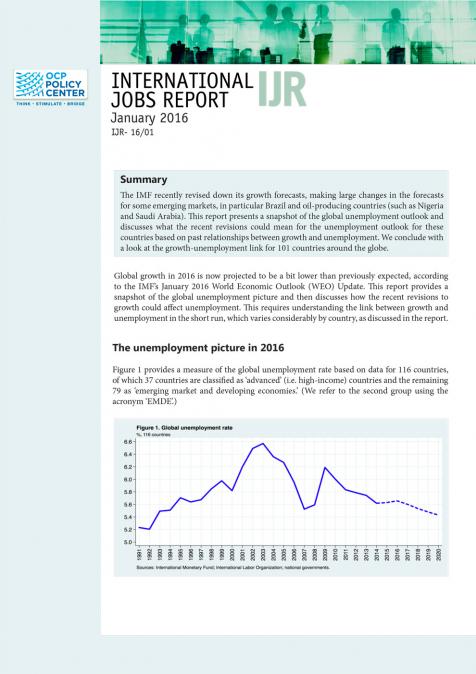
    The IMF recently revised down its growth forecasts, making large changes in the forecasts for some emerging markets, in particular Brazil and oil-producing countries (such as Nigeria and Saudi Arabia). This report presents a snapshot of the global unemployment outlook and discusses what the recent revisions could mean for the unemployment outlook for these countries based on past relationships between growth and unemployment. We conclude with a look at the growth-unemployment link f ...
  • Authors
    December 7, 2015
    The Euro-Mediterranean Partnership was initiated with the aim to build a space of shared prosperity and security among all the countries in the region. The achievement of this objective, however, continues to be challenged by several geopolitical, economic and social factors. In such a context, there is now a greater urgency to adapt the approach and the instruments, thus allowing Euro-Mediterranean partners to seize opportunities towards an effective area of shared stability and pr ...
  • Authors
    Kassim Bouhou
    September 17, 2010
    Before the 9/11 events, US-Maghreb relations were growing stronger, especially after the United States had long left the floor to the Maghreb’s “natural” European partner. Therefore the American action in this region was in line with a mechanism previously set off by Clinton Administration member, Stuart Eizenstat, which aimed at reducing intra regional obstacles and stimulating American investments towards an area where Americans were little-represented. Hence Washington seemed mor ...
  • From

    26
    5:30 pm May 2026
    تعالج هذه الحلقة تصاعد التوترات حول مضيق هرمز وانعكاساتها على استقرار أسواق الطاقة العالمية، في ظل عالم يشهد تحولات جيوسياسية متسارعة. وتناقش كيف كشفت الأزمة هشاشة نظام الطاقة الدولي واعتماده على ممرات استراتيجية حساسة، كما تتوقف عند تداعيات أي اضطراب محتمل على أسعار النفط والتضخم والنمو الاقتصادي العالمي. وتسعى الحلقة إلى فهم ما إذا كان العالم يعيش أزمة ظرفية أم بداية تفكك تدريجي للنظام الطاقي الذي حكم العقود الماضية  ...