Podcasts

Back

India’s Foreign Policy

18
December 2014
Dhruva Jaishankar

This podcast is performed by Dhruva Jaishankar. India has had several stages to its foreign policy since its independence. This included active international engagements in the 1950s, isolations and regional rivalries in the 1960s, closer cooperation with the Soviet Union in the 1970s, and gradually closer relations with the United States beginning in the late 1990s. Today, India’s foreign policy can be characterized primarily by a quest for security, for economic development, and for autonomy of action. India also seeks greater influence in multilateral forums, whether the United Nations, BRICS, or G20. The three most important bilateral relationships are with the United States, Pakistan, and China. Relations with important smaller actors (Singapore, Israel, and South Korea), complex ties in the Middle East (with Iran, Saudi Arabia, and Israel), and major secondary powers (Japan, Europe, Australia, Brazil, Russia). New trends are radically changing India’s international engagements. New priorities include sourcing foreign direct investment and utilizing India’s large and wealthy diaspora. This also means that new actors - including businesses, NGOs, and the media - are influencing foreign policy in novel ways.

RELATED CONTENT

  • September 25, 2026
    In this episode, Senior Fellow Ian Lesser examines the United States’ longstanding ties with the Mediterranean as the country marks its 250th anniversary. He discusses how a possible shif ...
  • Authors
    Marianna Albuquerque
    September 23, 2026
    The author of this opinion, Marianna Albuquerque, is a 2022 alumna of the Atlantic Dialogues Emerging Leaders Program.As world leaders gather in New York for the 81st United Nations General Assembly, climate change returns to the center of multilateral diplomacy under markedly different circumstances. The debate is no longer confined to whether the world must decarbonize, but increasingly centers on how the transition will happen, who will bear its costs, who will capture ...
  • Authors
    September 23, 2026
    Depuis 2010, environ, on sait que la Méditerranée orientale est une nouvelle province gazière. Des ressources gazières ont en effet été découvertes au large de quatre pays ou territoires, l’Égypte, Israël, Chypre et Gaza. Deux d’entre eux sont devenus producteurs et exportateurs de gaz naturel, l’Égypte et Israël. Au large de Gaza, le champ gazier de Gaza Marine n’a jamais été développé et il est très peu probable qu’il le soit prochainement en raison des très fortes tensions entre ...
  • Authors
    September 17, 2026
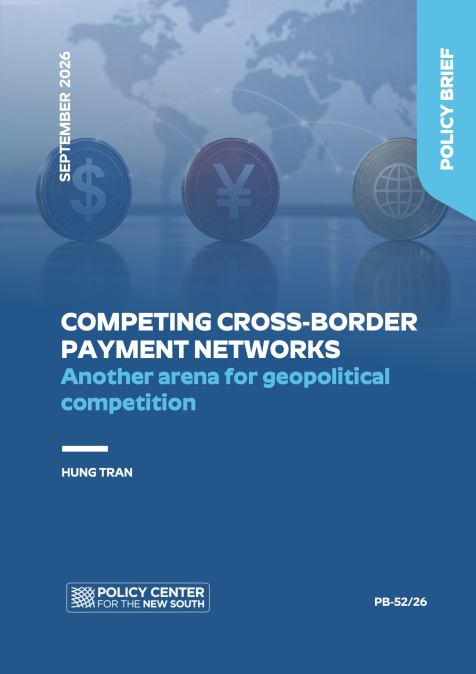
    Various competing cross-border payment networks have become vehicles for geopolitical competition. As tensions have risen, many countries want to secure access to cross-border payment systems by joining with like-minded countries to form interoperable networks, either via tokenization or Instant Payment Systems (IPSs). Three major projects are under development, serving the strategic interests of the US, China and the Rest of the World—corresponding to the three trading spheres taki ...
  • September 16, 2026
    Much of Western debate was revealingly silent on the Shanghai Cooperation Organization (SCO) summit, which took place on August 31 and September 1 in Bishkek, Kyrgyzstan. That relative silence reflects how poorly the organization’s growing significance is still understood. The meeting has not gone unreported. Any gathering of Xi Jinping, Narendra Modi, and Vladimir Putin inevitably attracts&nbs ...
  • Authors
    Stephan Klingebiel
    Andy Sumner
    September 4, 2026
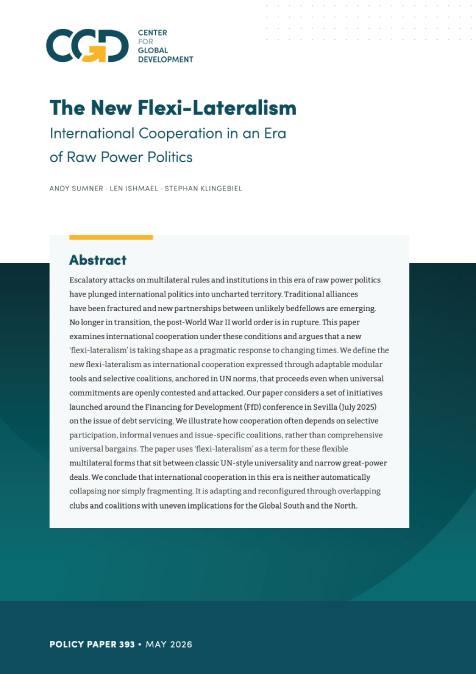
    This Paper was originally published on cgdev.org. Escalatory attacks on multilateral rules and institutions in this era of raw power politics have plunged international politics into uncharted territory. Traditional alliances have been fractured and new partnerships between unlikely bedfellows are emerging. No longer in transition, the post-World War II world order is in rupture. This paper examines international cooperation under these conditions and argues that a new "flexi-l ...
  • August 25, 2026
    Predictions of American decline have become increasingly prevalent. The United States has run persistent trade deficits for decades, but its public debt now exceeds its annual economic output. Meanwhile, and new centers of industrial and technological power continue to emerge across Asia. Yet despite these developments, no country has so far replaced the United States as the main organizing power of the international economy. Conventional explanations explain this in terms of U.S. m ...