Special PCNS - UN75: Are Development challenges really intractable?

October 22, 2020

To commemorate the 75th anniversary of the United Nations, the Policy Center for the New South is pleased to organize a series of webinars to discuss key themes related to the role of the UN on the international scene. Moderator : Eduardo Amaral Haddad, Senior Fellow, Policy Center for the New South Speakers : Chidiogo Akunyili, Founder, She Roars (ADEL Alumna) Doreen Mashu, Development Consultant/Founder, The Good Heritage (ADEL Alumna) Mouhamadou Ly, Senior Economist, Policy Center for the New South

Speakers
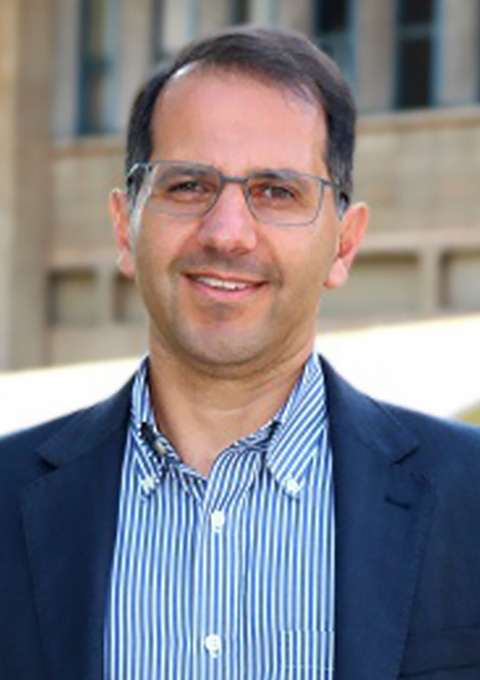
Eduardo Amaral Haddad
Senior Fellow
Eduardo A. Haddad is Full Professor at the Department of Economics at the University of São Paulo, Brazil, where he directs the Regional and Urban Economics Lab (NEREUS). He is additionally a Affiliate Professor at the Faculty of Governance, Economic and Social Sciences of the Mohammed VI University. He also holds a position as Affiliate Research Professor at the Regional Economics Applications Laboratory – REAL – at the University of Illinois at Urbana-Champaign, USA. He is a Senior Fellow at the Policy Center for the New South, Rabat, Morocco. Prof. Haddad has published widely in professional journals on regional and interregional input-output analysis, computable general equilibrium modeling, and various aspects of regional economic development in developing countries; he ...

Mouhamadou Moustapha Ly
Economist, African Department of the International Monetary Fund (IMF)
Currently economist within the African Department of the International Monetary Fund in Washington DC, where he works on East African economies on various macroeconomic policy subjects and surveillance, he is also an affiliate professor of economics at Mohamed-6 Polytechnic university in Rabat (Morocco). Prior to that, Mouhamadou was senior economist at the Policy Center for the New South in Rabat (Morocco) working on development related issues and regional integration in the African continent. Mouhamadou also spent several years as assistant professor at Gaston Berger university in Saint-Louis (Senegal) and a lecturer at Auvergne university (France) and City university (London). He also worked as research fellow at the African Center for Statistics in the United Nations Econo ...
RELATED CONTENT

  • Authors
    July 28, 2026
    The term “K-shaped recovery” was introduced to describe the economic recovery from the recession triggered by the Covid-19 pandemic. It refers to the uneven and divergent growth pattern between leading industries or sectors (the upper arm of the letter K—mainly the high-technology sector) and laggards, or the rest of the economy (the lower arm—the traditional industries). Since then the term has become popular in portraying divergent growth patterns within and between countries, esp ...
  • Authors
    July 16, 2026
    Thanks to the AI investment boom, the U.S. economy has performed well at the macroeconomic level. However, it is on an unsustainable fiscal and debt path. Mr. Trump’s fiscal policy in his second term has aggravated this trajectory. In turn, Mr. Trump’s tariff-based trade policy has failed to address what he sees as U.S. economic problems associated with the trade balance. Besides explaining why this has been the case, and what its implications are for the U.S. economy and the r ...
  • July 10, 2026
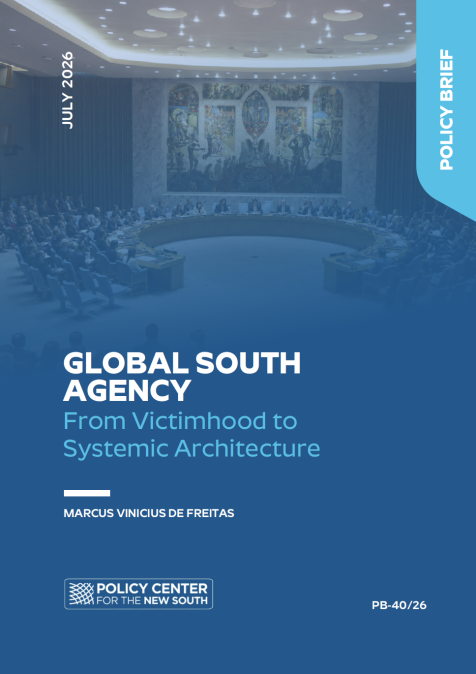
    For much of the post-war period, the Global South was framed as an object of history, defined by dependency, constrained by structural asymmetries, and confined to the margins of global decision-making. That narrative, once empirically grounded, is now no longer adequate. A profound yet uneven transformation is underway. The Global South is no longer only reacting; it is increasingly shaping rules, institutions, and narratives.This Policy Brief argues that the Global South is thus t ...
  • July 6, 2026
    Cette interview explore les grands enjeux de l’urbanisation au Maroc, en mettant l’accent sur les défis de gouvernance, de planification et de politiques publiques. Elle revient sur l’évolution des modèles de développement urbain, les effets du changement climatique sur les villes, ains...
  • July 3, 2026
    Este Policy Paper también ha sido publicado en inglés y francés por Le Grand Continent La economía marroquí constituye un caso ilustrativo entre las economías de renta media, en un contexto marcado por una creciente fragmentación del entorno internacional, un crecimiento mundial anémico y una desaceleración de la convergencia. Desde 2022, su trayectoria se caracteriza por una relativa solidez, con un crecimiento superior a la media de las economías de la misma categoría. Superi ...
  • July 3, 2026
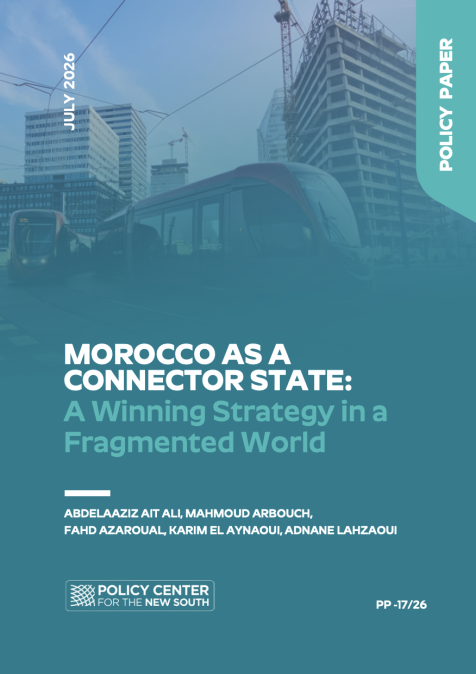
    This Policy Paper has also been published in French and Spanish by Le Grand Continent Morocco offers a compelling example of how a middle-income economy can navigate a more fragmented global environment, characterized by weak growth and slower convergence. Since 2022, economic activity has remained relatively strong, with growth exceeding that of many comparable economies. Non-agricultural growth has averaged 4.4% since 2022, around 1.3 percentage points above its historical av ...
  • July 3, 2026
    Ce Policy Paper a également été publiée en anglais et en espagnol par Le Grand Continent Le Maroc offre un exemple éclairant parmi les pays à revenu intermédiaire, dans un contexte marqué par une fragmentation croissante de l’environnement international, une croissance mondiale atone et un ralentissement de la convergence. Depuis 2022, sa trajectoire se distingue par une certaine robustesse, avec un rythme d’expansion supérieur à celui des autres économies de même catégorie. Dé ...
  • Authors
    June 30, 2026
    The inventory is worrisomely low The US military has fired off more than 1000 Tomahawk cruise missiles, roughly ten times the number it currently buys each year. The Pentagon used more than 1200 Patriot interceptor missiles, "more than three million dollars a pop", and more than 1000 precision strike, ground based missiles, "leaving the inventories worrisomely low." US commanders were forced to ration interceptors by letting unguided or less destructive missiles hit empty or no ...