
John Sawers, former Chief of the Secret Intelligence Service (MI6), shares his insights on how security threats have evolved with the rise of digital technologies and social media. In this interview, he offers a compelling exploration of the shift from traditional methods to contemporary security challenges. Sawers examines how intelligence approaches have adapted to address new threats, including the influence of social media on democratic processes and the evolving global geopolitical landscape. The discussion provides An insightful analysis of the current dynamics in intelligence work and highlights the critical issues facing intelligence services in an increasingly interconnected and digital world.
RELATED CONTENT
-
 July 24, 2026Recorded on the sidelines of the 10th edition of APSACO, this podcast explores the role of African youth in conflict prevention and political transformation. It highlights the gap between ...
 -
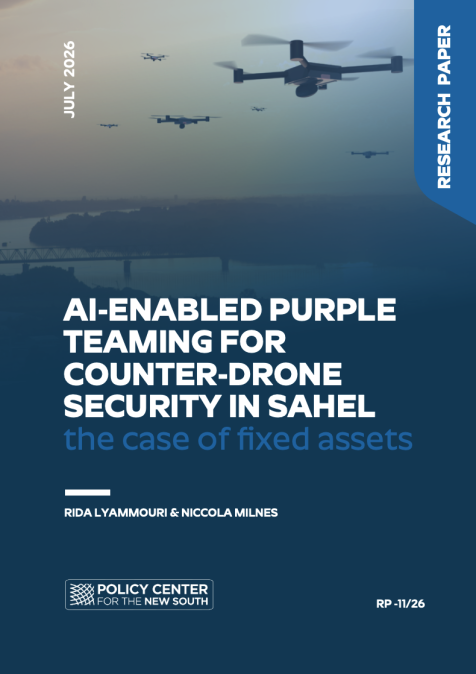 July 21, 2026Armed-group drone use in the Sahel and Lake Chad Basin has scaled from rudimentary commercial-quadcopter Improvised Explosive Device (IED) drops in 2023 to a capability set that now includes First-Person View (FPV) strikes with shapedcharge anti-armor warheads, fiber-optic FPVs that defeat radio-frequency jamming, coordinated drone-and-ground assaults on hardened airfields, and a 25-drone non-state swarm. Four groups—Jama'at Nusrat al-Islam wal-Muslimin (JNIM), the Azawad Liberation ...
 -
July 17, 2026In this episode, Emiliano Alessandri explores how emerging technologies are reshaping peacebuilding and conflict dynamics. He discusses the opportunities and risks of AI, drones, and soci ...
-
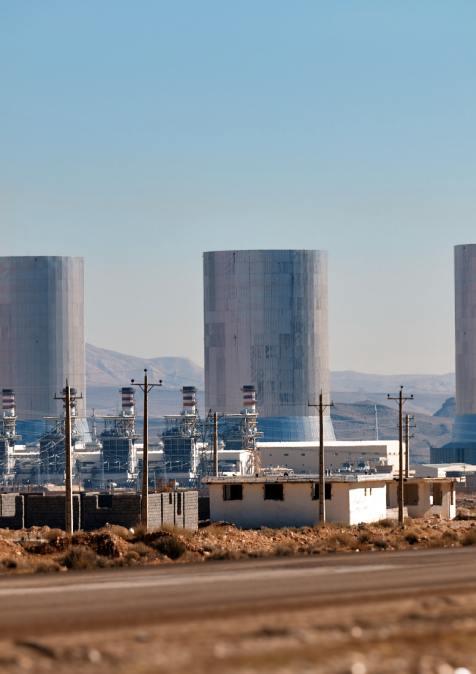 July 17, 2026The close relationship between energy and geopolitics is well established. The same holds true for several armed conflicts. In recent years, however, the conflict most closely intertwined with energy has been the 2026 Iran War, which began on February 28. A ceasefire has been in effect since April 8, and a Memorandum of Understanding (MoU) was signed by Iran and the United States on June 17. Nevertheless, as demonstrated by Iran's attacks on commercial vessels and recent U.S. strike ...
 -
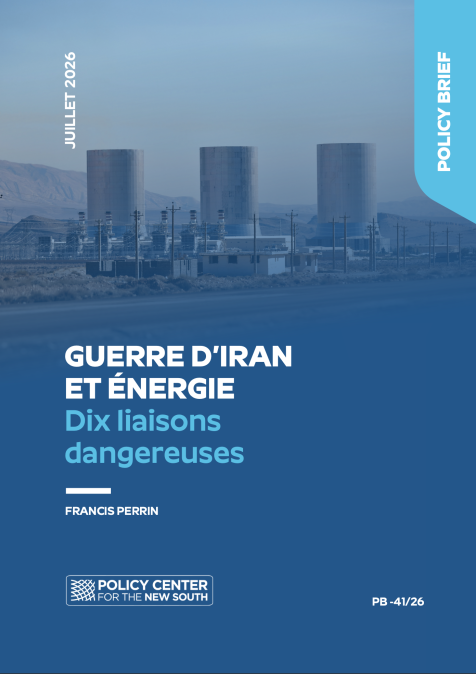 July 17, 2026Les relations, très étroites, entre l’énergie et la géopolitique sont bien connues. Cela vaut aussi pour plusieurs conflits armés. Mais, dans la période récente, le conflit le plus lié à l’énergie est la guerre d’Iran de 2026, qui a débuté le 28 février. Un cessez-le-feu est en vigueur depuis le 8 avril et un protocole d’accord a été signé le 17 juin par l’Iran et les États-Unis. Mais, comme le montrent les attaques de l’Iran contre des navires et les frappes américaines de ces dern ...
 -
 July 15, 2026We Are Watching You In April 2026, the UK Ministry of Defence revealed that it had tracked a covert Russian submarine operation apparently intended to map critical undersea cables and pipelines in the North Atlantic and the North Sea. A Russian attack submarine and two specialised intelligence vessels operated by the Main Directorate of Deep-Sea Research, commonly known as GUGI, were reportedly monitored for four weeks by the Royal Navy, including HMS St Albans and P-8 Poseidon ...
 -
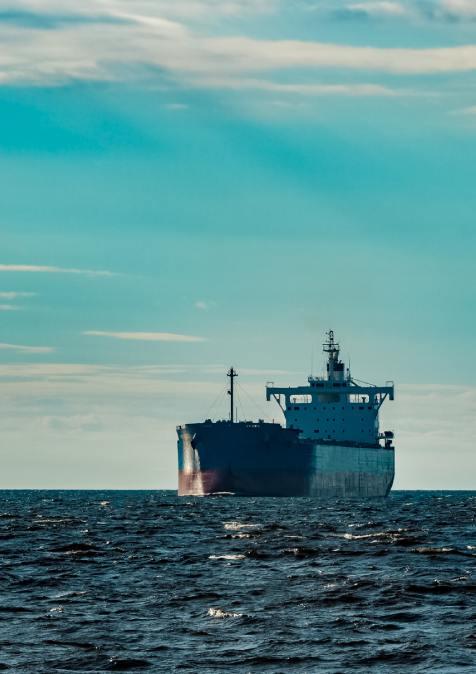 July 13, 2026On “marinetraffic.com”, thousands of triangles fill a map of the world’s ports and oceans, each representing the active location and destination of a ship, reported the “McGill International Review” (April 16, 2026) adding,” suspicious tankers are plentiful among them.” One of these vessels, marked by a red triangle, appears, zoomed, as “Monique”, a twenty-year-old vessel, aka Tokyo, Phuket and Elysia. Its old age and the frequent name change, suspects reporter Julnar Alzuki, “indic ...
 -
 July 10, 2026À la suite des récents développements au Moyen-Orient, le Policy Center for the New South lance une série de trois webinaires consacrée aux conséquences stratégiques, géopolitiques, sécuritaires et économiques du conflit entre les États-Unis et l’Iran. S’appuyant sur la publication Hor...
 -
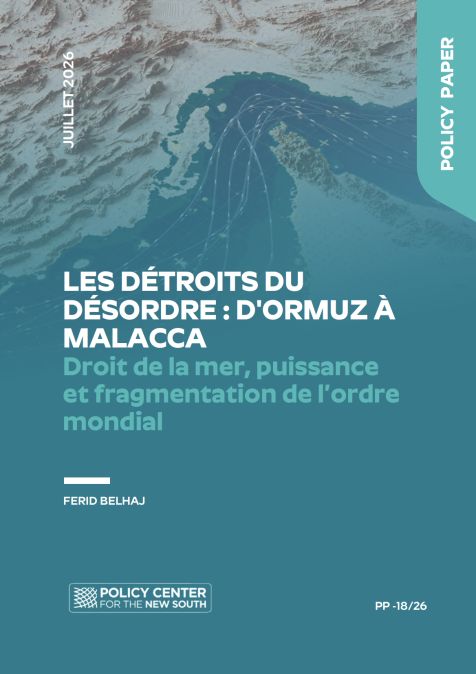 July 9, 2026Cet essai analyse la guerre Iran–États-Unis–Israël de 2026 comme un révélateur de la transformation profonde de l’ordre international. À travers le prisme du droit de la mer, du détroit d’Ormuz, des alliances fragmentées, des câbles sous-marins et des flux énergétiques, il montre que le pouvoir mondial se déplace progressivement du contrôle des territoires vers la maîtrise des infrastructures de circulation. Loin de disparaître, la mondialisation entre dans une phase de connectivité ...
 -
July 7, 2026Following recent developments in the Middle East, the Policy Center for the New South is launching a three-part webinar series on the strategic, geopolitical, security, and economic consequences of the US-Iran conflict. Building on the publication Hormuz and the Invisible Fractures...

