RELATED CONTENT : Economic growth

  • February 22, 2021
    The monetary policy report submitted by the Board of Governors of the Federal Reserve System to the U.S. Congress on Friday Feb. 19 showed that the Fed’s members have improved economic growth expectations for 2021 and 2022, expect lower unemployment rates. Meanwhile, only two of the 18 participants projected PCE (personal consumption expenditures) inflation to (slightly) exceed the 2% that serves as the longer-run objective for the monetary policy regime. In this context, is there ...

  • Authors
    December 30, 2020
    According to this month’s OECD economic outlook, global GDP --- which took a huge hit from the pandemic and is still 3% below its level of a year ago – will not recover its pre-pandemic level until the end of 2021. In a downside scenario, the return could take almost a year longer. The OECD predictions, which imply high and protracted unemployment, are in line with the view of many other official and private organizations. The arrival of effective vaccines such as Pfizer-BioNTech wa ...
  • November 24, 2020
    The global economic activity has climbed up since June but there are signs that the recovery may be losing momentum. Instead of a V, U, W, or L, a square root as a recovery shape looks more likely, as we approached before in this series. And the crisis is likely to leave deep, unequal s...
  • November 16, 2020
    Africa is experiencing economic growth deceleration that reached 2.9% on average between 2010 and 2018, against 5.4% between 2000 and 2010. The sectoral performance of African economies depends critically on the stock and quality of infrastructure, directly as an essential input (for example, energy and transport) and indirectly by increasing total factor productivity. African economic integration, and the hoped-for emergence, can never be fully achieved with poor infrastructure, bo ...
  • October 22, 2020
    To commemorate the 75th anniversary of the United Nations, the Policy Center for the New South is pleased to organize a series of webinars to discuss key themes related to the role of the UN on the international scene. Moderator : Eduardo Amaral Haddad, Senior Fellow, Policy Center for ...
  • Authors
    October 2, 2020
    Africa’s infrastructure investment gap has widened over time. Addressing the mismatch between developed countries’ “global savings glut” and African countries’ “investment dearth” might be a win-win. To facilitate that matching, some risk mitigation tools can be used. In this brief, we propose that by providing such risk mitigation tools, development institutions and governments can crowd-in private investment rather than crowd them out by providing full financing. This article was ...
  • Authors
    Mohammed Al Doghan
    Muhammad Bhatti
    Carlos Braga
    Abdulelah Darandary
    Anabel González
    Niclas Poitiers
    September 15, 2020
    Diversification is important because it is associated with economic growth and reduced volatility. Diversification of exports, which provide foreign exchange and enable imports of critical goods, services, and know-how, is crucial for developing countries. The question we address in this brief is how export diversification is affected by trade policies, including multilateral rules, regional trade agreements, and national measures. The record on diversification is poor across a larg ...
  • August 9, 2019
    China’s economic records over the past four decades generated the intellectual curiosity of many foreign observers and researchers . The development pathway of Beijing is interesting to study as it proves that a country can take its destiny in its own hand. This paper tries to draw possible lessons from the Chinese development path to see if some of them could be adaptable to feed the development of the African countries. Introduction Forty years ago, China opened up its economy t ...
  • Authors
    March 7, 2019
    A well-functioning modern infrastructure is essential for social and economic development. It has the power to change the quality of life of populations as well as the prospects of businesses. Despite developing Asia’s remarkable economic performances since the 1980s, the region still faces important difficulties in delivering adequate infrastructure services. “Over 400 million Asians do not have electricity access; 300 million live without safe drinking water and 1.5 billion withou ...
  • Authors
    Sara Hasnaa Mokaddem
    March 5, 2019
    Since coming to power on April 2018, Dr. Abiy seems to be unstoppable, making the world headlines on many occasions. He has embarked the country on an ambitious and transformative project; he has freed thousands of prisoners and established a Reconciliation Commission, has called on the privatization of state-owned enterprises and signed a stunning peace treaty with Eritrea. Furthermore, in a complete shift from the old paradigm of developmental state, the new PM outlined his renewe ...
  • Authors
    Olalekan Samuel
    Mma Amara Ekeruche
    Adedeji Adeniran
    February 12, 2019
    This study was carried out within the framework of the Global Economic Governance Africa (GEGAfrica) funded by the UK Department for International Development. The GEGAfrica programme is a policy research and stakeholder engagement aimed at strengthening the influence of African coalitions at global economic governance forums and increase, inter alia, the visibility and the outreach of African views at the regional and worldwide levels. Policy Center for the New South was requested ...
  • Authors
    Bouchra Rahmouni
    November 22, 2018
    Nowadays, links between development and security are widely recognized by many, just as they were during the development of the Marshall Plan. As mentioned in the United Nations "A More Secure World" report, threats to one are intrinsically a threat to all. Thus, 17 UN-agreed goals were agreed upon to help end poverty, protect the planet, and ensure prosperity for all by 2030, including goal 16 for "peaceful and inclusive societies". Last month, the UN’s inaugural Africa Dialogue S ...
  • Authors
    September 18, 2018
    If I were to synthesize the current situation of the Brazilian economy in one sentence, I would say: “it is suffering from a combination of ‘productivity anemia’1 and ‘public sector obesity2’". On the one hand, the mediocre performance of productivity in Brazil in recent decades has limited its GDP growth potential. On the other, the gluttony for expanding public spending has become increasingly incompatible with such limits in the potential expansion of GDP, particularly since ...
  • Authors
    Anabel Gonzalez
    August 30, 2018
    The agreement establishing the African Continental Free Trade Area (AfCFTA) is a framework to create a free trade area across the region, bringing together the 55 members of the African Union into a continental market with a cumulative Gross Domestic Product (GDP) exceeding US$2.2 trillion and a total population of over one billion people. When concluded and successfully implemented, it will become the largest free trade area in the world in terms of membership, opening up significa ...
  • Authors
    August 27, 2018
    Latin America is up against a momentous year on multiple fronts. On one hand, game-changing national elections in six countries, including three of its largest – Brazil, Mexico and Colombia – are poised to reshape the political scenario in the region. In parallel, the economic agenda is front and center of countries’ efforts to overcome imbalances, implement reforms and accelerate growth. As a backdrop to all this, an important feminist movement is unfolding on the heels of a y ...
  • Authors
    March 7, 2018
    Brazilian conditional cash transfers are small amounts of money the government distributes directly to very poor households on condition that their children attend school and are vaccinated. The money goes to the women of the household, because research undertaken in the 1990s – and later confirmed in other countries – showed an increase in babies' height and weight when women have more control over household income. Greater control over household resources by women can strengthen a ...
  • Authors
    Jorge Arbache
    December 18, 2017
    I am in Marrakech attending the Atlantic Dialogue, a very interesting event organized by the OCP Policy Center. One of the questions put to debate was: "How can Sub-Saharan Africa benefit from its economic potential to grow, thrive and eliminate poverty?" In fact, this is one of the questions most frequently raised by the economic development community. And one of the most common responses is that, alongside natural resources, the young population is the most powerful engine of gro ...
  • Authors
    Diana Quintero
    March 23, 2017
    Colombia is a country of incredible contrast: known to be one of the places on earth where people feel happiest, it is also one of the most unequal and for many decades, a country immersed in a protracted conflict. Despite the latter - and here is the starkest contrast - Colombia has recently succeeded in reducing poverty and building the foundations for sustainable growth and prosperity. The Santos administration has delivered on two of its main promises: sign a peace agreement wi ...
  • Authors
    Vera Songwe
    December 23, 2016
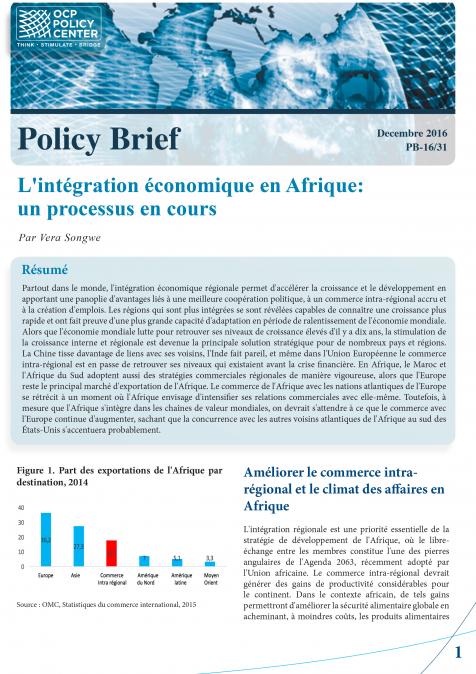
    Partout dans le monde, l'intégration économique régionale permet d'accélérer la croissance et le développement en apportant une panoplie d'avantages liés à une meilleure coopération politique, à un commerce intra-régional accru et à la création d'emplois. Les régions qui sont plus intégrées se sont révélées capables de connaître une croissance plus rapide et ont fait preuve d'une plus grande capacité d'adaptation en période de ralentissement de l'économie mondiale. Alors que l'écono ...
  • October 11, 2016
    This podcast is performed by Francis Ghilès. Tunisia is facing a year of great uncertainty as fighting rages in the ruling Nida Tunes Party and the En-Nahda Islamist Party finds itself in ...
  • Authors
    Samuel George
    September 27, 2016
    On July 15, Turkey’s tumultuous 2016 took a shocking twist as elements within the country’s military attempted a coup against the government of President Recep Tayyip Erdogan. The putsch rapidly snapped at the seams, and a night that began with soldiers blocking bridges yielded a morning with those same soldiers flogged by civilians in the street. In the days following the attempt, Erdogan declared a three-month state of emergency and began purges of depth and breadth that extended ...
  • June 01, 2016
    This podcast is performed by Jeffrey Alexander Frankel. He is professor of Capital Formation and Growth at Harvard University's Kennedy School; ...
  • Authors
    Dedewanou Finagnon Antoine
    April 6, 2016
    Cet article fait une analyse comparative de quelques déterminants de la croissance économique dans les pays de l’Union Economique et Monétaire Ouest Africaine (UEMOA) et dans les pays à forte croissance afin de proposer des mesures de politique économique pour la relance de la croissance dans les Etats de l’UEMOA. Pour ce faire, nous utilisons les données de la Banque Mondiale sur cinq pays à forte croissance (Brésil, Russie, Inde, Chine, Afrique du Sud) et sept pays de l’UEMOA (Bén ...
  • Authors
    Mohamed Hamza Sallouhi
    March 23, 2016
     Partie 1. Le ralentissement économique de la Chine : une transition inquiétante  L’incertitude sur les marchés financiers, la transition de l’économie chinoise vers un modèle de croissance moins extraverti et le ralentissement du rythme de la croissance des pays émergents, sont autant de facteurs qui fragilisent considérablement une croissance mondiale durable et synchronisée. Dans ce contexte, l’OCP Policy Center a tenu une table ronde animée par Patrick Artus ...
  • Authors
    Nisrine Ouazzani
    January 6, 2016
    The economic growth of the African continent and its positioning as an emerging force is a reality no longer questioned. Optimism surrounding the Africa rising narrative is supported by a growing young workforce, an expanding middle class, new discoveries of natural resources and minerals, relative political stability and infrastructure developments. Economic and international financial actors now recognize the potential that the continent represents for the world economy, consider ...
  • Authors
    January 23, 2015
    The year just ending disappointed economic forecasters, as did the year prior, and the one before that. The aftereffects of the Lehman crisis, now over six years old, and of the subsequent sovereign crisis in Europe, have been systematically underestimated and continue to plague us.  Although the outlook for 2015 is foggier than usual, there are significant areas of strength and many signs that the world economy continues to heal, beginning from here in the United States. &nbs ...
  • December 18, 2014
    This podcast is performed by Dhruva Jaishankar. India has had several stages to its foreign policy since its independence. This included active international engagements in the 1950s, iso ...