Publications /
Opinion

Back
The size of Biden’s fiscal package
February 22, 2021

The monetary policy report submitted by the Board of Governors of the Federal Reserve System to the U.S. Congress on Friday Feb. 19 showed that the Fed’s members have improved economic growth expectations for 2021 and 2022, expect lower unemployment rates. Meanwhile, only two of the 18 participants projected PCE (personal consumption expenditures) inflation to (slightly) exceed the 2% that serves as the longer-run objective for the monetary policy regime.

In this context, is there some justification for fears on the part of some that the $1.9 trillion fiscal package sent to Congress by the Biden government, with approval expected by mid-March, carries the risk of bringing too much stimulus to the country's economy, which is already recovering? Could the package cause inflation spikes and, consequently, a reversal of the looseness in monetary policy, with an increase in interest rates causing shocks to highly indebted non-financial companies?

There are even those who suggest the recent slight rise in longer-term interest rates on Treasury debt securities already reflect such an expectation. Last week, yields on 10-year bonds reached 1.3%, after being slightly above 0.9% at the beginning of the year. Several analysts pointed to yields implicit in 10-year protected-against-inflation government securities as embedding inflation expectations at around 2.2%, the highest since 2014. Figure 1 shows recent spikes in 5-to-10-year-forward inflation compensation.


Figure 1: 5-to-10-year-forward inflation compensation
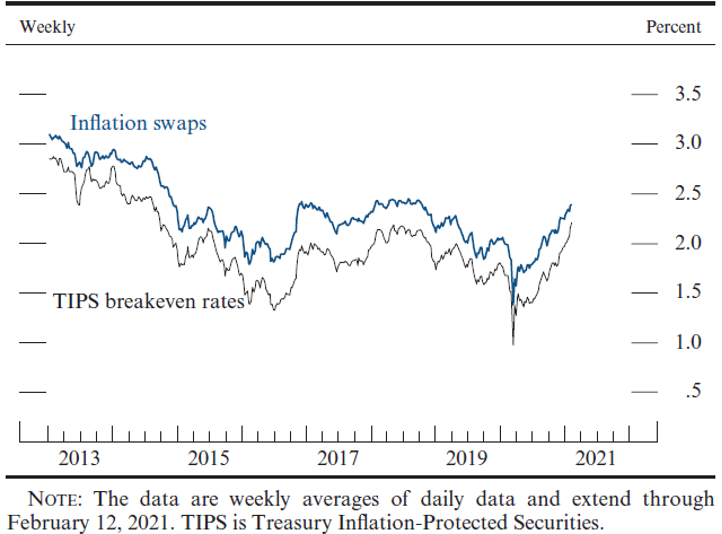
5-to-10-year-forward inflation compensation

Source: Board of Governors of the Federal Reserve System, February 19, 2021.


When added to previous packages since the beginning of the pandemic crisis, amounts equivalent to 13% of GDP will be reached, something unprecedented since the Second World War. It was very striking that the concern about excess has been expressed by renowned economists—including Lawrence Summers and Olivier Blanchardwho have always called for fiscal policies to not leave the task of recovery entirely on the shoulders of monetary policy.

Even before considering the Biden package, the U.S. Congressional Budget Office had already projected the country's GDP as exceeding the pre-pandemic level this summer. If the Trump administration's second package was enough, the impact of the Biden package on demand (9% of GDP) would be beyond what is necessary for the return to potential GDP. Morgan Stanley Research has forecast a 6.5% GDP growth rate for 2021 and a trajectory even above the pre-COVID-19 path (Figure 2).


Figure 2 – US real GDP (rebased Q4 2019 = 100)
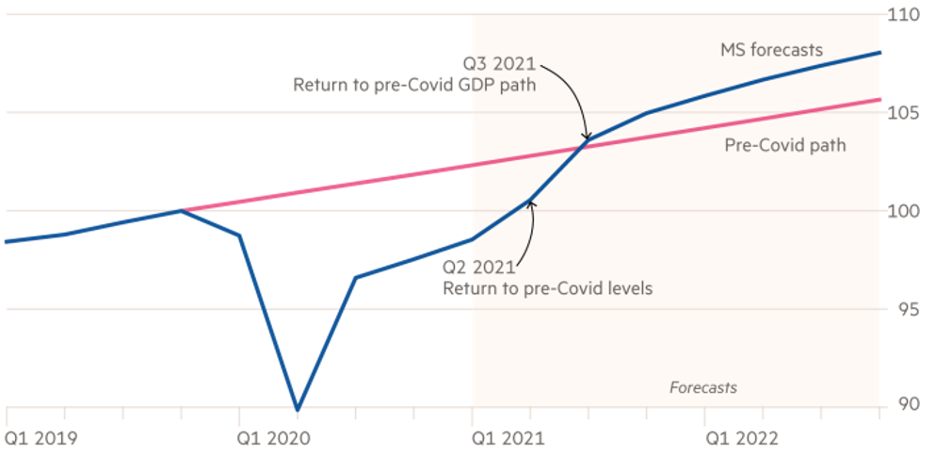
Figure 2 – US real GDP (rebased Q4 2019 = 100)

Source: Gille, C., Financial Times, February 18, 2021.


The fiscal package has components that need to be differentiated. On the one hand, it would provide an amount of resources that could be considered as part of the extraordinary public expenditure related to the pandemic, and which does not correspond to a macroeconomic recovery policy, even though it will have an impact on aggregate demand. This includes money to speed up the vaccination campaign, including spending by subnational entities, and reinforcement of unemployment insurance. On the other hand, items pointed out as excessive and poorly focused include another round of checks sent directly to households, as was done last year.

Paul Krugman, for his part, has expressed less concern about the potential excess aggregate demand that would be be brought about by such checks, which would not be focused on the lower levels of the income pyramid, judging by their diversion to precautionary savings by households last year. Former U.S. Treasury Secretary Larry Summers reiterated that, even if this is the case, the corresponding fiscal space should have been reserved for some future package that is expected to come for investments in infrastructure and “green recovery“.

However, two relevant aspects must be taken into account. First, according to Treasury Secretary Janet Yellen, it would be better to run the risk of excess than insufficiency.

In addition, the Federal Reserve's new monetary policy regime puts the 2% inflation target as an average, not as a ceiling forcing monetary policy to act to prevent it in advance. After a long period of inflation below 2%, even in years with low unemployment and interest rates on the floor, monetary authorities can afford to wait some time with above-average inflation until they are compelled to pull the brake. The report presented to Congress Feb. 19 says this explicitly.


 

RELATED CONTENT

  • Authors
    December 3, 2025
     Global GDP growth has proven resilient in 2025, despite the shocks caused by the trade policies implemented by United States President Donald Trump in the first year after his return to office. The gloomy projections offered by multilateral and private institutions in the first quarter of 2025 have given way to revised levels mostly in the 2.5% to 3% range for the year. ...
  • November 25, 2025
    This Policy Paper analyses the Fourth Industrial Revolution (4IR) through the critical lens of technological colonialism. It argues that the fusion of physical, digital, and biological technologies is not merely a technical phenomenon but a civilizational shift reshaping the foundations of global power. The article traces a historical continuum from previous industrial revolutions, demonstrating how patterns of inequality and extraction persist, now transposed into the digital realm ...
  • Authors
    November 21, 2025
    This report addresses the business environment in Brazil as one of the determinants responsible for the weak evolution of productivity in recent decades. After addressing this productivity performance, we define what constitutes the business environment, using as a reference the three ways in which the World Bank has been addressing the subject.Next, we highlight how the business environment affects productivity in a country. Finally, we review some recent reforms in the country's b ...
  • Authors
    Lahcen Oulhaj
    November 19, 2025
    La modélisation classique de la croissance repose sur des outils – notamment la fonction de production agrégée et la comptabilité de la croissance – dont les incohérences logiques et les ambiguïtés épistémologiques sont connues depuis la Controverse de Cambridge et les travaux d’Anwar Shaikh. Pourtant, ces failles continuent d’alimenter des raisonnements fallacieux dans le débat économique et les discours institutionnels. Cet article montre que la nature tautologique de ces outils n ...
  • November 18, 2025
    The meeting between Donald Trump and Xi Jinping in Busan, South Korea, was more than an exercise in diplomacy. It was an emblematic performance of a world in transformation. Behind the formalities, the cameras, and the studied smiles lay an unspoken recognition: the world is no longer unipolar. The era of American supremacy, sustained for decades through its economic reach, military presence, and ideological projection, is giving way to a more diffuse, multipolar reality. ...
  • Authors
    Arkebe Oqubay
    November 17, 2025
    Morocco has emerged as one of Africa's success stories, achieving significant progress in economic transformation and the green transition over the past 25 years. Continuing and deepening this transformation is essential to reach the country’s goal of becoming a high-income economy in the coming decades. Significant challenges include managing the risk of the middle-income trap, addressing demographic pressures, promoting inclusive growth, ensuring environmental sustainability, and ...
  • Authors
    November 11, 2025
    Official Development Assistance (ODA) to developing countries has fallen in recent years to well below the UN target of 0.7% of developed countries’ gross national income. Global remittances have become the biggest inflow to poor countries, greater than ODA or foreign direct investment which has also declined. Against the backdrop of geopolitical tension between major powers, other countries including developing ones and development institutions have to do their parts in mobilizing ...
  • Authors
    Jorge Arbache
    October 9, 2025
    Conventional wisdom holds that the United States has undergone massive deindustrialization in recent decades, with the country's manufacturing sector supposedly withering as it lost ground to China. This narrative has fueled debates about industrial policy, economic nationalism, and the reshoring of manufacturing production. But what if this story is only partially true? What if, instead of disappearing, American industry simply changed its address?  ...
  • October 7, 2025
    Global economic growth has been more resilient than expected, as the artificial intelligence-led growth seems to be compensating for the negative impacts of trade conflicts. Overstretched asset values and slowing jobs growth may be signaling that the balanced crossing of those two paths...
  • Authors
    October 3, 2025
    Global economic growth has been more resilient than expected, as the artificial intelligence-led growth seems to be compensating for the negative impacts of trade conflicts. Overstretched asset values and slowing jobs growth may be signaling that the balanced crossing of those two paths will be challenged. ...