Publications /
Opinion
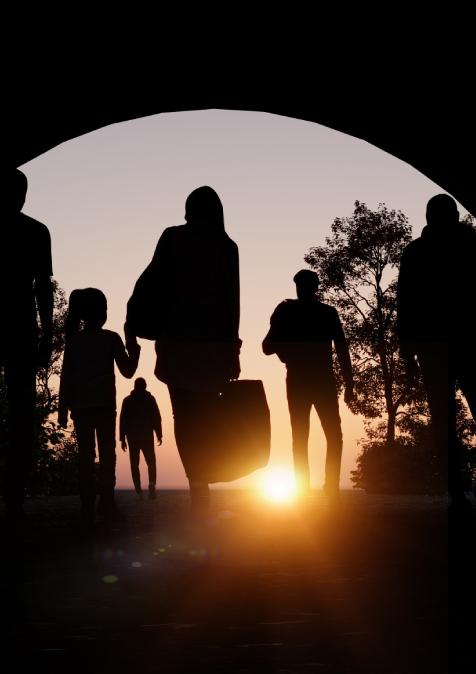
The 13 kilometer-square settlement near Cox’s Bazar, Bangladesh, is a symbol of human failure. Kutupalong does not harvest diamonds, rare earth, or oil; rather it produces misery. It houses refugees—one million plus. Most are Rohingya people, Muslims driven out of their homes in the state of Rakhine, Myanmar, formerly a British colony known as Burma, wedged between India and China with 50 million citizens and 135 ethnic groups. Kutupalong is the world’s largest refugee camp, densely populated and based on mud, which turns into rivers when the monsoon wipes away the primitive housing. Refugees have the right to asylum, medical care, and work, but most of the refugees in this mega-monstrosity are only surviving, some for decades. The government of Bangladesh for years has tried to improve Kutupalong, but “the ongoing influx of immigrants”, observed Development Aid writer Danill Filipenco (March 28, 2023) “makes this almost impossible.”
A barbaric civil war in Myanmar is uprooting millions, sweeping thousands of Buddhists and Muslims across the borders, as witnessed at the Thai/Burmese border town of Myawaddy during the first week of April. The fighting in forests and towns across Myanmar, around the golden pagodas and Buddhist monasteries, “gets little of the international attention claimed by the conflicts Ukraine and Gaza”, reported the Japan Times (May 3, 2024), although Myanmar has been engulfed in an armed conflict since a military coup in 2021. The Japan Times reported: “As the fighting has moved into the more populated areas, about one million people have been forced to flee their homes since the start of the offensive of government forces in October 2023, contributing to the more than three million internally displaced people.”
An estimated 108 million people worldwide, according to the UN Refugee Agency (UNHCR), have fled their homes. The war in Ukraine, which triggered Europe’s largest displacement crisis since the Second World War has played a significant role in the rise of global refugee figures. As of June 2022, nearly six million Ukrainians were internally displaced, and 5.9 million had fled their country, settling in Romania, Moldova, Georgia, Poland, and Germany. As of February 2024, the government in Berlin had registered 1.13 million Ukrainians; Poland had received 955 000 citizens of its war-torn neighbor. By the end of 2022, 52% of the world’s refugee population came from Syria (6.5 million), Afghanistan (6.1 million), and Ukraine (5.9 million). In the past decade, the global refugee crisis has more than doubled in scale, UNHCR confirmed. The South American nation of Venezuela for years has been suffering a refugee crisis, which already in 2018 was judged (Washington Post, February 24) as “the largest displacement of people in Latin America’s history.”
The Reality is Grim
7.7 million people uprooted from Venezuela, trying to settle in Latin America, the Caribbean, and the U.S. It is a never ending crisis, touching “an even greater number than the displacements of Syrians and Ukrainians outside of their countries”, noted the Washington based Center for Strategic and International Studies (CSIS, November 27, 2023), in a report title ‘The persistence of the Venezuelan Migrant and Refugee Crisis’. Of the displaced Venezuelans, 1.7 million escaped to Colombia, 950 000 settled in Peru, 500 000 tried to find new roots in Chile (Statista, November 15, 2023). Despite these numbers, CSIS observed, the Venezuelan migrant and refugee crisis, quite unfortunately, dropped down the list of political and policy priorities, with fewer headlines in the media and sporadic policy conversations in Washington. “The reality is grim”, CSIS pointed out, “this year, more than four million Venezuelans housed in Latin America lack access to food shelter and formal employment”. A similar predicament faced by Syrian refugees, settled in neighboring nations including Turkey (3.6 million), Lebanon (1.5 million), and 675 000 in Jordan, which already has to secure more than two million Palestinians, of whom 18% live in ten recognized refugee camps throughout the country.
Global migration patterns, wrote the World Bank in its Metadata Glossary (2024, The World Bank Group), “have become increasingly complex in modern times, involving not just refugees, but millions of economic migrants. But refugees and migrants, even if they often travel in the same way, are fundamentally different, and for that reason are treated very differently under modern international law”. Migrants, especially economic migrants, choose to move to improve their future prospects for themselves and their families. Refugees have to move if they want to save their lives or preserve their freedom. They have no protection from their own states. Indeed, it is often their own governments that threaten to persecute them.” If other countries do not let them in”, warned the World Bank, “, and do not help them once they are in, then they may be condemning them to death—or to an intolerable life in the shadows without sustenance and without rights.”
Daily images of desperation invade social media and television.TV snippets or photographs picture a growing reality-refugees forced to sleep under bridges, in tents. Refugees drown between Libya’s Zawiya and Italy’s Lampadusa island—an estimated 2500 in 2023 alone. In the refugee camp of Kakuma in northwestern Kenya, 180 000 refugees are housed behind barbed wire. Hundreds of miles away the Dadaab refugee complex, three camps in one, is home to 230 000 uprooted people, mainly Somalis, most seem to be there forever. Za’atari, a camp in Jordan, houses 80 000 people, mainly Syrians, supported by over 30 international organizations. Assuming that an average refugee camp houses 11 500 people, suggests Danill Filipenco, “there are at least 500 refugee camps in the world.” In some regions, the border between Mexico and the U.S., for example, thousands sleep rough, since refugee shelters are overcrowded. For the desperate masses, arriving at the U.S. border after long, perilous marches from Guatemala or Belize, Honduras or El Salvador, the crossing into California, Arizona, or Texas is their last chance to reach their imagined paradise.
Shrinking Migration Pathways
No such a chance for some millions in Africa, for whom the continent has turned into a dystopian landscape. Ongoing conflict and natural disasters in South Sudan have caused one of the largest refugee crises in Africa. About two million people are displaced within the country, and an additional 2.2 million fled into the Democratic Republic of Congo, a nation that can hardly absorb the additional drama. The DRC displacement numbers are the highest in Africa, according to the International Organization for Migration , at 6.9 million (October 30, 2023). “With ongoing conflict and escalating violence, the DRC is facing one of the largest internal displacement and humanitarian crisis in the world.” Conditions in Sudan have deteriorated throughout 2023, noted the Dublin-based Concern Worldwide charity (December 18, 2023), “as the country faces some of the worst violence in decades”. At the end of 2022, approximately 844 000 refugees around the world were Sudanese. As of mid-2023, “that number exceeded 1.02 million, and showed no sign of abating”. While the world is focusing on Ukraine, unprecedented funding shortages and shrinking migration pathways leave Africa stranded, complained the Institute for Security Studies (ISS, February 15, 2023). “Across many parts of Africa, conflict, political violence, climate change and food insecurity are converging to forcibly displace more Africans than ever.”
Because of armed conflict and violence, an estimated 63 million people in sub-Saharan Africa are expected to be displaced in 2024, predicted UNHCR. Makhtar Diop, Managing Director of the International Finance Corporation, and former Vice President of the World Bank for Africa, confirmed that “the reality is that the great majority of African refugee movements happen within Africa, with the burden of caring for these migrants falling on neighboring countries. Of the total 18 million displaced persons in Africa, more than 12.5 million are internally displaced, living in their own countries. The IDPs and refugees share something in common—the agony and costs of being forced to flee their homes.”
Internally displaced persons are often confused with refugees. Unlike refugees, internally displaced people remain under the protection of their governments, noted the World Bank’s Metadata Glossary, “even if their reason for fleeing was similar to that of refugees.” Refugees are people “who have crossed an international border to find sanctuary and have been granted refugee status, or temporary protection.” Unlike refugees, who cross national borders and benefit from established systems of international protection and assistance, those forcibly uprooted from within their own countries by armed conflict, systematic violations of human rights, or natural disasters, “lack predictable structures of support.” Internal displacement, insists the World Bank, “has become one of the more pressing humanitarian, human rights and security problems, confronting affected countries and the international community at large.”