Publications /
Opinion

This blog was originally published on cgdev.org
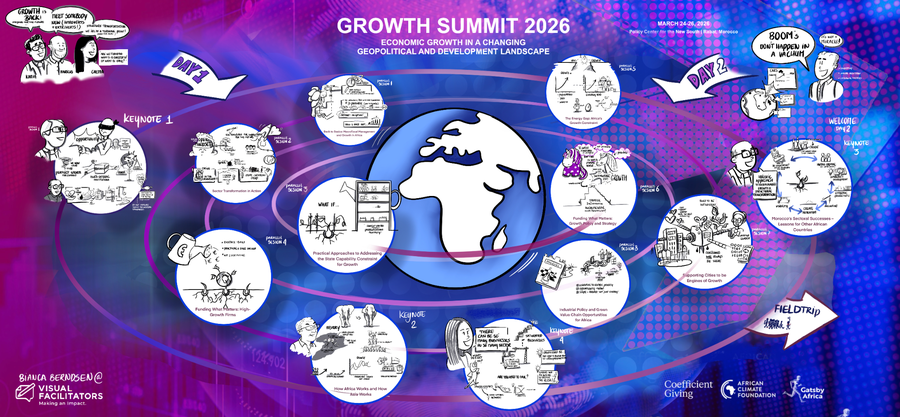
We recently wrapped up the second edition of the Growth Summit, organized by our three organizations and hosted by the Policy Center for the New South. The event was filled with eclectic voices. To give you a sense of the discussions, we’ve tried to capture some of the key messages from the 12 sessions (with no direct attribution).
Overall, the eclecticism of the debate points to an uncomfortable truth: there is today no shared playbook for growth strategies in the developing world. A broad consensus does exist, but only at the level of first principles. Macroeconomic stability remains a prerequisite. The gains from open trade are widely acknowledged. Investing in education to raise productivity is seen as essential, as is developing robust innovation ecosystems. And in an era of mounting global uncertainty, preserving policy space is seen as an imperative.
Yet beyond these points, agreement quickly breaks down. There is no clear consensus on sequencing, nor on the relative weight that should be assigned to different policy instruments. What matters most remains contested.
This leaves countries with a difficult but unavoidable task. They need to craft their own development strategies, rooted in domestic realities rather than imported recipes. Success will depend not only on policy design, but on the ability to articulate a coherent vision capable of aligning domestic priorities with external support.
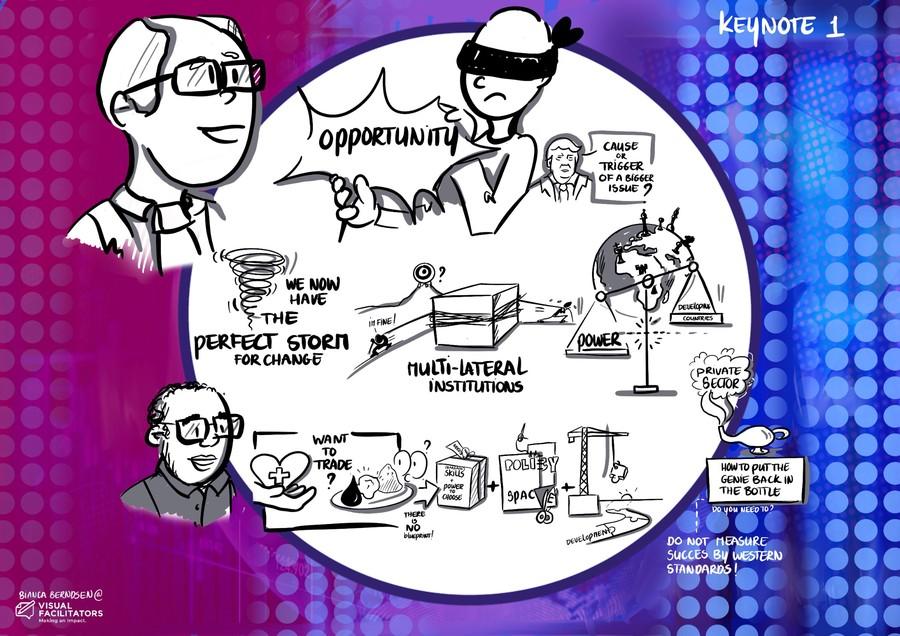
Keynote 1: Global geopolitics, policy space, and development pathways
Adeyemi Dipeolu, Alexia Latortue, Mark Malloch-Brown
- The future of aid will be more humanitarian, more multilateral development bank, health and education and global public goods. But there won’t be enough money to do this all well.
- We are moving into a grouping-of-power world, rather than an ascendant hegemon. This will be messy—a mix of high principle and low politics.
- For governments to make progress on development, macro stability is necessary but not sufficient. We need focus.
- Policy experimentation can go two ways: disaster or innovation. You need guardrails.
Session 1: Back to basics: Macrofiscal management and growth in Africa
Mark Miller, Kari El Aynaoui, Mamo Mihretu, Kwame Owino, Catherine Patillo
- Strong management of fiscal policy is boring but important
- Pragmatic, adaptable policy is key. Sequencing matters for both policy success and political economy. And don’t forget the communication—across policymakers and to the public.
- Don’t rule out default as an option for dealing with debt, but be aware of its consequences.
- We know the technical part of increasing domestic resource mobilization. What we understand less is the political economy: the social compact, how to communicate.
Session 2: Sector transformation in action
Bill McRaith, Obaid Ur Rehman, Lucy Kimani, James Foster
- Sector transformation depends on coordination among actors (state, IFI/DFIs, and the private sector) with a clear shared vision.
- This can include various constellations of these actors, including pre-competitive coordination within the private sector—firms that share a supply base can collaborate to build entire industries (PVH in Ethiopia).
- The key is not just engaging with the private sector per se but aligning around a clear strategy that avoids rent-seeking and entrenching incumbent firms.
- Sequencing can be critical to unlocking value chains: in Kenya, a large-scale fish farm generated demand for feed, which is now produced domestically by 11 firms. Demand creation had to come first to support downstream growth.
Session 3: Funding what matters: High-growth firms
Matthew Guttentag, Nicholas Coloff, James Foster, Joshua Bicknell, Elizabeth Brown, Naomi Kirungu, David Munnich, Maryanne Ochola
- Firm growth is the key to reducing poverty.
- Firms need support with business development services (BDS) and access to finance. Well-performing BDS can have 16X returns.
- Big firms are key: 15 percent of firms create 85 percent of jobs
- We need to not only support firms but fix environmental constraints too (e.g., regulation)
- Youth enterprise should be retired. Instead, young people should be able to get experience working with larger firms first.
- Generic matching funds should also be eliminated. We need more patient capital; pension funds (especially from the region) could have a role here.
- We heard a great set of lightning talks from different organizations doing neat things in this space.
Session 4: Addressing state capability constraint
Kartik Akileswaran, Piero Ghezzi, Mark Henstridge, Anna Lyimo, Naim Merimeche
- State capability is a binding constraint on growth. Improving outcomes is not just about providing/better targeting subsidies or tax incentives; it requires strengthening underlying state capabilities.
- Government systems often skew incentives toward risk aversion, not problem-solving. Public sector incentives often favor consistency over experimentation (don’t want to do something different and get fired). Effective reform depends on small, empowered teams focused on specific problems.
- Shifting the trajectory (going from 0 to 1) is fundamentally different from scaling (going from 1 to 10). The former requires altering underlying systems, incentives, and norms (political challenge), not just increasing spending.
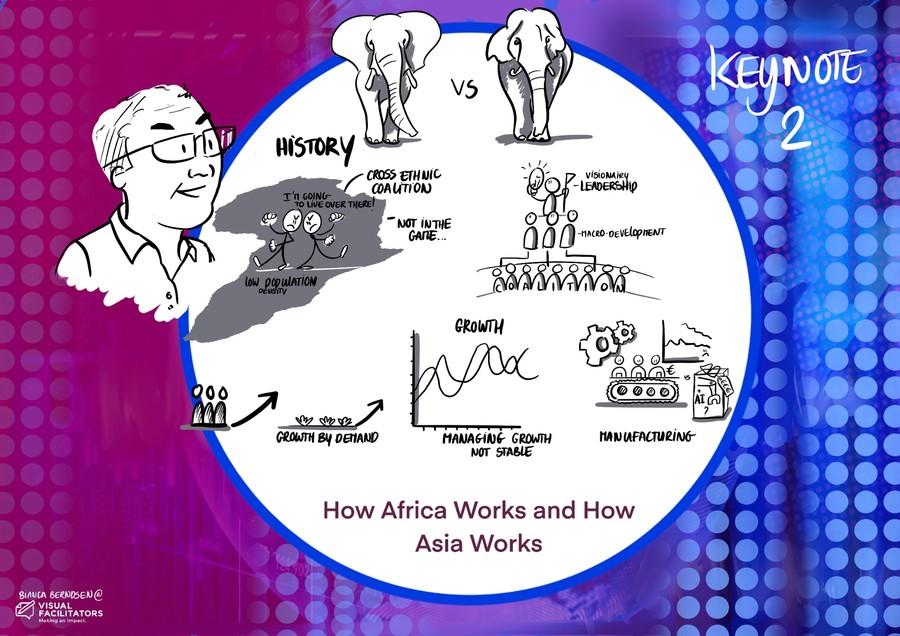
Keynote 2: How Africa works and how Asia works
Ken Opalo, Joe Studwell
- Population density is key (but not sufficient); Africa is now just reaching Asian population density in 1961.
- With this demographic density, manufacturing by Africa for Africa can take off. And cost and flexibility mean that humans dominate robots for the near term.
- Part of Asia’s success was having a team of policy thinkers who served leaders and made sure the ideas propagated through the government and across governments.
- You don’t have to be perfect to grow, but things get better with growth.
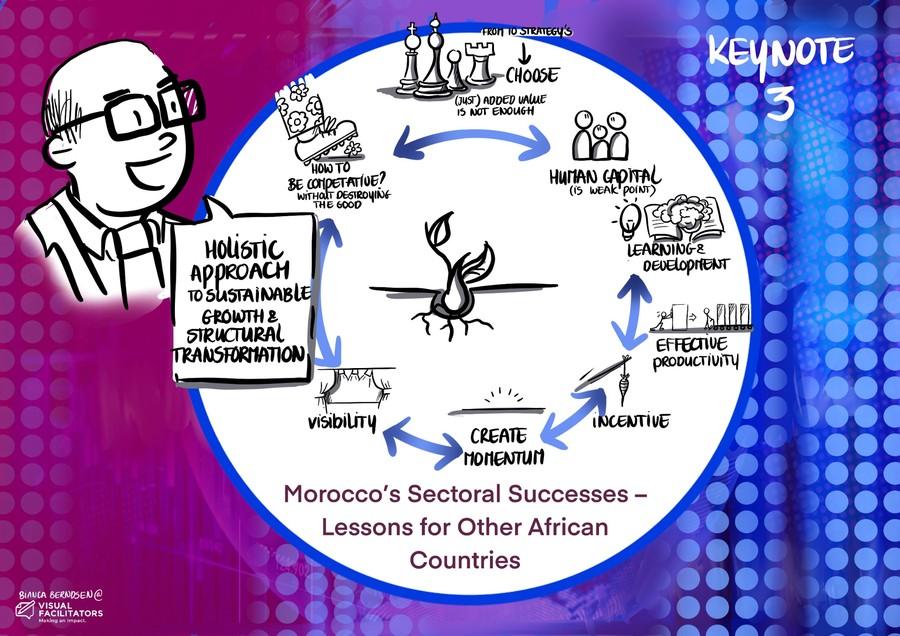
Keynote 3: Morocco’s sectoral successes – lessons for other African countries
Larabi Jaidi, Oliver Hanney, Chema Triki
- Political commitment and getting institutional support structures right were key ingredients to Morocco’s reforms.
- The political turning point in 1994 was key to the intellectual and institutional turning point in 2005, with the adoption of “Plan d’emergence Maroc.”
- Strategies for transformation targeted 10 sectors—and the resulting transformation was intra-sectoral, not inter-sectoral.
- Automotive development was a result of these ingredients, combined with an alignment with an anchor investor’s strategy. Having reliable anchor investors is key.
- There were a number of iterations in industrial policy, and Morocco moved throughout the years from focusing on bringing in anchor investors to building ecosystems and clusters around these investors.
- Key issues going forward are addressing the need for some skills that are currently not being well supplied and boosting homegrown innovation.
- OCP and the successful trajectory of the company show that it is possible to have competitive SOEs, but you need to get the governance right and have these SOEs managed like private firms.
Session 5: The energy gap: Africa’s growth constraint
Casey Dunning Davis, Moussa Blimpo, Charles Mensa, Gyude Moore
- The shadow title for the session was jobs vs. the Premier League—highlighting the political economy tension of prioritizing delivering electricity to households vs. firms.
- Delivering power to households is often an important way for governments to deliver votes.
- But low-income connections with high transmission costs create sustainability issues.
- Not paying attention to this political economy tension ex ante may mean you have to reallocate from firms to households when power supply becomes tight (including from issues of sustainability.
Session 6: Funding what matters
Justin Sandefur, Lant Pritchett, Chema Triki, Tim O’Brien, Tayo Aduloju, Bruce Byiers
- Countries need a “horse” in the first place (growth), before you can worry about its color or characteristics (whether it is inclusive, sustainable, etc.).
- Strategic incrementalism: the Growth Lab model aims to tackle one binding constraint at a time, removing the key obstacles that stand between a country and long-run growth.
- High returns from targeted, long-term bets: in the 1990s, the Ford Foundation created ICRIER for about $10 million. It delivered huge long-term returns, even if it explains only a small fraction of India’s growth.
- A core challenge is distinguishing effective teams and policy advice from wasteful ones. The broad community of practitioners needs to work to hold teams/efforts accountable.
- There is a need to fund initiatives that support states in implementing policies, while building state capabilities and not substituting them to enable the learning-by-doing process in policymaking.
Session 7: Industrial policy and green value chain opportunities for Africa
Markus Goldstein, Mugo Kibati, Tristan Reed, Zainab Usman, Nimrod Zalk
- We had a quick overview of the new World Bank report on industrial policy
- Industrial policy is not just a toolbox of instruments; it is fundamentally a process of discovery and market coordination.
- Green industrial policies go beyond critical minerals and energy. There are opportunities in other productive sectors, including agriculture and manufacturing, where African countries could leverage emerging green technologies to enter.
- We’ve been doing government intervention through the “free market” era.
- There are four key ingredients: coordination, finance, market access, and commitment.
Session 8: Supporting cities
Kurtis Lockhart, Abhas Jha, Solly Angel, Josephine Rogate Kimaro, Peter Nyong’o
- Urbanization is a major opportunity—and risk: one billion people will be added to African cities by 2050, either driving agglomeration benefits and growth or congestion, disease, and infrastructure strain.
- Much of this expansion will take place in secondary cities, which are the least prepared. There must be a focus on building the internal capacities of these cities to borrow, plan, and deliver services.
- Planning is critical but should be pragmatic—guided by overarching principles rather than rigid or comprehensive master plans.
- Fragmentation is a constraint on productivity: African cities are highly fragmented, with only 38 percent of urban land currently part of identifiable employment clusters. This limits potential gains from density and agglomeration.
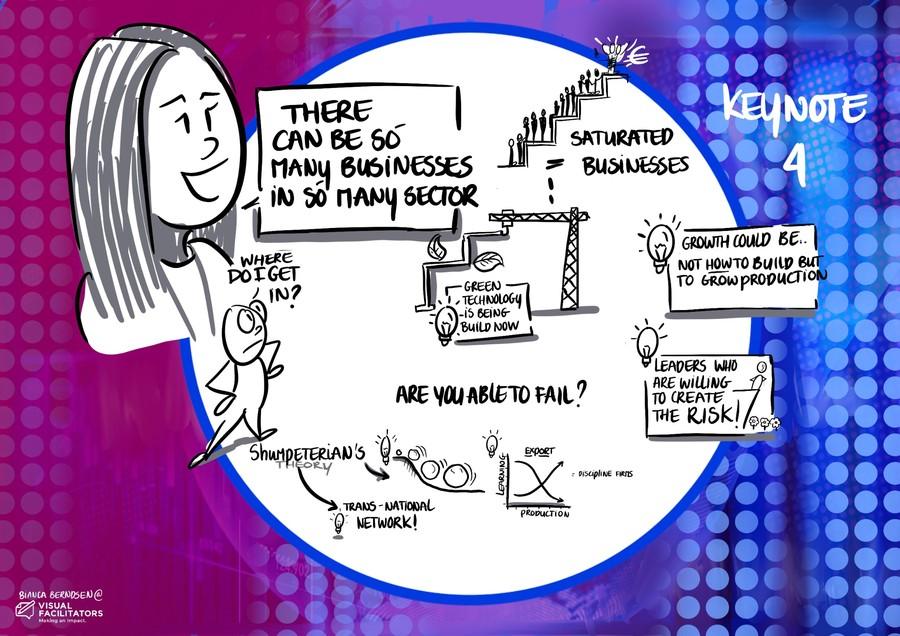
Keynote 4: Firms, innovation and the state in today’s geopolitics
Lauren Gilbert, Lindsay Whitfield, Stefan Dercon
- It’s a zero-sum game within industries—at least in the short-term– maybe until trade opens further, countries (and their firms) have to take market share.
- Green transition offers an opportunity; innovation is happening fast (e.g. in batteries).
- Industrial policy requires industry knowledge and expertise within key government institutions—governments need to understand the industries to be able to seize windows of opportunity!
- Economic development is about creating proprietary knowledge within firms—countries need to take risks, set up mechanisms to bring in (often tacit) knowledge, while building linkages.
- It’s not just about picking winners but being willing to lose and learning from failure.
- You need engineers and businesspeople, not only economists