Publications /
Opinion
There is a story told by Václav Havel, the Czech dissident writer who later became president after the fall of communism. In his essay The Power of the Powerless, Havel describes a shopkeeper who, every morning, places a sign in his window reading: “Workers of the world, unite!” He does not believe in it. Nor do the people around him. Yet the sign remains.
The Sign That Stays
On every street, other shopkeepers do the same. They display the slogan not out of conviction but to avoid trouble, signal compliance, and make everyday life a little easier. The system endures not because people believe in its message, but because they continue to act as if they do.
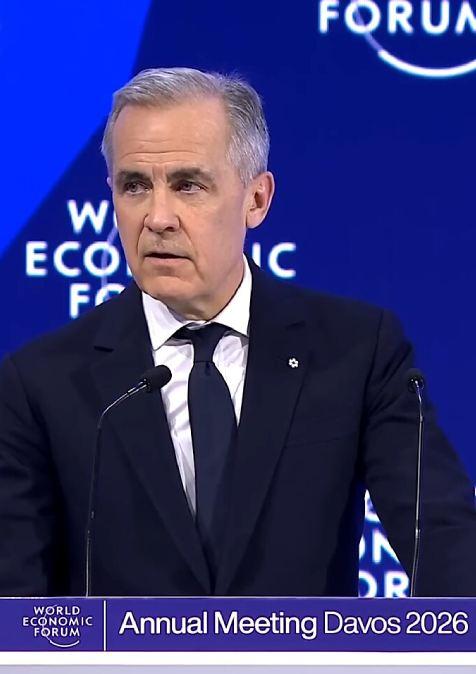
Mark Carney returned to this story in his speech at the World Economic Forum in Davos. By invoking Havel, the Canadian Prime Minister was making a broader point: many of the habits, concepts, and narratives we still use to describe the international system no longer correspond to how it actually functions.
For years, global affairs have been framed as being in a period of “transition”, the assumption being that the international order was under strain, yet fundamentally intact, and that stability would eventually reassert itself. Carney challenges this view. He argues that “we are in the midst of a rupture, not a transition.” The force of this argument lies in its refusal to treat today’s tensions as temporary. Instead, it points to a deeper, structural break in the foundations of the global order.
At the heart of his speech lies a simple observation: even though the old story about the international system no longer holds, it continues to be told.
That story is familiar. It portrays a rules-based international order, presents economic integration as largely beneficial, and assumes that multilateral institutions can shield weaker actors from stronger ones. Over time, this narrative has drifted ever further from reality. Power imbalances have been visible for years, yet rarely confronted directly. As long as the system appeared to function, its contradictions were largely set aside.
The sign remained in the window.
When Integration Becomes Leverage
Carney argues that continuing this performance has become increasingly dangerous. Economic integration, through trade, finance, and global supply chains, was long understood as a shared good. Today, it is frequently deployed as leverage. Tariffs, market access, financial infrastructure, and supply chains have become instruments of pressure, sometimes used not only against rivals, but also against allies.
In this context, describing integration primarily in cooperative terms no longer captures how interdependence is actually being exercised. As Carney puts it, it is no longer possible to “live within the lie of mutual benefit when integration becomes the source of subordination”.
This gap between language and reality is no longer merely implicit, it is increasingly stated openly. In a recent interview, Stephen Miller, a senior White House official and close adviser to Donald Trump, argued that “we live in a world… governed by strength, by force, by power”.
What matters here is not the individual remark, but what it reveals about the moment we are in. When someone so close to the center of power speaks in these terms, there is no longer even an attempt to sustain the fiction. The notion that international politics is primarily shaped by rules or shared principles is not only undermined in practice, it is openly rejected.
This is where Havel’s shopkeeper becomes relevant once again. What initially served as a form of protection gradually turns into a sign of compliance. The sign no longer shields the shopkeeper; it exposes him. A similar dynamic can unfold at the international level. States that continue to rely on the language of cooperation, even as they are subjected to pressure, may find that this language no longer offers protection. Instead, it highlights their vulnerability.
Facing Fragmentation
Unsurprisingly, many countries are now seeking to depend less on others and more on themselves. Energy, food, industrial capacity, and control over strategic sectors have moved to the top of national agendas. Carney treats this shift as understandable: a country unable to secure its basic needs has very little freedom to make its own choices.
At the same time, he warns that national solutions alone are not sufficient. Seeking autonomy in isolation risks producing a fragmented world, one in which countries retreat behind economic and political barriers, becoming less prosperous, less resilient, and less capable of cooperation.
Carney offers a different way of framing the challenge. As he puts it, “nostalgia is not a strategy.” The old order is not coming back, and acting as if it might only postpones decisions that already need to be made. What matters instead is how states, particularly middle powers, adapt to a system shaped by fragmentation and unequal power, without simply accepting a diminished role.
This reflects a basic reality. In bilateral relations with dominant powers, countries rarely negotiate as equals. What ultimately matters is not shared principles, but how much pressure each side can absorb. Governments often justify compromises by claiming there was no real alternative, and sovereignty begins to feel more symbolic than substantive. In this sense, taking the sign down means ending the performance.
Ending the Performance
This is not a call for confrontation or disengagement. It is a call for honesty. The old order no longer delivers what it once promised; double standards erode credibility; and values cannot be defended without the capacity to sustain and protect them.
One of the most pragmatic aspects of Carney’s speech is his emphasis on domestic strength. He links a country’s ability to act abroad to its resilience at home. Building economic capacity, diversifying partnerships, investing in technology, and developing human capital are not expressions of isolationism; they reduce vulnerability and give governments greater room for choice. When defending principles carries immediate costs, governments often opt for what they can afford rather than for what they believe.
For many middle powers and countries in the Global South, this argument will sound familiar. For years, the language used in international forums has diverged from lived experience on the ground. Many states have remained engaged with the system out of necessity rather than conviction. What Carney appears to suggest is that this implicit bargain, stability in exchange for silence, no longer holds.
Havel’s parable helps explain why. In his story, the system appears solid only because people continue to play their assigned roles. It does not unravel through open rebellion, but when individuals quietly stop going along with it. Once that happens, the system begins to weaken from within.
This is the risk Carney is warning about. Repeating the language of cooperation and mutual benefit when it no longer reflects how power is actually exercised may feel safer in the short term, but it cannot endure indefinitely.
Carney therefore argues for a shift in focus. Rather than waiting for the old order to return, governments should begin building what they claim to believe in. This means creating institutions and agreements that function as advertised and reducing forms of dependence that enable pressure and coercion. For Carney, this process begins at home, with a stronger and more resilient domestic economy.
This is where middle powers matter most. Individually, their influence is limited; collectively, they can reduce vulnerability and shape cooperation in more pragmatic ways. As Carney put it in one of the most memorable lines of his speech: “If we’re not at the table, we’re on the menu.”