Publications /
Policy Brief

Back
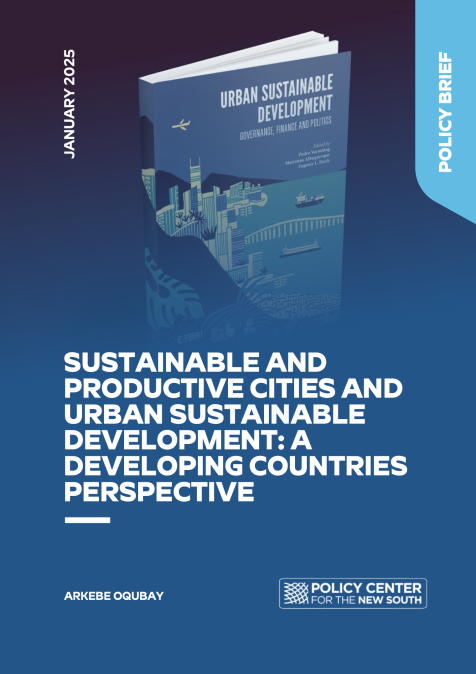
Sustainable and Productive Cities and Urban Sustainable Development: A Developing Countries Perspective
Authors
Arkebe Oqubay
January 20, 2025

This paper, included in the report "Urban Sustainable Development: Governance, Finance and Politics.", was originally published on:https://cebri.org/en/doc/356/cebri-and-rio-g20-committee-publish-urban-sustainable-development-governance-finance-and-politics

 © Vormittag, Pedro, Marianna Albuquerque & Eugénie Birch (Eds.). 2024. Urban Sustainable Development: Governance, Finance and Politics. Rio de Janeiro: CEBRI.


The article discusses the role of sustainable and productive cities as drivers of global transformation. Cities, as the heart of human civilizations, not only propel economic development and serve as technological and innovation hubs but also inspire hope and optimism for the future. They contribute over 80 percent of the global economy and nearly 100 percent to all scientific and technological breakthroughs. Rapid urbanization has been a primary force in the demographic shift that impacts global transformation. With their unparalleled resilience and innovation ability, cities are also at the forefront of significant global challenges, such as the COVID-19 pandemic and climate change, finding sustainable solutions. Cities are not just essential to the 2030 Agenda for Sustainable Development and the Paris Climate Agreement, endorsed by all United Nations member countries, but are the subject and primary actors in implementing it. By recognizing the importance of making “cities and human settlements inclusive, safe, resilient and sustainable” (Goal 11), the 2030 Agenda underscores the importance and impact of cities in shaping the future.

However, in shaping global transformation, cities face significant challenges in releasing their full potential, including financial, governance, and political constraints. A G20 Summit in Rio de Janeiro led by Brasil could be instrumental in promoting city transformation and urban sustainable development as essential components of the development agenda, empowering cities to take charge of their transformation. The objectives of the paper are: (1) to present urbanization and urban transformation as a framework; (2) to explain why and how cities should strive to be not only productive but also sustainable to promote their national development strategies, to achieve Sustainable Development Goals (SDGs) and the net zero agenda; (3) to further discuss the dynamics of city transformation with a focus on Addis Ababa’s transformation as a case study; and (4) to learn from city leadership experiences. The article will explore critical questions: What specific strategies can cities implement to become productive and sustainable cities? What examples of successful city transformation and leadership experiences can be learned from? Given the urbanization wave, population growth, and the lagging structural transformation, these questions have significant implications for cities in emerging and developing economies or the Global South.

This article is enriched by the author’s over three decades of experience in development policymaking and transformation, including serving as the former mayor of Addis Ababa and former minister of urban development. This unique perspective, combined with extensive scholarly and research work drawing from development economics, urban development, and international political economy, provides a comprehensive understanding of the issues at hand. The paper is structured into four sections covering the above mentioned themes, supplemented by an introduction and conclusion. The author’s unique perspective is a critical element that makes this paper a valuable resource for understanding urban transformation.


RELATED CONTENT

  • August 22, 2025
    This episode explores the opportunities and challenges of achieving deeper economic integration under the African Continental Free Trade Area (AfCFTA). We discuss the potential for boosting intra-African trade, industrialization, and investment flows. The conversation highlights the nee...
  • Authors
    August 19, 2025
    The multilateral, rule-based trading system underpinned by the World Trade Organization (WTO) has been undermined by the unilateral imposition of U.S. tariffs. Crucially, the foundational principle of non-discrimination among WTO members has been abandoned. While many countries have attempted to negotiate with the U.S. to resolve tariff disputes, they have simultaneously sought to deepen trade ties with each other through plurilateral and regi ...
  • Authors
    August 19, 2025
    The international monetary system has been dominated by the U.S. dollar since the Second World War. The hegemony of the greenback cut across the end of the dollar exchange standard established by the Bretton Woods Agreement, and came out from the global financial crisis—and the euro crisis—even stronger than before. The euro area and China are taking steps to strengthen the international role of their currencies, but surmounting the inner strength of the dollar-based monetary system ...
  • August 18, 2025
    China's ascent to the position of the world's most prominent energy consumer has altered global energy markets and fundamentally reshaped the geopolitics of energy security. As China navigates the complexities of sustaining its economic momentum, ensuring access to reliable, affordable, and diversified energy sources has become an existential imperative, intricately woven into its foreign policy strategy. In parallel, Africa's immense wealth of both conventional and renewable resour ...
  • Authors
    Sergio Queiroz
    Nicholas Vonortas
    August 18, 2025
    This Paper was originally published on springer.comBrazil went from a quite impressive economic performance during much of the twentieth century to a period of mediocre growth from 1980 onwards. This shift has positioned the country as a textbook case of the “middle-income trap”. This paper aims to demonstrate how certain transformations in the international economy since the 1980s—notably the globalization of firms and industries—combined with a set of domestic challenges, disrupte ...
  • August 08, 2025
    Dans cet épisode, Ibrahima Sory Cissé  et Adri Dibaba Makpira Gnassengbe  partagent leur expérience à la tête des radios rurales en Afrique de l’Ouest. Ils évoquent le rôle cruc ...
  • Authors
    Jihad Ait Soussane
    August 7, 2025
    This paper was originally published on tandfonline.comThis study investigates the long-term impact of hosting the FIFA World Cup on unemployment using panel data of 10 countries from 1983 to 2022. The empirical analysis used two estimation techniques namely the Robust Weighted Least Squares (RWLS) and Estimated Generalized Least Squares (EGLS) with fixed and random effects. Our findings reveal that hosting the FIFA World Cup can reduce long-term unemployment by 2.86% to 3.60% over f ...
  • Authors
    Zakaria Elouaourti
    August 7, 2025
    This paper was originally published on tandfonline.comYouth’s life paths have become increasingly challenging, especially for those classified as ‘Not in Education, Employment, or Training’ (NEET), who comprise 31.2% of North Africa’s youth population. This paper contributes to the growing discourse on the NEET phenomenon by exploring its structural and psychosocial dimensions in North Africa, with a specific focus on gender. Using a rich micro-level dataset of 7,815 individuals age ...
  • August 7, 2025
    This episode focuses on the Africa Pulse Report 2025, the World Bank’s flagship analysis of economic trends and policy challenges in Sub-Saharan Africa. As the region works to strengthen its recovery while contending with structural and macroeconomic difficulties, Andrew Dabalen, Chief ...