Publications /
Research Paper

Back
Stabilization Experience in the MENA Region: An Analytical Retrospective (2015–2024) Egypt, Morocco, Tunisia, and Jordan
Authors
El Hussein Fouad
June 17, 2025

This paper analyses the stabilization experience in the MENA region, focusing on Egypt, Morocco, Tunisia, and Jordan over the past century. It seeks to answer the question: To what extent have these countries succeeded in achieving resilience to shocks and stresses? Key policy elements included significant fiscal adjustments—varying in scale across countries—and exchange rate developments supported by monetary policies aimed at combating inflationary pressures. The outcomes involved avoiding output collapse despite fiscal consolidation and repeated shocks, enduring stress within the financial system without systemic failure, and maintaining external viability despite lackluster trade performance.

The paper proposes macroeconomic policy recommendations across three key pillars: fiscal policy, monetary policy, and trade and industrial policy. These recommendations are tailored to the structural characteristics, reform priorities, and external vulnerabilities of each country. The experience of successful stabilization provides a solid foundation for advancing the structural reforms needed to enhance resilience and boost economic growth.
RELATED CONTENT

  • Authors
    Amine BENBERNOU
    Dorothée SCHMID
    March 23, 2020
    La géopolitique du Moyen-Orient connaît aujourd’hui des changements structurels: l’ordre régional est en transition, dans le sillage des printemps arabes, qui ont ébranlé la gouvernance autoritaire et libéré la compétition de puissance, sur fond de retrait américain. Cette nouvelle course à la domination régionale remet en cause la hiérarchie traditionnelle des puissances, essentiellement fondée sur la capacité militaire et le jeu des alliances extérieures. L’économie, jusque-là gar ...
  • December 19, 2019
    Emerging market and developing economies: Engine of the global economic growth despite some vulnerabilities1 After a long spell of slow growth post-crisis, the global economy’s recovery was mainly supported by the improvement of emerging markets and developing economies growth. However, this recovery is subject to wide-ranging uncertainties and is now in some danger. According to the IMF, the global economic growth is expected to fall to 3 % in 2019, the lowest level since 2008. Th ...
  • Authors
    Taoufik Abbad
    February 3, 2017
    La réflexion développée dans cet ouvrage part d’un constat alarmant et pressant. Le processus continu et renforcé de l’accumulation du capital, dans lequel s’est engagé le Maroc depuis les années 2000, a permis certes de préserver la stabilité des équilibres fondamentaux et d’amortir les différents chocs exogènes, aussi bien internes qu’externes, mais il n’a pas permis d’insuffler un accroissement plus important des gains de productivité et d’accélérer la transformation de la base p ...
  • Authors
    Prakash Loungani
    November 9, 2016
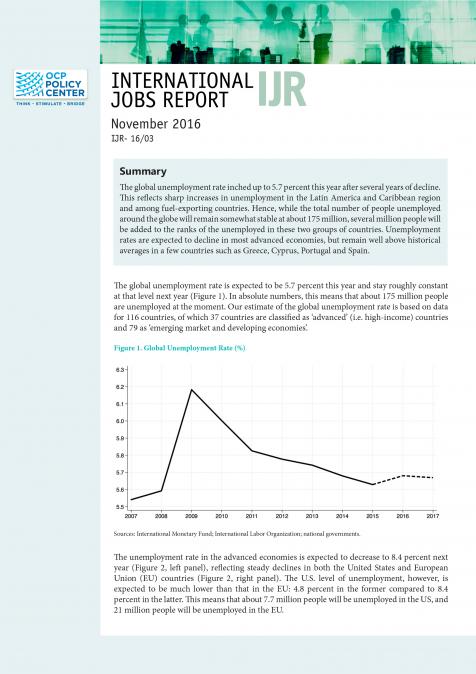
    The global unemployment rate inched up to 5.7 percent this year after several years of decline. This reflects sharp increases in unemployment in the Latin America and Caribbean region and among fuel-exporting countries. Hence, while the total number of people unemployed around the globe will remain somewhat stable at about 175 million, several million people will be added to the ranks of the unemployed in these two groups of countries. Unemployment rates are expected to decline in m ...
  • Authors
    November 7, 2016
    Despite the gloomy tone of much discussion at the just-concluded IMF and World Bank annual meetings, the global economy is not in as bad shape as many think. The concerns about “secular stagnation” in advanced countries are also overplayed, and nor are developing countries directly exposed to such risks. By contrast, the pessimism about the prospects for MENA are unfortunately largely justified. Most importantly, at the global and at the MENA level the biggest concerns are not econo ...
  • Authors
    Russel Dinh
    January 27, 2016
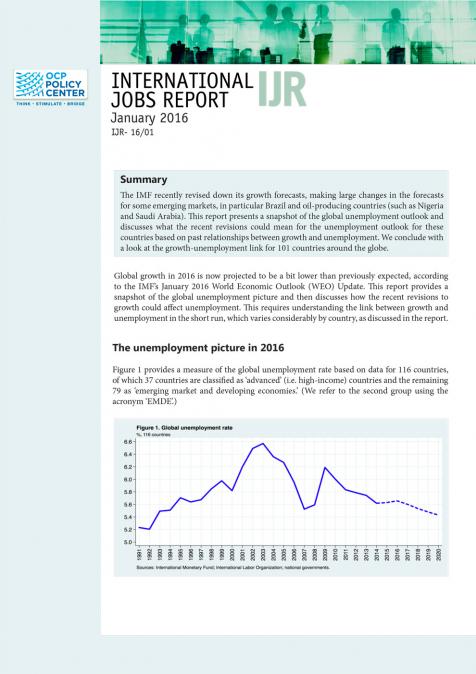
    The IMF recently revised down its growth forecasts, making large changes in the forecasts for some emerging markets, in particular Brazil and oil-producing countries (such as Nigeria and Saudi Arabia). This report presents a snapshot of the global unemployment outlook and discusses what the recent revisions could mean for the unemployment outlook for these countries based on past relationships between growth and unemployment. We conclude with a look at the growth-unemployment link f ...
  • Authors
    May 18, 2015
    Economic integration is crucial in order to achieve rapid and sustainable growth. However, instabilities in the MENA region and the recent plunge in oil prices may stifle the economic progress in some of these countries, and threaten their attempts at integration. Within this context, this note seeks to analyze the efforts of integration that MENA countries have undertaken, particularly through trade agreements; and to articulate some principles that can help guide the ongoing searc ...