Publications /
Opinion
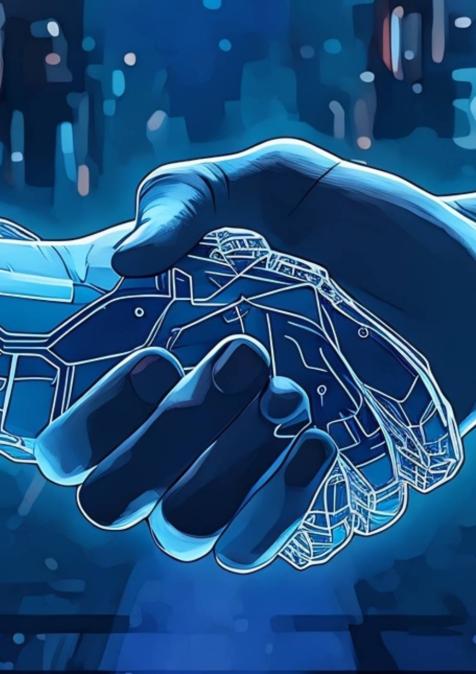
At the recent Annual Meeting of the Global Future Councils in Dubai (15-17 October), a thought-provoking session titled “Skills in the Age of AI” brought together international experts to examine how artificial intelligence will impact the future of work and education. The discussions highlighted an impending transformation, with AI poised to reshape and redefine the skills landscape over the next decade. Here, we explore some key ideas from the session and the essential skills needed to prepare for an AI-driven world.
AI: Catalyst for Job Creation and Disruption
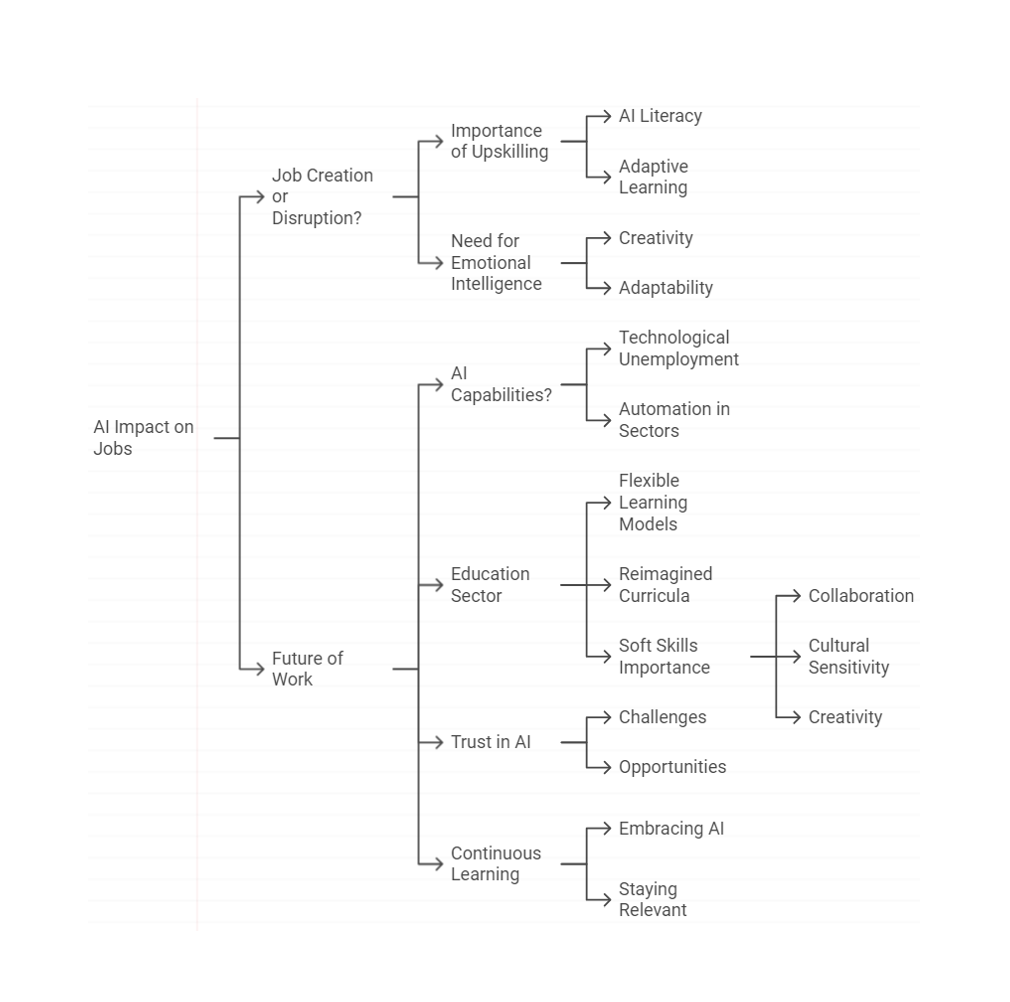
In the years ahead, AI is expected to act as both a creator and a disruptor of jobs. While fears of job loss due to automation are not new—similar concerns surfaced historically, like when Oxford professors protested calculators—they are now amplified by AI’s rapid advancement. Experts argue that the issue is not that AI will replace every job but that it will heighten the value of uniquely human skills. Without AI literacy, individuals may face greater challenges, creating a clear need for workforce upskilling worldwide.
However, many organizations are lagging in AI training, resulting in a significant skills gap. Although AI provides an opportunity for companies to reimagine human capital management, very few have actively invested in reskilling their employees. This session highlighted that preparing workers with adaptive learning skills, critical thinking, and a foundational understanding of AI will be essential for maintaining employability in a rapidly changing job market.
The Future of Work: Speculation and Divergent Opinions
Looking ahead, experts at the session painted two contrasting pictures of AI’s impact on jobs. Some believe that within the next decade, AI could surpass human capabilities in various fields, potentially leading to widespread “technological unemployment.” In this scenario, each worker might have a more efficient, less costly AI “twin,” putting job security in traditional roles under new pressures. Others suggest that such advancements may be further off than expected, though automation is already making significant changes in sectors like manufacturing and even some creative fields.
Skills such as emotional intelligence, creativity, and adaptability emerged as essential to human resilience against automation. As machines take over repetitive tasks, interpersonal skills and critical thinking will likely define human value in the workforce. The panel’s outlook: while demand for roles in AI engineering and robotics is expected to rise in the short-term, interpersonal and adaptive skills will be crucial in the long run.
A New Frontier for Learning: Adapting to an AI-Infused World
The session also highlighted the education sector’s need for flexible, adaptive learning models to keep pace with AI's rapid evolution. New AI-based learning tools are emerging faster than institutions can adapt; for example, a recent academy module became outdated within just a week of its release. Learning solutions like Arist, developed amid Yemen’s crisis, were showcased as examples of resilient and inclusive educational technologies, with SMS-based access proving vital for remote learners.
To remain relevant in a fast-changing job market, educational institutions must evolve alongside AI. The rise of skilled, self-taught developers challenges traditional academia’s dominance in credentialing, spurring calls at the council to rethink how engineering and AI curricula are designed and delivered. The call to action: restructure education to evolve as swiftly as technology, equipping students with skills for future careers.
Additionally, AI integration in the workplace—through platforms like Teams and WhatsApp—marks a shift toward “in-the-flow” learning, where employees acquire skills relevant to their tasks without traditional classroom constraints. Experts advocated for "liquid" learning experiences that align with the user-friendly interfaces of companies like Apple and Amazon, responding to the demand from younger, tech-savvy learners.
Beyond Hard Skills: The Growing Importance of Soft Skills
The session underscored the rising importance of “soft” skills—such as collaboration, cultural sensitivity, and creativity—in an AI-driven future. As AI systems become more generative and collaborative, successful human-machine partnerships will require strong human contributions, including effective communication, cultural intelligence, and constructive feedback. Additionally, transferable skills like agility, critical thinking, and adaptability were identified as essential for workers to thrive in a landscape shaped by continuous technological progress.
Building Trust in AI: Challenges and Opportunities
As automation expands in the workplace, trust in AI systems becomes crucial. While companies are eager to implement AI solutions, they exercise caution, especially in sensitive areas like customer interactions. Missteps involving AI chatbots that miscommunicate or lead to legal issues highlight the need for more reliable systems. For AI to reach its full potential, fostering a culture of trust is vital, particularly as we transition to more integrated AI applications across industries.
Closing Reflections: Embracing Continuous Learning
In their closing reflections, council participants emphasized the importance of cultivating a culture of lifelong learning. For individuals, this means viewing AI as an ally rather than a competitor and continuously expanding their skill sets to remain relevant. With technology evolving at an unprecedented pace, staying proactive and adaptable will be essential for anyone aiming to succeed in the AI era.
As the meeting concluded, a shared sense of both challenge and opportunity permeated the room. Participants left with the understanding that the path forward will require intentional, collaborative efforts to integrate AI ethically and effectively across all sectors. The future, as envisioned by the Global Future Councils, is one where AI and human ingenuity not only coexist but amplify each other—provided we commit to the challenge of lifelong learning and adaptability.