Publications /
Opinion

Back
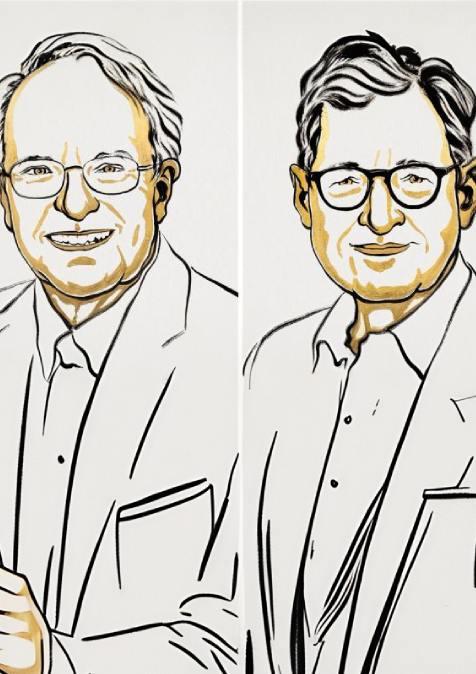
Robert E .Hall et Michael Woodford, Prix Nobel d’Économie 2026
October 26, 2026

Depuis que l’économie a été reconnue par les Nobel en 1969, il revient à cette discipline de clore les cérémonies annuelles d’attribution des Prix aux lauréats. C’est le 12 octobre 2026 que le jury du prix de la Banque de Suède, en sciences économiques en mémoire d’Alfred Nobel, a consacré deux Américains Prix Nobel de l’économie : Robert E. Hall et MichaelWoodford, pour leur contribution aux « fondements microéconomiques de la stabilisation macroéconomique de la stabilisation ».

Le choc pétrolier de 1973, aboutissant à la stagflation, va mettre à mal les recettes keynésiennes de l’après-guerre. Mais, à la différence de nombreux   Keynésiens qui désiraient tourner la page du Maitre de Cambridge, nos deux lauréats vont chercher à donner une nouvelle dimension à son analyse, à partir d’une approche micro économique comportementale des individus et des entreprises. Et ils vont agir en complémentarité, Robert E .Hall, en privilégiant la demande, Michael Wood, l’offre.

Robert E .Hall enseigne toujours à l’université de Stanford (Californie), aux États-Unis, après avoir soutenu sa thèse de doctorat, sous la direction de Robert Solow, Prix   Nobel d’Économie en 1987. Ses travaux vont porter principalement sur la prise en compte des anticipations dans la décision   de consommer ou de ne pas consommer. Avant sa contribution, on considérait que la consommation dépendait du revenu disponible et de lui seul. Hall va montrer qu’on ne peut comprendre l’évolution de la consommation sans prendre en compte les anticipations individuelles du consommateur, par exemple celle qui concerne son salaire ou son pouvoir d’achat. Dans un article fondateur de 1978, il montre que le changement de consommation est imprévisible, ce qui le conduit à conclure que la meilleure prédiction de la consommation ne peut se fonder que sur la consommation du moment, à une variation imprévisible près. (Son ouvrage de   référence : ‘’The 

Rational Consumer :Theory  and Evidence ‘’, MIT Press /Cambridge, Massachusetts 1990)

Michael Woodford enseigne à l’université de Columbia (New York). Ses travaux concernent la version offre de la problématique. Et ce, en analysant la fixation des prix par les entreprises, et plus particulièrement les raisons pour lesquelles , en cas de choc, les prix ne s’ajustaient pas rapidement. Il va montrer que si ces prix pouvaient baisser, cela ne pouvait être que très lentement, leur adaptation au choc nécessitant de multiples, et parfois couteuses, micro-décisions. À partir de ce constat, il va développer, en y intégrant, les travaux de Hall sur la consommation, un modèle macroéconomique beaucoup plus efficace, montrant, par exemple, que l’inflation globale est fonction des anticipations et du niveau actuel de la production, qu’il va intégrer à celui de Hall. Woodford va ainsi influencer les politiques économiques et monétaires du monde entier. Ce qui lui vaudra d’être qualifié par certains du « plus grand économiste monétaire de son temps ». ( Son ouvrage de référence : ‘’ Interest   and Prices :Foundations  of a Theory of Monetary Policy ‘’ Princeton University Press   2003 )

En distinguant un champ de recherche, celui de la nouvelle économie keynésienne, le jury ne pouvait en ignorer le pionner :Robert E .Hall , et celui qui va le plus contribuer à la faire progresser, allant jusqu’à la modéliser avec des applications concrètes : Michael Woodford.


RELATED CONTENT

  • Authors
    March 25, 2025
    When President Donald Trump gave his State of the Union address to a joint session of the United States Congress on March 4, 2025, many of his announced tariffs went into effect. These included a 25% levy on most goods imports from Canada (10% on oil and gas) and Mexico (though Trump subsequently exempted Canadian and Mexican imports that satisfy USMCA rules of origin requirements); and 20% (doubling the 10% implemented in February) on all imports from China. A 25% tariff has been i ...
  • Authors
    Sampawende J. Tapsoba
    March 24, 2025
    The return of President Donald Trump could significantly impact macroeconomic policy in Africa. The effects may vary across the continent. Nations that remain neutral towards U.S. influence are likely to benefit, while those aligned with the U.S.'s rivals or lacking immediate economic advantages may be deprioritized in U.S. foreign policy. In this article, we examine the channels through which U.S. policies and the change in political discourse could affect macroeconomic policies in ...
  • Authors
    Peter Drysdale
    Alicia Garcia-Herrero
    Nagesh Kumar
    B. V. R. Subrahmanyam
    March 21, 2025
    This Chapter was originally published on springer.comSo, this session really is about what's happened to global trade in the last couple of decades, of course, really since the global financial crisis, trade dependency has levelled off, peaking at around 60% in 2008, 2009.  ...
  • Authors
    March 21, 2025
    MENA faces a severe water crisis, with 12 of the world’s 17 most water-stressed countries. Climate change, population growth, inefficient water management, and weak governance drive this challenge. Water production, treatment, and distribution require high energy inputs, while energy generation depends on water for cooling and refining. The region must integrate renewable energy, especially solar power, into water solutions like desalination. Inaction could shrink GDP by up to 14% ...
  • March 20, 2025
    Le marché du travail marocain traverse des défis structurels majeurs, avec un taux de participation relativement faible (43,5 %) et encore plus marqué chez les femmes, dont la participation reste inférieure à 20 %. Le chômage, quant à lui, est élevé, particulièrement parmi les jeunes diplômés, atteignant 30 %, et une grande partie de l'emploi urbain se trouve dans le secteur informel, représentant entre 20 et 40 % des emplois. Ce marché est également marqué par des d ...
  • March 20, 2025
    This paper (see pages: 152-164), included in the report 'The Reckoning Regression or Renaissance?' was originally published on orfonline.org   Calls for reforms of the International Financial Architecture (IFA) are foregrounded by the growing financing needs of developing countries, driven by mounting climate-related challenges; conflict and violence; rising numbers of internally displaced persons (IDPs); and macroeconomic imbalances, including crippling debt service and ...
  • March 18, 2025
    كشفت المندوبية السامية للتخطيط في نتائج البحث الوطني الأخير حول معيشة الأسر المغربية معطيات تثير النقاش، أبرزها وضع الطبقة الوسطى التي تُعد ركيزة أساسية للاستقرار الاقتصادي والاجتماعي ومحركًا رئيسيًا للنمو. لكن هذه الطبقة تواجه اليوم تحديات غير مسبوقة، وأهمها تصاعد غلاء المعيشة. فما هو ...
  • Authors
    March 14, 2025
    The traditional model of Official Development Assistance (ODA) has not only entrenched financial dependence but also served as a tool for geopolitical influence, often prioritizing donor interests over genuine economic self-sufficiency in developing nations. The 2015 Sustainable Development Goals (SDGs) envisioned a shift towards private investment, but this strategy has largely failed. Capital flight, rising debt burdens, and systemic financial asymmetries have ensured that investm ...
  • Authors
    Zakaria Elouaourti
    March 14, 2025
    This paper was originaly published on erf.org.eg   Youth's life paths have become increasingly challenging, especially for those classified as "Not in Education, Employment, or Training" (NEET), who comprise 31.2% of North Africa's youth population. The region faces high youth unemployment rates, with 22.3% in 2023, rising slightly to 22.5% in 2024, and projected to return to 22.3% in 2025 (ILO, 2024). Notably, North African youth not only exhibit the highest desire to m ...
  • Authors
    Mohamed Elmagbri
    March 13, 2025
    Libya faces a paradox: it has a bloated public sector employing millions, yet a crippling unemployment crisis, especially among young people. According to the Libyan Audit Bureau’s 2023 report[1], over two million people work for the government, a figure that excludes state-owned enterprises such as oil companies, banks, and utilities companies. With a total labor force of 2.5 million[2], out of every ten Libyan adults, eight are employed by the government. This massive public workf ...