Publications /
Policy Brief

Back
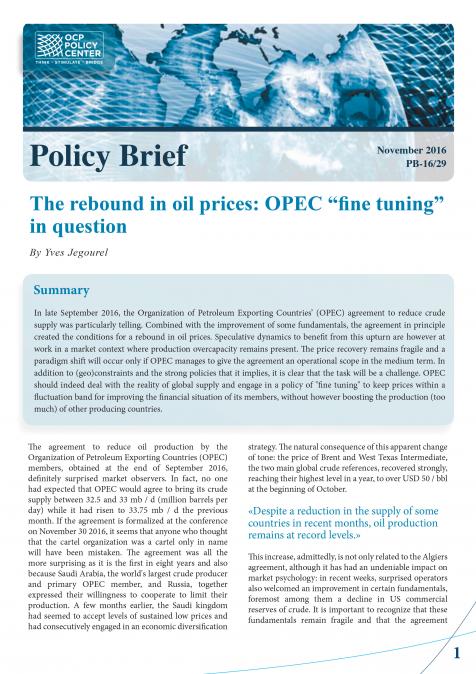
The rebound in oil prices: OPEC “fine tuning” in question
Authors
November 21, 2016

In late September 2016, the Organization of Petroleum Exporting Countries’ (OPEC) agreement to reduce crude supply was particularly telling. Combined with the improvement of some fundamentals, the agreement in principle created the conditions for a rebound in oil prices. Speculative dynamics to benefit from this upturn are however at work in a market context where production overcapacity remains present. The price recovery remains fragile and a paradigm shift will occur only if OPEC manages to give the agreement an operational scope in the medium term. In addition to (geo)constraints and the strong policies that it implies, it is clear that the task will be a challenge. OPEC should indeed deal with the reality of global supply and engage in a policy of "fine tuning" to keep prices within a fluctuation band for improving the financial situation of its members, without however boosting the production (too much) of other producing countries.

RELATED CONTENT

  • Authors
    Daniel Yeo
    Global Green Growth Institute Ethiopia
    June 12, 2014
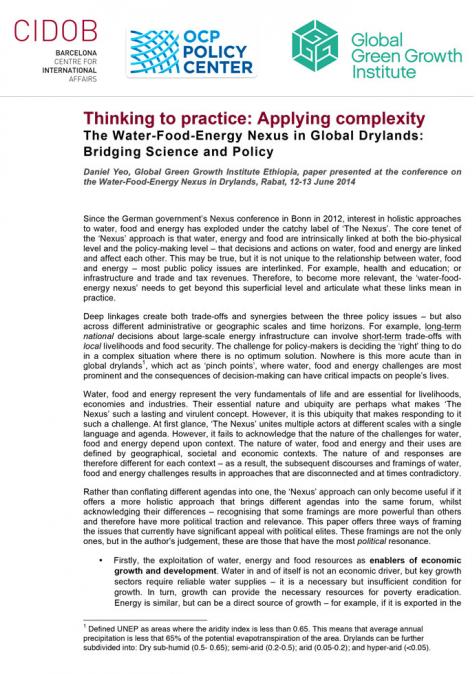
    Since the German government’s Nexus conference in Bonn in 2012, interest in holistic approaches to water, food and energy has exploded under the catchy label of ‘The Nexus’. The core tenet of the ‘Nexus’ approach is that water, energy and food are intrinsically linked at both the bio-physical level and the policy-making level – that decisions and actions on water, food and energy are linked and affect each other. This may be true, but it is not unique to the relationship between wat ...
  • June 12, 2014
    Interview with THONY ALAN - International Conference on The Water-Food-Energy Nexus in Drylands: Bridging Science and Policy 11-13 June 2014, Rabat, Morocco ...
  • October 20, 2010
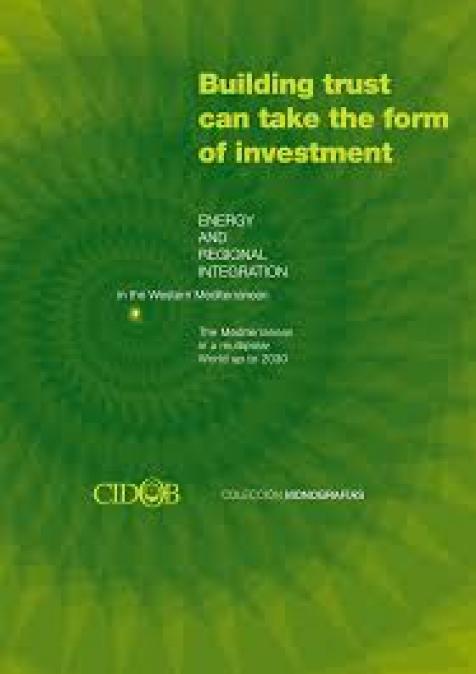
    Under the general title of “The Mediterranean in a multipolar world up to 2030”, CIDOB, in partnership with the OCP Foundation in Rabat, is working on a three year research program (2010-2012) whose aim is to analyse how countries in the area might overcome their differences and imagine a common future. This publication is a result of the initial phase of the research, which focused on energy and regional integration in the Western Mediterranean. It includes 5 comprehensive papers w ...
  • From

    03
    11:00 am November 2026
    Le nucléaire civil connaît depuis quelques années un regain d’intérêt dans les politiques énergétiques et climatiques internationales. Face à la hausse de la demande électrique, aux objectifs de décarbonation et aux préoccupations de sécurité énergétique, il retrouve une place parmi les options envisagées. Son développement soulève toutefois des défis importants, notamment en matière de financement, de délais de construction, de sûreté et de sécurisation des chaînes d’approvisionnement.Ces enjeux se posent différemment entre les deux rives de la Méditerranée. Alors que plusieurs pays européens cherchent à prolonger ou renouveler leurs capacités nucléaires existantes, les pays du Sud et de l’Est de la Méditerranée doivent évaluer les conditions nécessaires à l’introduction éven ...
  • From

    29
    5:30 pm October 2026
    Cet épisode examine le stress hydrique en Afrique du Nord en démêlant ses causes (changement climatique, hausse des besoins, gouvernance de l’eau) et en montrant que leur poids varie selon les pays. Il interroge ensuite la répartition du coût de la pénurie et les arbitrages entre villes, agriculture et industrie, afin de limiter les inégalités sociales et territoriales. Enfin, il évalue la place du dessalement : ce qu’il permet de sécuriser, ce qu’il ne règle pas, et les conditions (accessibilité des prix, maîtrise énergétique, protection du milieu marin) pour qu’il devienne une solution durable plutôt qu’un simple prolongement des modèles actuels. ...