Interview Rabi Mohtar - Texas A&M University & Qatar Foundation

June 12, 2014

Interview with Rabi Mohtar - International Conference on The Water-Food-Energy Nexus in Drylands: Bridging Science and Policy 11-13 June 2014, Rabat, Morocco

Speakers
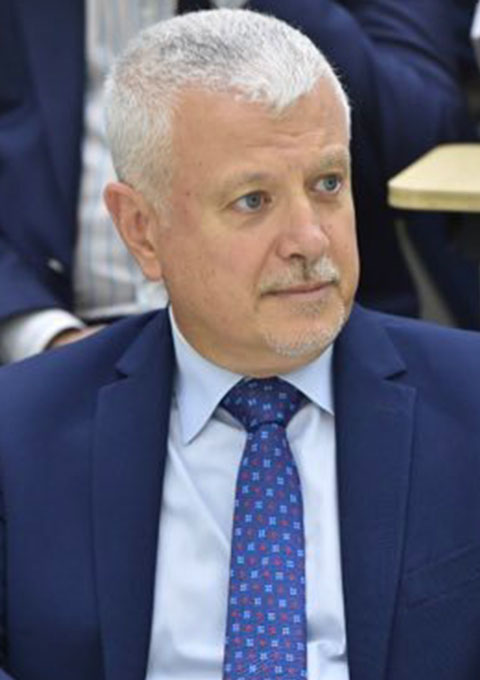
Rabi Mohtar
Senior Fellow
Rabi H. Mohtar is a Senior Fellow at the Policy Center for the New South and Professor and former Dean of the Faculty of Agricultural and Food Sciences at the American University of Beirut, who focuses on Civil and Biological/Agricultural Engineering, Environmental and Ecological Engineering, Water-Energy-Food Nexus, Water Security and Climate Change. He is also Professor at Texas A&M University, College Station, Texas and Adjunct Professor at Purdue University. He is the Founding Director of Qatar Environment and Energy Research Institute (QEERI) a member of Qatar Foundation, Research and Development and the Founding Director Strategic Projects at Qatar Foundation Research and Development. He was also the inaugural Director of the Global Engineering Programs at Purdu ...

RELATED CONTENT

  • Authors
    October 27, 2026
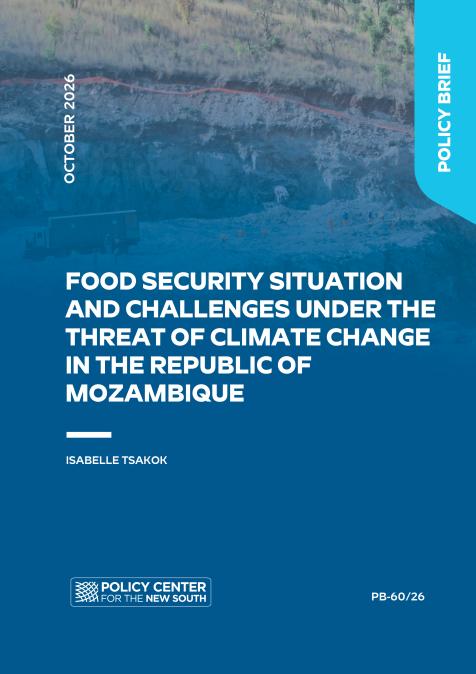
    Mozambique’s extractive-industry development model is a textbook case of how enormous FDI funds derived from its rich mineral base have not been leveraged to   promote inclusive economic growth and generate food security for all. It is a textbook case of the resource curse.  Instead, only a few have benefitted, leaving the poor and vulnerable, who constitute the vast majority, to struggle unassisted. These include smallholders in subsistence-oriented agriculture ...
  • October 23, 2026
    In this episode, Mehran Haghirian explores the global economic consequences of disruptions in the Strait of Hormuz, beyond oil and gas. He examines their impact on trade, fertilizer suppl ...
  • Authors
    September 14, 2026
    The outbreak of the war in Iran and the closure of the Strait of Hormuz have had major consequences for a large number of global commodity markets. While media attention has understandably focused on oil and natural gas, as well as on aluminum – owing to the strong dependence of that metal’s supply on energy prices – sulfur, like helium, ethylene, propylene, or urea, has also been caught up in the fallout of this conflict. Far from being a marginal commodity, it is essential to the ...
  • Authors
    September 14, 2026
    Le déclenchement de la Guerre en Iran et le blocage du détroit d’Ormuz ont eu des conséquences majeures sur un grand nombre de marchés mondiaux de matières premières. Si l’attention médiatique s’est logiquement portée sur le pétrole et le gaz naturel, ainsi que sur l’aluminium, en raison de la forte dépendance de l’offre de ce métal aux prix de l’énergie, le soufre, comme l’hélium, l’éthylène, le propylène ou l’urée, a également été pris dans les rets de ce conflit. Loin d’être une ...
  • Authors
    August 5, 2026
    This paper addresses the persistent challenge of resource dependence in the world's poorest countries, focusing on the ten poorest African nations where natural- resource rents average 14% of income. It argues that four decades of conventional policy advice, which treated resource dependence primarily as a revenue management problem, have failed to help these countries. While stabilization funds and permanent-income frameworks aim to smooth consumption, they do not answer the fundam ...
  • May 5, 2026
    Gaspillage de l’eau et son mésusage : deux facteurs du stress hydriqueCe Policy Brief est consacré aux phénomènes de gaspillage et de mésusage de l’eau: deux impératifs de la lutte contre le stress hydrique, rappelés, avec insistance, par   Sa Majesté le Roi Mohammed VI dans son discours du 29 juillet 2024, à l’occasion de la célébration du 25ème anniversaire de son accession au Trône. La première partie de l’étude aborde la problématique générale du gaspillage e ...
  • April 9, 2026
    Cet entretien explore le Nexus Eau-Énergie-Alimentation comme un défi systémique majeur pour le Maroc, dans un contexte de rareté croissante des ressources et de pressions sur la souveraineté. Il met en lumière les interdépendances critiques entre ces trois secteurs et les limites d’app...
  • Authors
    July 2, 2024
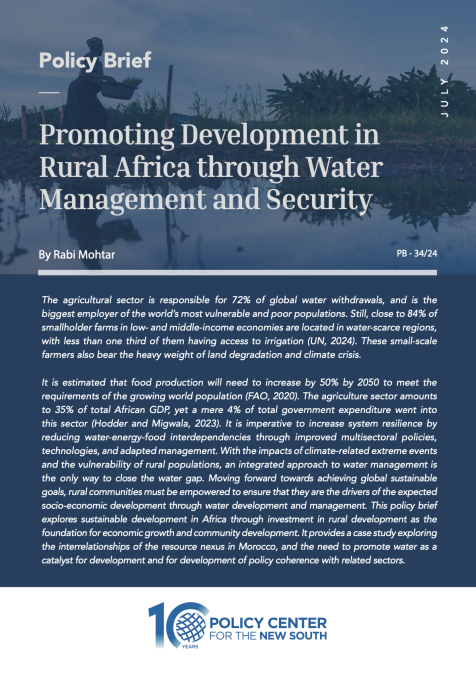
    The agricultural sector is responsible for 72% of global water withdrawals, and is the biggest employer of the world’s most vulnerable and poor populations. Still, close to 84% of smallholder farms in low- and middle-income economies are located in water-scarce regions, with less than one third of them having access to irrigation (UN, 2024). These small-scale farmers also bear the heavy weight of land degradation and climate crisis. It is estimated that food production will need to ...