Interview Rabi Mohtar - Texas A&M University & Qatar Foundation

June 12, 2014

Interview with Rabi Mohtar - International Conference on The Water-Food-Energy Nexus in Drylands: Bridging Science and Policy 11-13 June 2014, Rabat, Morocco

Speakers
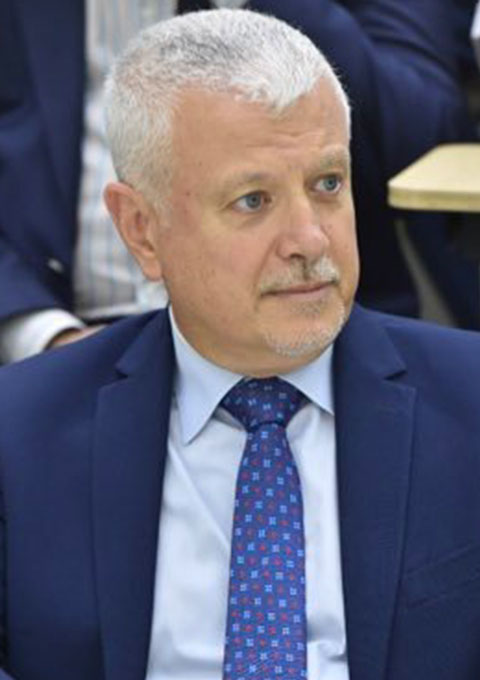
Rabi Mohtar
Senior Fellow
Rabi H. Mohtar is a Senior Fellow at the Policy Center for the New South and Professor and former Dean of the Faculty of Agricultural and Food Sciences at the American University of Beirut, who focuses on Civil and Biological/Agricultural Engineering, Environmental and Ecological Engineering, Water-Energy-Food Nexus, Water Security and Climate Change. He is also Professor at Texas A&M University, College Station, Texas and Adjunct Professor at Purdue University. He is the Founding Director of Qatar Environment and Energy Research Institute (QEERI) a member of Qatar Foundation, Research and Development and the Founding Director Strategic Projects at Qatar Foundation Research and Development. He was also the inaugural Director of the Global Engineering Programs at Purdu ...

RELATED CONTENT

  • Authors
    May 18, 2022
    The world food price index collected for the last 60 years by the United Nations Food and Agriculture Organization (FAO) hit its highest record in March, declining gently in April. Pandemic, war and death in Ukraine, and droughts in the last 2 years… Such a combination looks apocalyptical. Now it is adding global hunger risks, because of the food price crisis. The rise in global food prices started in mid-2020 because supply chain disruptions triggered food stockpiling. Mobility r ...
  • March 1, 2022
    Known for being a climate change hotspot, Morocco is at the forefront of a climate disaster. Consequences are already being felt, whether in the form of increasing temperature or a downward trend in precipitations, which directly threaten the water security and, by extension, the social-ecological systems of the country. The systems by which food, energy, and water are produced, distributed, and consumed heavily depend on one another. Their implicit feedbacks and links are not linea ...
  • Authors
    December 10, 2021
    Addressing the increasing demands for water, energy, and food requires a coherent methodology to ensure that  societies have access to them and that conflict over them is avoided. For example, agriculture and food production  require water and energy; energy production also requires water and, in some instances, agricultural products.  Water distribution and treatment can be very energy intensive. Therefore, the benefits of approaching the Water- Energy-Food (WEF) nex ...
  • March 17, 2021
    Cette étude concerne la Communauté économique des Etats d'Afrique de l'Ouest (CEDEAO), rappelant, tout d'abord, leur diversité géographique, démographique et économique. Montrant ce que ces Etats ont en commun mais, aussi, ce qui les différencie. La CEDEAO, qui réunit quinze pays parmi les plus pauvres de la planète, si on se réfère à leur PIB par habitant, en dollar courant ou en parité de pouvoir d'achat/PPA/. Ce qui explique une démographie explosive, sans que l'on puisse dire si ...
  • Authors
    Sang-Hyun Lee
    Amjad T. Assi
    Bassel Daher
    October 5, 2020
    Our Senior Fellow Rabi Mohtar has co-authored with our economist, Fatima Ezzahra Mengoub along other researchers a research paper entitled « A Water-Energy-Food Nexus approach for conducting trade-off analysis: Morocco’s phosphate industry in the Khouribga region » in Hydrology and Earth System Sciences Journal (Volume 24, Issue 10). The study objective was to develop and use the Water-Energy-Food Nexus Phosphate (WEF-P) Tool to evaluate the impact of Morocco’s phos ...
  • Authors
    Tharcisse Guedegbe
    September 27, 2019
    This paper is about the basic principles which should guide fertilizer policy for smallholder agriculture in sub-Saharan Africa It is not about detailed country-specific prescriptions on the “how” of policy. This important task should constitute the substance of detailed country studies. The overarching goal here is to use fertilizer to spearhead and sustain an African Green Revolution (GR). In this paper, fertilizer use is not considered as an end in itself, but as a necessary mean ...
  • Authors
    Holger Hoff
    Sajed Aqel Alrahaife
    Rana El Hajj
    Kerstin Lohr
    Nadim Farajalla
    Kerstin Fritzsche
    Guy Jobbins
    Gül Özerol
    Robert Schultz
    Anne Ulrich
    May 13, 2019
    Adopting an integrated approach to the management and governance of natural resources including land, water and energy is seen as an effective way to improve the sphere of production while respecting the environment. Fatima Ezzahra Mengoub, economist at the Policy Center for the New South, was invited by Stockholm Environment Institute, alongside other prestigious research centers with expertise in environmental studies, to co-author this research paper and share her analysis of th ...
  • Authors
    Sabine Cessou
    April 16, 2019
    Le rapport Arcadia a été présenté le 9 avril à Paris par le Policy Center for the New South (PCNS) et le Cercle CyclOpe. Ce document de référence fait chaque année le point sur la conjoncture des matières premières africaines. “Elles restent essentielles, avec une forte dépendance pour nombre de pays et une gestion de la rente relativement problématique”, a affirmé en introduction Philippe Chalmin, président du Cercle CyclOpe. Fortement exposées aux chocs extérieurs, les écono ...
  • Authors
    Sous la direction de
    Philippe Chalmin
    April 9, 2019
    Les cours des matières premières ont, une fois encore, été marqués par une importante volatilité en 2017 et 2018. Si de nombreux facteurs économiques permettent de l’expliquer, la raison politique fut également bien présente. Les Annual Report tensions commerciales entre la Chine et les États-Unis on Commodity et, plus globalement, la montée des incertitudes ont pesé Analytics and sur les perspectives macroéconomiques mondiales et sur Dynamics « le dynamisme des marchés ». Comptant ...