Publications /
Book / Report

Back
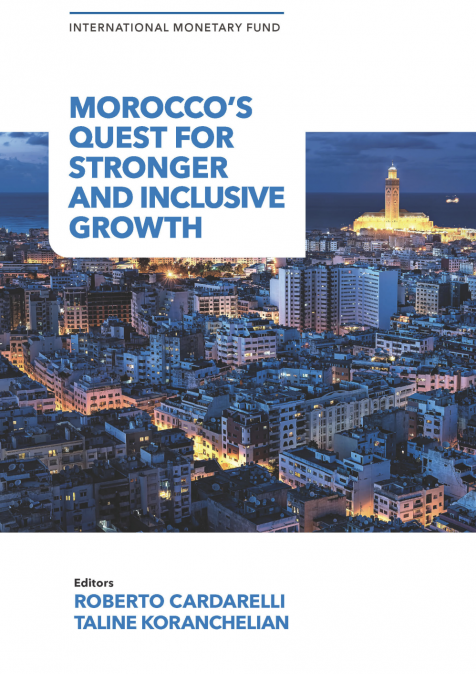
Morocco’s Quest for Stronger and Inclusive Growth
Authors
Edited by Roberto Cardarelli
Taline Koranchelian
October 9, 2023

This book was originally published on elibrary.imf.org


Throughout the past two decades, Morocco has faced several external and domestic shocks, including large swings in international oil prices, regional geopolitical tensions, severe droughts, and most recently the impact of the pandemic and the economic fallout from Russia’s invasion of Ukraine. Despite rough waters, the government stayed the course and remained focused not only on immediate stability, but also on the long-term needs of the Moroccan economy. This involved the adoption of a series of difficult measures, like the elimination of energy subsidies, and a strategy aimed at improving the country’s infrastructure, diversifying the production and export bases by attracting foreign investment, and modernizing the governance structure of the public administration. The road to higher and more inclusive growth, however, remains steep. Despite gains in poverty reduction, literacy and lifespans, Morocco economy continues to face a high share of inactive youth, large gaps in economic opportunities for women, a fragmented social protection system, and remaining barriers to private sector development. An ambitious reform agenda is needed to better meet the aspirations of Moroccans, by making economic growth stronger, more resilient and more inclusive, particularly to provide greater opportunities for young, women, and entrepreneurs. Morocco appears well positioned to address these challenges, and indeed, the country has recently sought to define and pursue a new “model of development”, through national debates and a more inclusive approach to reform. Significant reforms have been announced recently that revamp both the social protection system and the SOEs business model. This book draws lessons from the reforms Morocco has implemented in the past few decades and charts a course for Morocco by addressing key areas for reform.
RELATED CONTENT

  • Authors
    Sandra Polónia Rios
    Pedro da Motta Veiga
    Eduardo Augusto Guimarães
    February 22, 2017
    Despite the sustained growth in the bilateral trade observed at the beginning of the Century, Moroccan – Brazilian economic relations are still going through what could be called the ‘shallow’ phase of relations between two middle-income countries. Trade is concentrated in a few products – those where both countries enjoy long lasting and natural comparative advantages – and face strong difficulties to diversify in terms of products and to upgrade towards more complex models of lin ...
  • Authors
    February 1, 2017
    L’analyse des relations commerciales entre le Maroc et l’Afrique subsaharienne fait ressortir un volume des échanges croissants, reflétant ainsi une dynamisation continue des leurs relations commerciales. Une tendance similaire est observée au niveau des investissements directs étrangers, qui ne cessent de croître au cours des dernières années, traduisant la volonté du Maroc à devenir un acteur majeur dans le développement du continent africain. Ce Policy Brief présente dans un prem ...
  • Authors
    Vera Songwe
    December 23, 2016
    Partout dans le monde, l'intégration économique régionale permet d'accélérer la croissance et le développement en apportant une panoplie d'avantages liés à une meilleure coopération politique, à un commerce intra-régional accru et à la création d'emplois. Les régions qui sont plus intégrées se sont révélées capables de connaître une croissance plus rapide et ont fait preuve d'une plus grande capacité d'adaptation en période de ralentissement de l'économie mondiale. Alors que l'écono ...
  • Authors
    Edité par
    Idriss El Abbassi
    Lahcen Oulhaj
    Aziz Ragbi
    November 28, 2016
    Le présent ouvrage se propose d’apporter quelques éléments d’appui supplémentaires aux policy-makers pour une meilleure identification des défaillances des marchés au Maroc et une mise en place d’une stratégie de diversification et une politique industrielle efficientes, sans toutefois tomber dans la situation inverse où une stratégie mal définie et des outils mal choisis peuvent se traduire par une défaillance des politiques publiques. L’appréhension des difficultés qu’éprouve l’é ...
  • Authors
    Karim EL Mokri
    October 13, 2016
    Morocco is now more than ever threatened by the trap of middle-income economies. On one hand, it is caught between increased competition from low-income countries in low productivity and labor-intensive sectors and, on the other hand, the difficulty of accelerating its pace of structural transformation towards activities with higher value added and higher technological content. International experience shows that few countries have managed to climb to the status of an advanced econo ...
  • Authors
    June 16, 2016
    L’écart entre filles et garçons en termes de scolarisation, au Maroc, a longtemps préoccupé tant les académiciens que les décideurs. En revanche, très peu d’études se sont penchées sur l’analyse de cet écart sous une toile de fond quantitative. Ce présent travail s’intéresse à l’écart genre en termes d’acquis scolaires en lecture. La finalité étant de mettre en exergue les facteurs influençant les différences de performance entre les genres ainsi que leur ampleur. Pour ce faire, une ...
  • Authors
    May 20, 2016
    The 2015-2030 strategic vision innovates the Moroccan educational system. Unlike previous reforms, this vision addresses problems that have long been ignored. Among these problems is the quality of education. Although educational quality may have been included in previous reform programs, it is considered as one of the priorities in this new vision. The purpose of this Policy Brief is to assess the status of learning achievement, which is an integral part of educational quality, of ...
  • Authors
    December 23, 2015
    Global economic growth is likely to be a little better in 2016 than this year’s lackluster outcome. The ongoing slow recovery in the United States and Europe is likely to continue. However, weakness in China as well as several large emerging markets, and sluggishness of world trade, mean that risks are weighted on the downside of this forecast. Morocco, which is reliant on European markets, is a heavy importer of oil, and whose currency has devalued in effective terms, should find t ...