Publications /
Policy Brief

Back
Morocco’s Decarbonization Pathway - Part III: The Costs and Benefits of the Energy Transition
Authors
Chami Abdelilah
Derj Atar
Hammi Ibtissem
Morazzo Mariano
Naciri Yassine
with the technical support of AFRY
July 19, 2021

Morocco's significant renewable energy resources offer an unprecedented opportunity to anchor the country’s economic and political choices in the energy transition, and to turn the transition into an essential lever for economic development. This is all the more relevant as the costs of renewable energies have dropped over the past 10 years2, and now offer strong potential, not only for creating green jobs but for ensuring a dynamic and resilient economic growth as well. In 2020, nearly 20% of Morocco's electricity production was provided by renewable energy resources (RES), while the installed capacity of RES was around 36%. Morocco's ambition is to reach a target of 52% of installed RES capacity by 2030, reinforcing the country's commitment to energy transition and decarbonization. However, this transition must also be sustainable from a socio-economic point of view and must ensure that ‘no one is left behind’. It is, therefore, necessary to quantify the costs and benefits of the energy transition, in order to identify the right policy approaches and mitigate the potential negative effects of the transition on growth, particularly in terms of industrial competitiveness, employment, and citizens' purchasing power.

Part II of the Morocco’s Decarbonization Pathway Policy Brief series presented an update of the decarbonization scenarios. It revealed that in the Increased Ambition and Green Development scenarios, Morocco would achieve higher decarbonization targets than the current policy. Decarbonization targets will be achieved mainly thanks to extensive electrification of the final sectors and increasing RES in the generation mix. More specifically, the transportation, power generation, and residential sectors will be crucial to the decarbonization of Morocco’s energy consumption. This third Policy Brief in the series presents the results of a cost-benefit analysis, performed to identify the technological levers of the energy transition in Morocco, and to estimate the global economic benefit of modeled scenarios presented in Part II, both at national and sectoral levels.

RELATED CONTENT

  • Authors
    March 25, 2015
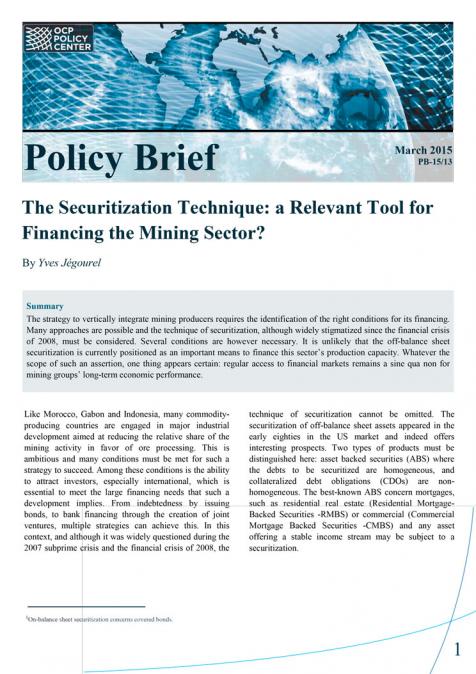
    The strategy to vertically integrate mining producers requires the identification of the right conditions for its financing. Many approaches are possible and the technique of securitization, although widely stigmatized since the financial crisis of 2008, must be considered. Several conditions are however necessary. It is unlikely that the off-balance sheet securitization is currently positioned as an important means to finance this sector’s production capacity. Whatever the scope of ...
  • Authors
    February 10, 2015
    Manufacturing is declining as a share of GDP not only in advanced countries, but in developing countries as well. This new trend, a result of complex forces, should be seen on balance as a reason for development-optimism, not pessimism. In the 21st century economy, manufacturing remains important, but poor countries can attract investment, grow rapidly and diversify away from agriculture on the basis of many possible sources of comparative advantage, without artificially promoting m ...
  • Authors
    Pierre-Richard Agénor
    January 24, 2015
    L’économie marocaine fait actuellement face au risque de se retrouver « prise en tenaille », entre, d’un côté les pays à faible revenu en croissance rapide, bénéficiant d’une main-d’oeuvre abondante et bon marché, et, de l’autre, les pays à moyen revenu, capables d’innover rapidement. De plus, les investissements massifs de la Chine en Afrique subsaharienne ont contribué à accélérer la participation de certains pays de cette région à la nouvelle division internationale du travail, p ...
  • Authors
    Pierre-Richard Agénor
    January 24, 2015
    The Moroccan economy is currently facing the risk of becoming caught between the rapid-growing low-income countries with abundant and cheap labor, and middle-income countries that are able to innovate quickly. In addition, China’s massive investments in Sub-Saharan Africa have accelerated the participation of some countries in the region in a new international division of labor, especially in low-skill-intensive light manufacturing. In parallel, through the structure of its trade a ...
  • Authors
    Pierre-Richard Agénor
    January 24, 2015
    OCP Policy Center est ravi de recueillir vos commentaires et d’engager la discussion autour de la publication de son dernier livre sur la stratégie de croissance du Maroc à l’horizon 2025 dans un environnement international en mutation, co-écrit par Pierre Richard Agénor et Karim El Aynaoui. L’économie marocaine fait actuellement face au risque de se retrouver « prise en tenaille », entre, d’un côté les pays à faible revenu en croissance rapide, bénéficiant d’une main-d’œuvre abond ...
  • From

    17
    3:00 pm November 2026
    The Oxford Handbook of the Moroccan Economy propose une analyse approfondie, structurée et rigoureuse de la trajectoire économique du Maroc de 1960 à 2025. Réunissant 53 contributeurs autour de 34 chapitres, l’ouvrage se présente comme une référence académique et analytique majeure, fondée sur l’étude des tendances de long terme, des faits stylisés, des transformations sectorielles et des principaux défis de politiques publiques qui façonnent le développement économique du Royaume.Au-delà d’une lecture centrée uniquement sur les agrégats macroéconomiques ou les indicateurs de progrès social, le Handbook interroge les ressorts profonds de la transformation structurelle de l’économie marocaine : dynamiques de productivité, diversification du tissu productif, qualité de l’emploi, ...
  • From

    12
    9:30 am November 2026
    The Oxford Handbook of the Moroccan Economy propose une analyse approfondie, structurée et rigoureuse de la trajectoire économique du Maroc de 1960 à 2025. Réunissant 53 contributeurs autour de 34 chapitres, l’ouvrage se présente comme une référence académique et analytique majeure, fondée sur l’étude des tendances de long terme, des faits stylisés, des transformations sectorielles et des principaux défis de politiques publiques qui façonnent le développement économique du Royaume.Au-delà d’une lecture centrée uniquement sur les agrégats macroéconomiques ou les indicateurs de progrès social, le Handbook interroge les ressorts profonds de la transformation structurelle de l’économie marocaine : dynamiques de productivité, diversification du tissu productif, qualité de l’emploi, ...
  • From

    08
    4:30 pm October 2026
    How do intra-African diasporas contribute to the continent’s development? This Africafé episode discusses their role in remittances, entrepreneurship, and skills circulation. The conversation addresses the administrative, financial, and institutional barriers that limit their contribution, alongside opportunities for South-South cooperation to strengthen their participation in Africa’s economic integration. ...