Publications /
Policy Brief

Back
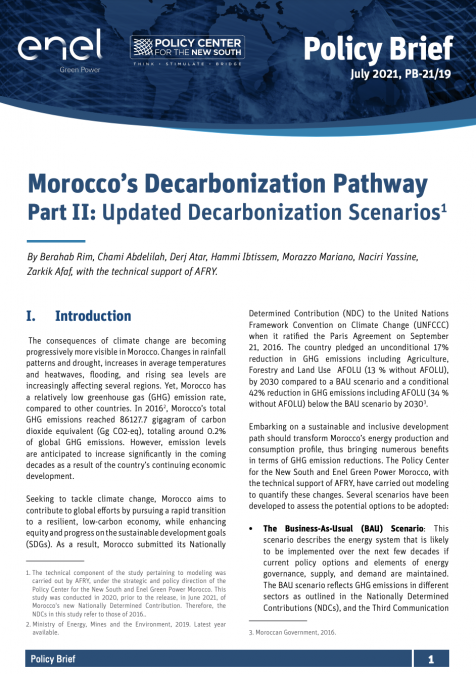
Morocco’s Decarbonization Pathway Part II: Updated Decarbonization Scenarios
Authors
Chami Abdelilah
Derj Atar
Hammi Ibtissem
Morazzo Mariano
Naciri Yassine
with the technical support of AFRY
July 9, 2021

The consequences of climate change are becoming progressively more visible in Morocco. Changes in rainfall patterns and drought, increases in average temperatures and heatwaves, flooding, and rising sea levels are increasingly affecting several regions. Yet, Morocco has a relatively low greenhouse gas (GHG) emission rate, compared to other countries. In 20162, Morocco’s total GHG emissions reached 86127.7 gigagram of carbon dioxide equivalent (Gg CO2-eq), totaling around 0.2% of global GHG emissions. However, emission levels are anticipated to increase significantly in the coming decades as a result of the country’s continuing economic development.
RELATED CONTENT

  • Authors
    Meryam Amarir
    August 13, 2026
    Recent crises in the Middle East, particularly attacks targeting commercial vessels in the Red Sea and tensions surrounding the Strait of Hormuz, have highlighted the vulnerability of the main strategic corridors of global trade. Rather than fundamentally disrupting the organization of trade flows, these crises are accelerating an ongoing transformation driven by the search for more resilient connectivity chains, the diversification of trade routes, and the development of logistics ...
  • Authors
    August 12, 2026
    La géographie mondiale des hydrocarbures n'est évidemment pas figée. De nouveaux producteurs de pétrole et/ou de gaz naturel apparaissent suite à des découvertes, le plus souvent réalisées par des compagnies pétrolières internationales. On pense notamment au Mozambique, qui produit et exporte du gaz naturel liquéfié (GNL) depuis la fin 2022, au Sénégal, qui est un producteur de pétrole offshore depuis la mi-2024, et au Sénégal et à la Mauritanie, qui sont devenus conjointement expor ...
  • Authors
    August 5, 2026
    This paper addresses the persistent challenge of resource dependence in the world's poorest countries, focusing on the ten poorest African nations where natural- resource rents average 14% of income. It argues that four decades of conventional policy advice, which treated resource dependence primarily as a revenue management problem, have failed to help these countries. While stabilization funds and permanent-income frameworks aim to smooth consumption, they do not answer the fundam ...
  • August 3, 2026
    This policy paper explores how China’s economic development model—rooted in pragmatism, long-term planning, and civilizational renewal—has become its most compelling soft power asset, particularly in the eyes of the Global South. While critically engaging with Joseph Nye’s original conception of soft power as a primarily cultural and normative force, the paper argues that China’s ability to transform itself from an impoverished postimperial state into the world’s largest trading nat ...
  • Authors
    Fatima Berahou
    July 28, 2026
    This Paper was originally published on cairn.infoL’insertion professionnelle des jeunes, et particulièrement des diplômés de l’enseignement supérieur, constitue un enjeu majeur pour le développement économique et la cohésion sociale de toute nation. Au Maroc, cette question revêt une acuité particulière et s’attache à un paradoxe persistant : malgré une démocratisation et une progression notable de l’accès à l’enseignement supérieur au cours des deux dernières décennies, le tau ...
  • Authors
    Edited by
    July 13, 2026
    Available soon on livremoi. The 2026 edition of the Annual Report on the African Economy examines the issue of the valorization of Africa’s natural resources, particularly its mineral wealth. While the continent holds some of the world’s largest known reserves of a wide range of minerals and metals, the objective is not merely to catalogue these resources, but rather to explore the conditions under which natural resource endowments can be transformed into drivers of Africa’s in ...
  • July 3, 2026
    Este Policy Paper también ha sido publicado en inglés y francés por Le Grand Continent La economía marroquí constituye un caso ilustrativo entre las economías de renta media, en un contexto marcado por una creciente fragmentación del entorno internacional, un crecimiento mundial anémico y una desaceleración de la convergencia. Desde 2022, su trayectoria se caracteriza por una relativa solidez, con un crecimiento superior a la media de las economías de la misma categoría. Superi ...
  • July 3, 2026
    This Policy Paper has also been published in French and Spanish by Le Grand Continent Morocco offers a compelling example of how a middle-income economy can navigate a more fragmented global environment, characterized by weak growth and slower convergence. Since 2022, economic activity has remained relatively strong, with growth exceeding that of many comparable economies. Non-agricultural growth has averaged 4.4% since 2022, around 1.3 percentage points above its historical av ...