Publications /
Book / Report

Back
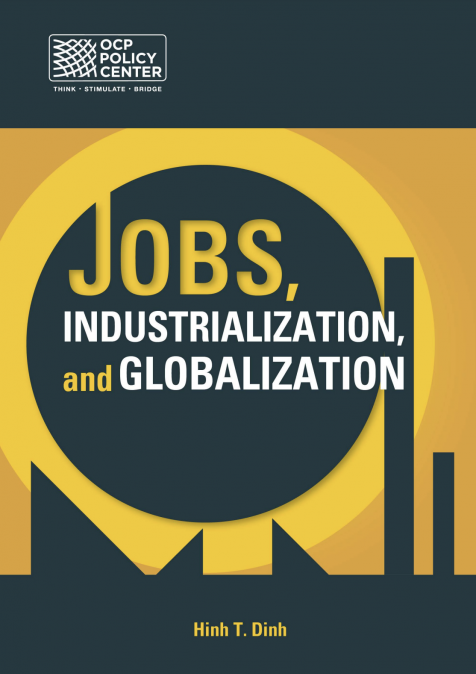
Jobs, Industrialization, and Globalization
Authors
October 26, 2017

After many decades of expansion, incomes and standards of living have never been better in many parts of the world. Yet, in the developed economies, there is anxiety over the loss of manufacturing jobs that once absorbed a large share of the labor force and created a middle class that formed the core of democracy. The vast majority of middle- income countries have not yet been able to make the transition to the high-income group despite decades of growth. Progress among low-income countries, particularly sub-Saharan African countries, in achieving productivity growth and structural transformation has been slow, and deindustrialization has occurred in some.

Jobs, Industrialization, and Globalization examines the development problems pertinent to each of these groups of countries and explores solutions. The book’s structural analysis reveals that, among the low- and middle-income countries, industrialization remains the major route, if not the only route, to creating jobs and raising incomes, while acquiring the necessary investment in human capital to reach the next stage of modernization. Among the low-income countries, it pays to shift resources from low- to high-productivity sectors and to create jobs in light manufacturing so that idle or laid-off workers can move there. Among the middle-income countries, global competition makes shifting production away from raw materials and commodities to manufactured goods essential; yet, the vertically specialized industrialization regime—the global value chains—is generating new challenges along the path to industrialization and requires a reappraisal of government policies. Among the advanced countries, such as the United States, modern industrialization involves shedding unskilled labor at an accelerating pace, partly because of automation and partly because of rising competition from abroad. More importantly, the future of modern manufacturing revolves around new technology, and there are many uncertainties. These countries require policy reform to protect workers and to keep a viable middle class that may serve as a foundation for democracy and prosperity.


RELATED CONTENT

  • From

    11
    10:00 am November 2026
    Depuis 2021, le Policy Center for the New South, le Programme des Nations Unies pour le développement et le Groupe de la Banque mondiale portent conjointement l’initiative « Parlons Développement », une plateforme de réflexion collective sur les enjeux du développement durable au Maroc. Organisée avec différents partenaires, notamment du monde académique et de la société civile, cette plateforme destinée à la jeunesse vise à rapprocher les débats stratégiques de ses préoccupations et à favoriser le dialogue autour de réponses concrètes aux défis du développement.Dans cette continuité, la 25ᵉ édition de « Parlons Développement », organisée en partenariat avec la Faculté des Sciences Juridiques, Économiques et Sociales de l’Université Mohammed Premier d’Oujda, sera consacrée au ...
  • Authors
    November 11, 2026
    Suriname is at a crossroads. In 2020, the country discovered extensive oil and gas reserves, presenting the new Geerlings-Simons Government with a golden opportunity to use this windfall to chart a new path of high productivity and inclusive growth, fundamentally different from the low and volatile growth of previous decades. The key question is: will it successfully do so? Success will require the current government to overcome the main constraints of the business-as-usua ...
  • November 10, 2026
    يناقش هذا الحوار أبرز التوجهات الاقتصادية والاجتماعية لمشروع قانون المالية لسنة 2027 في المغرب، في ظل الحاجة إلى التوفيق بين دعم النمو والاستثمار وخلق فرص الشغل، وتعزيز الحماية الاجتماعية، والحفاظ على التوازنات المالية. كما يتناول شروط فعالية المجهود الاستثماري، وسبل تمويل الأولويات الا...
  • Authors
    Patrick Kabanda
    November 10, 2026
    Cultural trade is a dynamic engine for economic diversification in the New South. Despite decades of diversification rhetoric, however, this sector remains underrealized. Thus, many countries across Africa, Latin America and the Caribbean, Asia, and the Middle East are still commodity-dependent, even though the global creative economy has grown roughly eightfold since 2002, to surpass $2 trillion—that figure, moreover, does not even account for the nonmonetary benefits that merit co ...
  • Authors
    Aziz Ajbilou
    Ouidade Sabri
    November 4, 2026
    School dropout remains a major challenge for education systems and public policy, with lasting consequences for human capital, labor market integration, social cohesion, and long-term economic growth. Despite sustained efforts to expand access to schooling, many countries continue to experience high dropout rates, particularly at key transition points in lower- and uppersecondary education. Policy responses have often relied on fragmented, sector-specific interventions—addressing ed ...
  • October 8, 2026
    This paper was originaly published on Higher Education Policy Journal This article critically assesses the alignment between Morocco’s public guidance schemes for international students and its national development goals. Specifically, it investigates the capacity of these mechanisms to transform student mobility from a potential ‘brain drain’ into a tangible ‘brain gain’. Employing a qualitative case study approach, we conducted a systematic content analysis of 204 mobili ...
  • Authors
    Soukaina Raoui
    October 5, 2026
    This paper was originaly published on International Journal of Educational Research Open University dropout remains a major challenge in higher education due to its academic, social, and economic consequences. This study examines the role of academic and career orientation in shaping dropout in Morocco and improving student retention. A sequential mixed-methods design is applied. The quantitative component uses APOGEE administrative data covering 55,674 students and logist ...
  • September 23, 2026
    تتناول هذه الحلقة حدود السباق المتسارع لتطوير نماذج الذكاء الاصطناعي والتحديات المرتبطة بفهم سلوكها والتحكم فيه. ويناقش الأستاذ كريم دربان، أستاذ بالمدرسة الوطنية للتجارة والتسيير بالدار البيضاء، مدى إمكانية الوثوق بهذه النماذج في اتخاذ القرار وحدود السلطة التي يمكن تفويضها لها. كما تتط...
  • September 11, 2026
    Since the early 2000s, the Moroccan labour market has experienced continuous educational expansion that has not been matched by an equivalent transformation of the economy's productive structure, giving rise to situations of vertical mismatch between employed workers' education levels and the requirements of the jobs they hold. This study analyzes the determinants of overeducation and undereducation using anonymized microdata from the 2014 General Population and Housing Census (RGPH ...