Publications /
Policy Brief
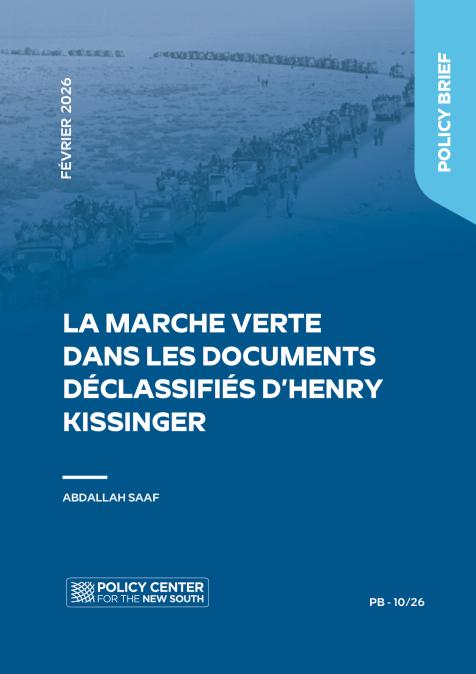
The Green March is one of those seminal moments that have never ceased to influence the course of political events in Morocco, because of its long-term significance from the outset, the context in which it unfolded, the logic of interactions in which it was embedded through its causes and effects, and as one of the striking figures in the national narrative.
1. The royal speech announcing the Green March
in 1975 was undoubtedly a founding moment, a dazzling episode, a historic landmark. It did not seem that the Moroccan intelligentsia of the time appreciated the importance of the initiative from the outset. It was to grow progressively stronger, becoming a far-reaching fact. In the first few days, public opinion in general, and left-wing circles in particular, reacted with a variety of positions, ranging from unconditional support and fervent appropriation, to cautious support and even opposition or, as we know, proposals for alternatives...
In the minds of those involved, various references were invoked between the peaceful marches of Gandh, Martin Luther King and the warlike marches of Mao, Guevara... before later taking on their own characters... However, in the days that followed, the project of a peaceful march to erase artificial and illegitimate borders gained in strength, coherence, conviction, originality and adequately supervised mobilization.
The constituent elements of the event converged rapidly: the speech announcing the Green March took place immediately after the Advisory Opinion of the International Court of Justice (mid-October 1975), logistical preparations were well advanced, the signal for the Green March was given from Agadir (November 6), with the package of administrative measures that were to accompany it, popular mobilization, but also a discreet military deployment, and intense diplomatic work.
Then things really started to happen: the Moroccan state apparatus moved into action and, as a result, the Green March became a structuring force in the country's political life, giving everything that was moving under the Moroccan sky an otherwise promising outlook.
Images, films, testimonies, detailed descriptions and more or less scholarly works highlighted the force represented by 350,000 people heading fervently towards the borders arbitrarily drawn by the colonialists who had passed through. Many other citizens had their ears glued to their transistor radios, or their eyes glued to their TV screens. The slogan of reclaiming stolen territories was clearly not a creation of the ruling circles alone.
From the very first days, the Green March took on the contours of a decisive process, from its inception, its political, geopolitical and diplomatic effects, its impact on collective and individual lives, right through to its conclusion.
2. Behind and around the event
the many elements would only really come to light long after the Green March, notably through declassified documentation, including American documentation. Specifically, the declassified archives of the US State Department, fifty years after the event, and those concerning Kissinger's activities, show his involvement in the emerging regional conflict.
Appointed U.S Secretary of State in 1973, Kissinger had already been an advisor on the National Security Council under the Nixon administration since 1969. He remained involved in the management of American foreign policy until 1977, winning the Nobel Peace Prize along the way for his role in the negotiations that ended the war between the USA and Vietnam.
He was to discover the seeds of this new emerging conflict when he embarked on a tour of Middle Eastern countries after the October war, coming to seek advice from the late Hassan II on a possible settlement of the Middle East conflict. At the same time, the US Secretary of State visited Tunisia, Egypt, Jordan and Saudi Arabia. During this first tour, he took the measure of the conflict in the Maghreb region right from the start of the Green March. Hassan II would later say that he remained in constant contact with Kissinger, who paid several visits to Morocco, Algeria and Spain.
America's interest in the developing conflict began as soon as Spain announced its intention to withdraw from the Sahara. Throughout his travels in the three countries concerned, he seemed to experience great difficulty in managing relations between Rabat, Algiers and Madrid over the future administration of the southern territories. Spain's position swung back and forth between Morocco and Algeria, sometimes in favor of one, sometimes in favor of the other, at the time of Franco's illness and the assumption of power by King Juan Carlos.
The declassified documents show that, despite Algeria's declared support for a Moroccan-Spanish agreement transferring sovereignty to the two states (Morocco-Mauritania), its attitude was unclear. According to the aforementioned documentation, the American services saw it as a diplomatic maneuver to wrest recognition from Morocco regarding the Algerianity of Tindouf, the ratification of the Ifrane agreements concluded in 1969, and the opportunities for revenge on "La guerre des sables".
In the heat of the exchanges between Kissinger and the late King Hassan II, while deciphering the preparations for the Green March, the American services wondered whether Morocco was preparing for a military intervention on three fronts (Spain, Algeria, the independence fighters...). Several signs were interpreted in this direction. Preparations for the Green March were mistaken for preparations for military intervention. This tendency to favour a military interpretation of what was happening in Morocco was undoubtedly due to the fact that Moroccan demands for armaments were becoming increasingly pressing (M6 tanks, F5 aircraft, missiles, 155 guns, to counter the Migs 21 and T 62 tanks).
The King reassured the Americans that there was nothing military about what he was planning.
3. At no time did he heed Kissinger's "very firm" advice, as Kissinger urged the King to back down and abandon the Green March.
Kissinger sent several messages to King Hassan II, urging him to abandon the March and informing him of threats from the Algerian president and the Spanish government. All to no avail. The declassified State Department and CIA documents show just how impressive the King's determined refusal was. Despite Kissinger's warnings, Hassan II went ahead with his project. The Secretary of State told him that Boumedienne had said that King Hassan II was playing with fire: "Morocco has no interest in clashing with the Algerian Revolution, but the Algerians are not afraid of this eventuality. We're revolutionaries, we're used to fighting. I have no throne to lose, unlike Hassan...". The King did not budge from his position.
He also passed on to him the warning message from Spain's Pedro Cortina Mauri, then Minister of Foreign Affairs: "Our armed forces have been ordered to repel any invasion attempt. Hassan II is gambling with his throne and wants to distract his opinion from his internal problems. Spain has no intention of paying for its mistakes. I ask you to do everything in your power to avoid the tragic consequences that this march is bound to have".
Kissinger, listening each time to the King, could not help but also rely on William Colby's document dated October 3, 1975: "King Hassan II, under pressure from the army, has decided to invade the Spanish Sahara within the next three weeks. The King is confident that the bulk of the Spanish troops are poorly trained and will refuse to fight. The Moroccans are also skeptical about any intervention by the Algerian army, but as a deterrent, they could call in detachments of allied troops: Syrians, Egyptians, Palestinians and, perhaps, Saudis...Our opinion is that King Hassan is seriously underestimating the Spanish capacity to fight back against his invasion plan. In the event of direct intervention by Algeria, the Moroccans might record some initial successes due to their numerical superiority in the region. But Algeria's 200-odd fighter jets are likely to quickly turn the tide against the 40 Moroccan aircraft, especially as Algerian troops are better trained and equipped overall."
Kissinger's communications with the Moroccan Sovereign did not go beyond the level of "strong" advice. The American power does not seem to have been seriously opposed to the Green March, but rather concerned to prevent a military confrontation in the region. Kissinger had the opportunity to explain this attitude orally to Bouteflika: "We don't have an anti-algerian position. Simply preventing the Green March from taking place would have destroyed our relationship with Morocco. It would have been like an embargo.
Later, with the arrival of Carter, US relations with Morocco became more complex. Initially, at least, they would be difficult, in an atmosphere marked by a marked improvement in relations between the USA and Algeria, and the closure of American bases in Morocco, which had been set up since the Second World War.
4. How can we analyze the approach represented by the Green March? Is it a global vision supported by a strategy of a more general nature?
operational? Is it simply an armed public policy based on a set of action programs? There's a little bit of everything in the definition we can give. Many oral and written elements, testimonies and studies today help us to better understand the motives behind this major event in the country's contemporary history. The CIA's memos seem rushed and summary. For example, the CIA memo dated September 6, which reads: "The King hopes that the campaign he has launched to recover the Spanish Sahara will strengthen his position and distract public opinion from the economic and social problems facing his country... But if he fails, the internal pressures will be such that they could well topple him, and if a war breaks out between the Moroccan and Algerian armies, the outcome is unpredictable".
John Waterbury, speaking of the Moroccans, seemed categorical: the Moroccans would not be strategists, he wrote in "(the) Commander of the Believers". They would act on an ad hoc basis. They were short-sighted tacticians. The conceptual and practical construction of the Green March clearly belies this. The Green March is essentially a pragmatic movement with a strategic scope in a favorable international context.
It was itself in the wake of events such as the recovery of Sidi Ifni, the recognition of Mauritania, border agreements with Algeria, the holding of the Rabat Islamic Conference, a calmer situation in the Middle East after the 1973 war, with Kissinger acting as negotiator for a global peace, at a time, moreover, when Hassan II's Morocco was positioning itself as mediator between Egypt and Israel. In Europe, Franco was dying and Spain was preparing for its democratic transition.
Internal factors are far from absent: after the attempted coups d'état at the start of the decade, the system's initial political, economic and social responses to the ordeals it had just undergone, the marked wait-and-see attitude of national political players, the interaction of regional players (Algeria and Libya), who were banking on a division of the domestic front, a laborious reconfiguration of the political field, the deployment of the army in the South....
On the other hand, we know more about where the idea for the Green March came from, how and under what conditions it emerged in the mind of the main decision-maker, what its initial objectives were... However, many grey areas remain, and the Green March remains a promising area for specialized academic research.
In this type of decision-making process, certain conditions are necessary. As the late King Hassan II recalled in his memoirs, this gave considerable strength to the great undertaking of the Green March. These conditions are, on the one hand, confidentiality (the number of people in the know was extremely small), and on the other, the element of surprise as an imperative, particularly in relation to opposing forces.
5. The Green March has become a central part of the national narrative in Morocco today, and a structuring theme of unprecedented force.
many actions to come. It has the same importance as the great events that have long marked the country's history: the Andalusian and Maghrebian epics, resilience in the face of attempts from the North, the Battle of the Three Kings, the alliance between the monarchical institution and the national movement (the Revolution of the King and the People)...
The Green March became a landmark episode, bringing with it a procession of major events: the new era, the so-called "democratic process", the alternation attempts of 1992 and 1993 and the alternation government itself, up to the new reign and, perhaps, the Equity and Reconciliation Commission, and all the contributions of Moroccan political reformism (on the institutional, economic, social and cultural levels), many new internal rearrangements, the reconfiguration of the political field and players... It has in fact revitalized national political dialogue over the long term. It can be credited with establishing a new alliance between the monarchical institution and the people.
Paradoxically, the Green March effect was part of a long-term process marked by various trends, but above all by a war that lasted from 1976 until the formal ceasefire in 1991 (although the confrontations lost their virulence in 1986 with the construction of the Wall).
The identity of the political action represented by the Green March calls for a different periodization of political life and, therefore, a different understanding of it. Its importance, its centrality and the fact that it set in motion new dynamics of significant scope call for a different division of the historical periods of Moroccan political temporality and of what animated its architects.
6. A few key conclusions stand out:
- the Green March represents an important moment in contemporary Morocco from a number of points of view. It inaugurated what came to be known as "The Democratic Margin", which was supposed to evolve day by day and grow ever wider;
- the Green March demonstrated the strategic mentality of the Moroccan people, as well as their tactical skill. The country demonstrated a pragmatism that surprised friends and foes alike, and an appreciable capacity for maneuver, in a spirit of moderation and prudence;
- the Green March brought about radical political change, but with continuity. At a time when the risks were at their highest, a war was waged against four countries (Cuba, Libya, Algeria, Spain), each contributing according to its means to support the opponents of the country's territorial unity. This war was presented as an opportunity for the system to rise to the challenge, to take root, to consolidate... ;
- the Green March made its way through a geo-political period where, while favorable elements existed, the risks and threats were far from insignificant. During his shuttles between the region's capitals, Kissinger informed the Algerian president that the United States was granting Algeria the status of regional power. Several factors worked against this: Morocco's success in integrating the Sahara, the fall of Franco's regime and the establishment of new alliances.
As a philosopher, the late King Hassan II drew the conclusion that alliances with the West were so insecure as to seem random. In his memoirs, he notes that an alliance on the Western side is a kind of club where relations between members are not binding, unlike in the alliance that grouped together the countries of the socialist camp.