Publications /
Policy Paper

Back
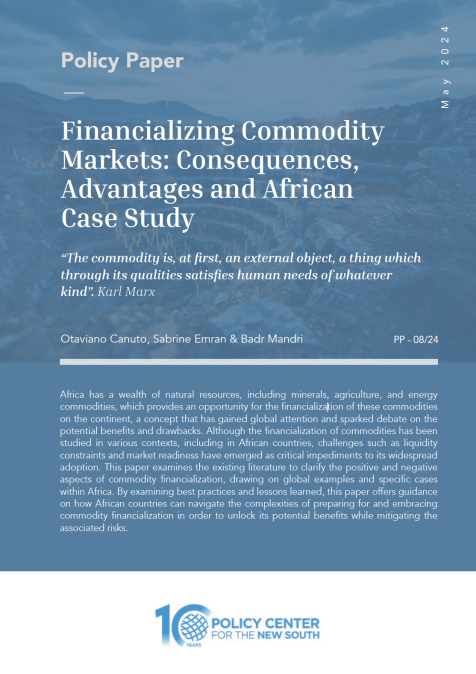
Financializing Commodity Markets: Consequences, Advantages and African Case Study
May 24, 2024

Africa has a wealth of natural resources, including minerals, agriculture, and energy commodities, which provides an opportunity for the financialization of these commodities on the continent, a concept that has gained global attention and sparked debate on the potential benefits and drawbacks. Although the financialization of commodities has been studied in various contexts, including in African countries, challenges such as liquidity constraints and market readiness have emerged as critical impediments to its widespread adoption. This paper examines the existing literature to clarify the positive and negative aspects of commodity financialization, drawing on global examples and specific cases within Africa. By examining best practices and lessons learned, this paper offers guidance on how African countries can navigate the complexities of preparing for and embracing commodity financialization in order to unlock its potential benefits while mitigating the associated risks.
RELATED CONTENT

  • Authors
    Sous la direction de Larabi Jaïdi
    September 29, 2022
    La succession des chocs pandémique, climatique et géopolitique a éprouvé les économies africaines. Les liens commerciaux et financiers avec le monde ne sont plus seulement considérés comme des moteurs de performance, mais aussi comme des sources potentielles de vulnérabilité. La défiance à l’égard de la mondialisation s’est accrue. Parce qu’elle est venue souligner la dépendance du continent, le dérèglement de ses rapports à la nature et sa vulnérabilité face aux tensions géopolitiq ...
  • Authors
    Moubarack Lo
    Amaye SY
    August 1, 2022
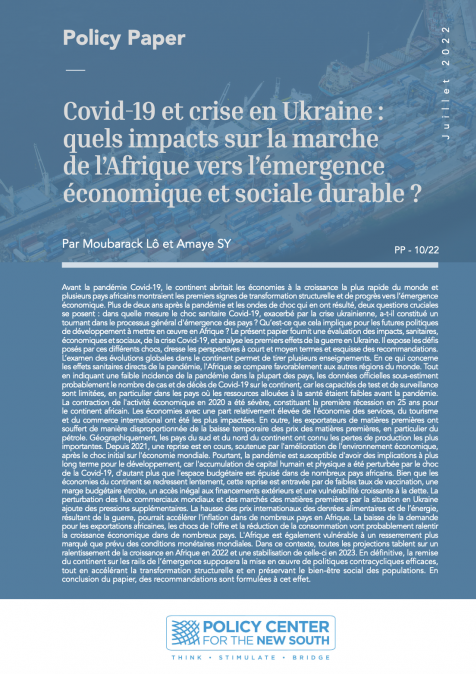
    Avant la pandémie Covid-19, le continent abritait les économies à la croissance la plus rapide du monde et plusieurs pays africains montraient les premiers signes de transformation structurelle et de progrès vers l’émergence économique. Plus de deux ans après la pandémie et les ondes de choc qui en ont résulté, deux questions cruciales se posent : dans quelle mesure le choc sanitaire Covid-19, exacerbé par la crise ukrainienne, a-t-il constitué un tournant dans le processus général ...
  • May 11, 2022
    Cet atelier a servi de plateforme pour présenter les ouvrages suivants :  - L'édition 2022 du Rapport Annuel sur la Géopolitique de l'Afrique : Ce rapport est publié annuellement par le PCNS et a pour objet de relater, étudier et analyser les faits géopolitiques majeurs qui o...
  • April 29, 2022
    Following on the heels of the COVID-19 pandemic and severe drought in North Africa, the Russian invasion of Ukraine – large exporters of food and, in the case of Russia, energy— may inflict increased hunger on the food insecure in Morocco – despite mitigating measures by the government. Morocco is so far successfully shielding its large poor and vulnerable population by subsidizing essential commodities. With memories of the violent protests during the 2007/08 food and fuel crisis ...
  • Authors
    March 16, 2022
    The 2021 German federal election brought about a historic reshuffle of the political parties’ hierarchy in Europe’s biggest economy. The Social Democratic Party are back in control of the Chancellery for the first time since 2005, as part of a three-party coalition at the federal level with the Greens and the Liberals, a first in Germany’s post-war history. Now, the federal government has turned its gaze towards its founding mission: more progress. The first 100 days of the three-pa ...
  • Authors
    March 11, 2022
    The pros and the cons of regional market integration are well exemplified by the experience of Uruguay, a small, open economy in MERCOSUR, which is a highly protectionist trade bloc, dominated by Argentina and Brazil. With access to such large markets, Uruguay did raise its growth rate during the first decade of MERCOSUR, the 1990s. However, market integration as implemented in MERCOSUR was also problematic in that Uruguay suffered from the high protectionism of Argentina in the for ...
  • Authors
    March 8, 2022
    The contrast between Argentina’s rich natural resource endowment and its poor economic performance has been the focus of much socio-political and economic analysis. When it created MERCOSUR with its immediate neighbors, Brazil, Uruguay, and Paraguay in 1991, it had access to a trading bloc with a combined GDP of US$ 419 trillion (2019), making it the 5th largest economy in the world. Joining the MERCOSUR was a break from its protectionist past. But it did not last. Argentina greatl ...
  • March 1, 2022
    Known for being a climate change hotspot, Morocco is at the forefront of a climate disaster. Consequences are already being felt, whether in the form of increasing temperature or a downward trend in precipitations, which directly threaten the water security and, by extension, the social-ecological systems of the country. The systems by which food, energy, and water are produced, distributed, and consumed heavily depend on one another. Their implicit feedbacks and links are not linea ...
  • February 28, 2022
    La guerre russo-ukrainienne aura des répercussions économiques et politiques dans les années à venir. Dans cette note, nous nous intéressons aux implications économiques de la guerre sur l’économie africaine à court et à long terme. Le conflit survient alors que l’Afrique s’efforce de mettre son économie sur la voie de la reprise, dans un contexte de pressions inflationnistes mondiales et de volatilité des marchés financiers et des matières premières. Alors que les exportateurs d’én ...
  • February 28, 2022
    The Russian-Ukrainian war will have major economic and political repercussions. In this note, we focus on the war’s economic short and long term implications on the African economy. This conflict comes at very arduous context, where Africa is still struggling to set its economy on the recovery path, amid global inflationary pressures and highly uncertain context. While natural resources countries, especially energy exporters, are sensing opportunities from the crisis, other countrie ...