Publications /
Policy Paper

Back
Financializing Commodity Markets: Consequences, Advantages and African Case Study
May 24, 2024

Africa has a wealth of natural resources, including minerals, agriculture, and energy commodities, which provides an opportunity for the financialization of these commodities on the continent, a concept that has gained global attention and sparked debate on the potential benefits and drawbacks. Although the financialization of commodities has been studied in various contexts, including in African countries, challenges such as liquidity constraints and market readiness have emerged as critical impediments to its widespread adoption. This paper examines the existing literature to clarify the positive and negative aspects of commodity financialization, drawing on global examples and specific cases within Africa. By examining best practices and lessons learned, this paper offers guidance on how African countries can navigate the complexities of preparing for and embracing commodity financialization in order to unlock its potential benefits while mitigating the associated risks.
RELATED CONTENT

  • Authors
    Manfred Hafner
    Simone Tagliapietra
    Lucia de Strasser
    October 4, 2018
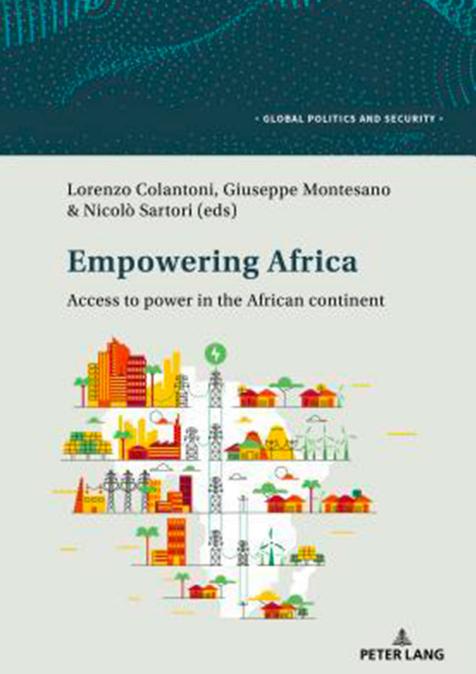
    This blog post summarizes the key findings of the new book Energy in Africa: Challenges and Opportunities, co-authored by Manfred Hafner, Simone Tagliapietra and Lucia de Strasser of the Italian think-tank, Fondazione Eni Enrico Mattei. The book, published by Springer, is freely available online. The book presents a picture of the current energy challenges on the African continent- the Sub-Saharan region in particular- and proposes pathways to an accelerated energy t ...
  • Authors
    September 5, 2018
    As the world is shifting away from conventional fossil fuels towards renewable energy sources, the power industry is starting to invest more in sustainable clean energy installations rather than the traditional large-scale infrastructures, which rely mainly on oil and coal.  Besides its environmental benefits, this shift to renewables is very likely to benefit economic growth as well. A recent study of the International Renewable Energy Agency shows that, indeed, dou ...
  • Authors
    August 13, 2018
    Depuis la fin de l’année 2017, le président Donald Trump mène plusieurs batailles commerciales, contre différents partenaires, sous prétextes de sauver des emplois industriels américains et de réduire le déficit commercial des États-Unis. S’il est difficile de se prononcer sur les effets des combats commerciaux amorcés par le président Trump, l’importance des opposants et des échanges pour l’économie mondiale en fait une source de risque pour la croissance, les emplois et les prix à ...
  • Authors
    Vinicius A. Vale
    April 26, 2018
    This paper reports the results of an application using an interregional input-output matrix for Morocco together with regional information on water consumption by sectors. We develop a trade-based index that reveals the relative water use intensities associated with specific interregional and international trade flows. We estimate, for each flow associated with each origin-destination pair, measures of trade in value added and trade in water that are further used to calculate our in ...
  • November 16, 2017
    The purpose of this paper is to propose the establishment of a forward-looking partnership between China and Morocco, centered around the agri-food issue in Africa. It is in Africa that the food demand will increase in a very significant way during the 21st century due, in particular, to population growth and the acceleration of urban development. Africa must succeed in its agricultural revolution in order to fight hunger and poverty, ensure the industrialization of its economy and ...
  • Authors
    June 9, 2017
    In June 2017, the second Annual Report on Commodity Analytics and Dynamics In Africa (Arcadia report) was published, in collaboration between the OCP Policy Center and CyclOpe. Its aim is to annually report on the evolution of the economic, legal, financial and societal links between Africa and the world commodity markets, both with regard to the cyclical changes in the markets, and to the structural changes or failures that may have emerged. Focusing on 2016 and early 2017, the Arc ...
  • April 25, 2017
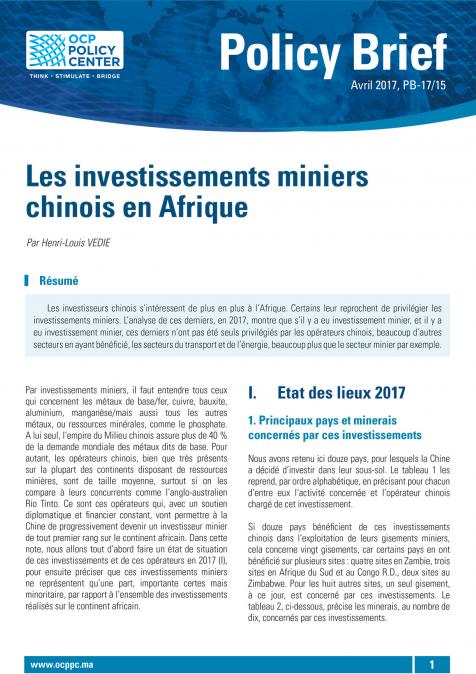
    Chinese investors are increasingly interested in Africa. Some criticize them for privileging mining investments. A 2017 analysis of these investments shows that investments in mining have not been the only ones privileged by the Chinese operators. Many other sectors such as transport and energy have benefited from Chinese investments, much more so than the mining sector, for example. ...
  • Authors
    March 29, 2017
    Dans un contexte mondial de plus en plus préoccupé par les aléas climatiques, comprendre l’impact de la croissance économique sur l’environnement devient crucial, notamment pour les pays en voie de développement. Ce papier aborde cette problématique sous le prisme des émissions de dioxyde de carbone (CO2) et examine comment la croissance économique se répercute sur l’environnement. L’objectif de cette étude est de tester la validité de la courbe environnementale de Kuznets (CEK) pou ...
  • Authors
    Edité par
    Idriss El Abbassi
    Lahcen Oulhaj
    Aziz Ragbi
    November 28, 2016
    Le présent ouvrage se propose d’apporter quelques éléments d’appui supplémentaires aux policy-makers pour une meilleure identification des défaillances des marchés au Maroc et une mise en place d’une stratégie de diversification et une politique industrielle efficientes, sans toutefois tomber dans la situation inverse où une stratégie mal définie et des outils mal choisis peuvent se traduire par une défaillance des politiques publiques. L’appréhension des difficultés qu’éprouve l’é ...
  • Authors
    Under the Supervision of
    Philippe Chalmin
    July 4, 2016
    Guinea’s bauxite, Moroccan phosphates, Nigerian Bonny Light, Zambian copper, Côte d'Ivoire’s cocoa, Ethiopian coffee or Madagascar’s vanilla: all are examples demonstrating that raw materials have a dimension that is as global as it is local. Global by the markets on which they are traded, local by their quality, a key element of their price, and their macroeconomic impact, particularly for Africa. In line with the 2016 CyclOpe report, which celebrates three decades of existence thi ...