Publications /
Policy Paper
“Every gun that is made, every warship launched, every rocket fired signifies in the final sense, a theft from those who hunger and are not fed, those who are cold and are not clothed.”
President Dwight Eisenhower, April 16, 1953
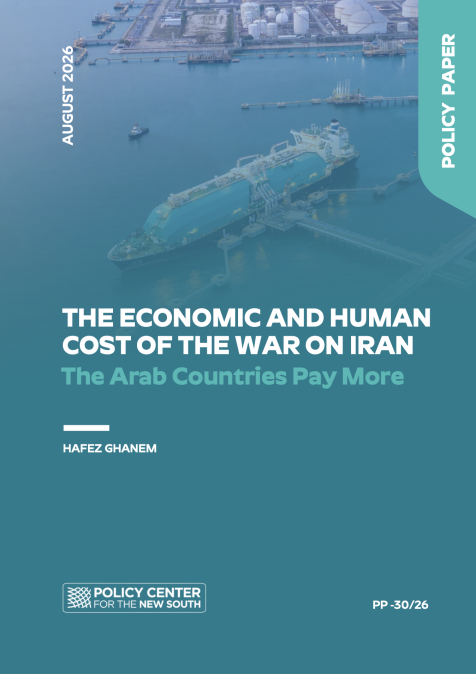
This paper examines the economic and human impacts of the first six months of the Iran war—from February to the end of August 2026—on Iran’s Arab neighbors and compares these impacts with those on the three countries directly involved—Iran, Israel and the United States. It reaches the surprising conclusion that Iran’s Arab neighbors have borne a higher cost than the three belligerents combined. For the purposes of the analysis presented here the Arab neighbors of Iran are divided into two groups: the three fragile and conflict-affected countries (FCS) with strong Iranian-allied militias—Iraq, Lebanon and Yemen—and the six Gulf Cooperation Council (GCC) countries—Bahrain, Kuwait, Oman, Qatar, Saudi Arabia, and the United Arab Emirates (UAE). Each group separately has borne higher economic losses from the war than the three belligerents combined.
This analysis has two policy implications for the GCC countries. First, on the geopolitical front, the GCC countries, which host American military bases and provide support to US forces, could negotiate agreements with their American partners to ensure that they are consulted and given a voice in decision-making processes affecting war and peace in their region. Second, they need to continue investing in oil pipelines and other transport facilities to avoid dependence on a single geographic chokepoint—whether the Strait of Hormuz, Bab El Mandeb, or the Suez Canal—for their exports and imports.
The three FCS countries have borne heavy relative costs, at a time when their economies and societies are facing enormous challenges. This is especially true of Lebanon, where the cost of the war could exceed twice the country’s GDP. It is time for the international community, perhaps led by the Arab League, to help these countries address the economic, social and political drivers of fragility. A stable and prosperous Lebanon, Iraq and Yemen would clearly benefit their populations, as well as the region and the rest of the world.
The paper is divided into six sections. Section 1 presents the analytical framework used to assess the cost of war. Sections 2, 3 and 4 present the costs incurred by the three belligerents, by the three FCS countries and by the GCC, respectively. Section 5 compares the results across countries and presents evidence that the Arab countries’ losses may be even greater than those of Iran. Section 6 concludes with the policy implications arising from the analysis.