Publications /
Policy Paper

Back
Diagnostic Stratégique de l’émergence économique du Maroc
Authors
Moubarack Lo
November 28, 2019

Le préalable et la première démarche d’une bonne évaluation de la marche du Maroc vers l’émergence consistent à bien clarifier ce concept. C’est le seul moyen d’apprécier convenablement, à terme, si le Maroc a atteint ou non l’objectif ainsi désiré. Selon le dictionnaire Le Robert, « émerger » se dit d’un phénomène « qui s’impose à l’attention par sa valeur ». Subséquemment, on peut considérer qu’un pays, anciennement pauvre, émerge lorsqu’il suscite l’intérêt et se démarque de la masse des nations sous-développées et situées en marge des échanges mondiaux de biens, de services et d’idées. Mais, à partir de quel moment, dans son cheminement vers le progrès économique, peut-on considérer qu’un pays est réellement devenu émergent ? Cette question est d’autant plus pertinente, qu’aujourd’hui, plusieurs pays, sur tous les continents, prétendent avoir atteint le stade de l’émergence ou sont en voie de l’être. Et, il est d’autant plus difficile de les départager, qu’il n’existe, à ce jour, aucune définition consensuelle de la notion d’émergence.
RELATED CONTENT

  • Authors
    Karim El Mokri
    Idriss El Abbassi
    June 8, 2026
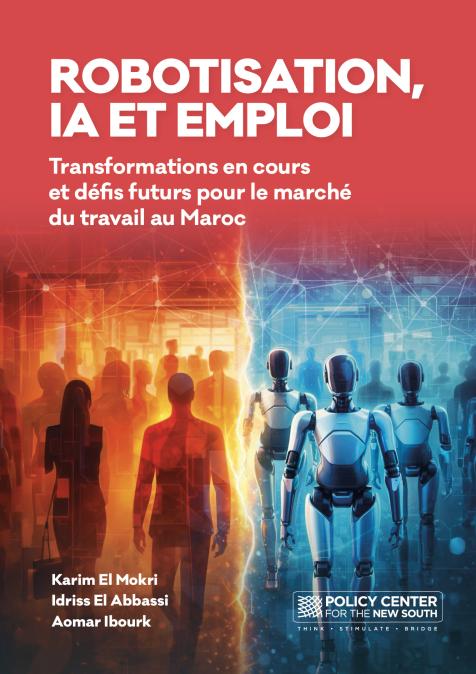
    Bientôt disponible en vente sur amazon et Livremoi. Le monde du travail est engagé dans un processus de mutation sans précédent. La quatrième révolution industrielle, portée par l’intelligence artificielle (IA) et la robotisation, a été le point de commencement d’une ère nouvelle où les repères économiques et sociaux se redéfinissent à une vitesse inédite. Ces technologies suscitent un engouement légitime et offrent des perspectives prometteuses, mais requièrent une vigilance a ...
  • June 1, 2026
    Cette interview met en lumière le rôle central du secteur textile et de l’habillement dans l’économie marocaine, tant en matière d’emploi que d’exportations. Notre économiste, Mr. Fahd Azeroual revient sur son évolution historique, ses principaux défis, notamment la dépendance aux impor...
  • Authors
    May 22, 2026
    This paper, the fourth in a research series on services-led growth in the Global South, examines Egypt’s potential for growth and economic transformation through the integration of services into Global Value Chains (GVCs). It employs a new taxonomy that classifies services into Knowledge Services (KS), Enabling Services (ES), and Local Services (LS) and applies OECD 2025 Trade in Value-Added (TiVA), Trade in Employment (TiM), and input-output databases to benchmark Egypt against Mor ...
  • Authors
    May 15, 2026
    This paper is the third in a series of country and comparative studies that together comprise a research program on services as drivers of economic growth and structural transformation in the Global South. The paper analyzes the pattern of Tunisia's services-led economic growth from 2012- 2022 using a specialized three-category framework: knowledge services (KS), enabling services (ES), and local services (LS). Using data from the OECD Trade in Value Added (TiVA), Trade in Employmen ...
  • Authors
    April 30, 2026
    This paper is the second in a series examining services-led development and global value chain (GVC) integration in the Global South. It applies a three-category analytical framework covering knowledge services (ICT and professional business services), enabling services (transport, logistics, and finance), and local services (retail, hospitality, health, and personal services), to OECD Trade in Value Added indicators. The paper thus  ...
  • Authors
    March 12, 2026
    Historically, manufacturing has served as the primary pathway to economic development, offering strong scale economies, learning-by-doing effects, and the capacity to generate the foreign exchange necessary to import capital goods and technology. However, advances in robotization and artificial intelligence (AI) are fundamentally undermining manufacturing’s traditional role, making it increasingly skill- and capital-intensive while limiting its ability to absorb labor. Thi ...
  • Authors
    El Hussein Fouad
    June 17, 2025
    This paper analyses the stabilization experience in the MENA region, focusing on Egypt, Morocco, Tunisia, and Jordan over the past century. It seeks to answer the question: To what extent have these countries succeeded in achieving resilience to shocks and stresses? Key policy elements included significant fiscal adjustments—varying in scale across countries—and exchange rate developments supported by monetary policies aimed at combating inflationary pressures. The outcomes involved ...
  • Authors
    March 21, 2025
    MENA faces a severe water crisis, with 12 of the world’s 17 most water-stressed countries. Climate change, population growth, inefficient water management, and weak governance drive this challenge. Water production, treatment, and distribution require high energy inputs, while energy generation depends on water for cooling and refining. The region must integrate renewable energy, especially solar power, into water solutions like desalination. Inaction could shrink GDP by up to 14% ...
  • January 03, 2025
    تتناول هذه الحلقة من سلسلة بودكاست مركز السياسات من أجل الجنوب الجديد مفهوم المرونة الاقتصادية بوصفه أداة أساسية لفهم ديناميات الاقتصاد المصري في مواجهة الصدمات المتكررة والتحديات الهيكلي ...