Publications /
Policy Brief

Back
Cooperation Against Transnational Crime: The Case of the Zone of Peace and Cooperation of the South Atlantic
Authors
Mostapha Mouzouni
January 23, 2017

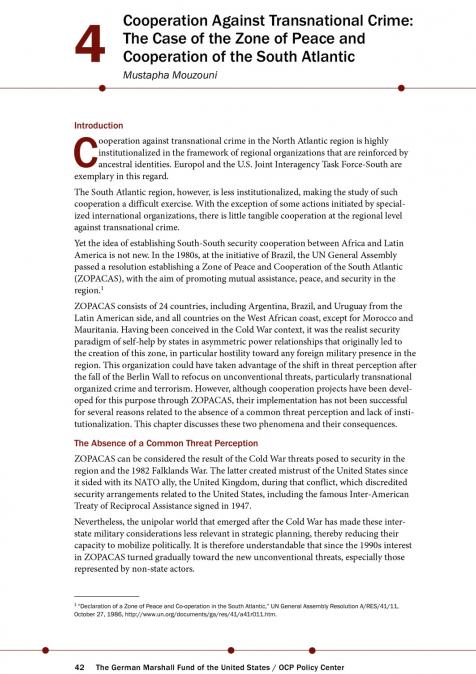
Cooperation against transnational crime in the North Atlantic region is highly institutionalized in the framework of regional organizations that are reinforced by ancestral identities. Europol and the U.S. Joint Interagency Task Force-South are exemplary in this regard. The South Atlantic region, however, is less institutionalized, making the study of such cooperation a difficult exercise. With the exception of some actions initiated by specialized international organizations, there is little tangible cooperation at the regional level against transnational crime. Yet the idea of establishing South-South security cooperation between Africa and Latin America is not new. In the 1980s, at the initiative of Brazil, the UN General Assembly passed a resolution establishing a Zone of Peace and Cooperation of the South Atlantic (ZOPACAS), with the aim of promoting mutual assistance, peace, and security in the region.1 ZOPACAS consists of 24 countries, including Argentina, Brazil, and Uruguay from the Latin American side, and all countries on the West African coast, except for Morocco and Mauritania. Having been conceived in the Cold War context, it was the realist security paradigm of self-help by states in asymmetric power relationships that originally led to the creation of this zone, in particular hostility toward any foreign military presence in the region. This organization could have taken advantage of the shift in threat perception after the fall of the Berlin Wall to refocus on unconventional threats, particularly transnational organized crime and terrorism. However, although cooperation projects have been developed for this purpose through ZOPACAS, their implementation has not been successful for several reasons related to the absence of a common threat perception and lack of institutionalization. This chapter discusses these two phenomena and their consequences.
RELATED CONTENT

  • Authors
    Meryam Amarir
    August 13, 2026
    Les crises récentes au Moyen-Orient, notamment les attaques ciblant les navires commerciaux en mer Rouge et les tensions autour du détroit d'Ormuz, ont mis en évidence la vulnérabilité des principaux corridors stratégiques du commerce mondial. Plus qu'un bouleversement de l'organisation des échanges, elles accélèrent une transformation déjà engagée, fondée sur la recherche de chaînes de connectivité plus résilientes, la diversification des itinéraires commerciaux et le développement ...
  • Authors
    August 13, 2026
    The Resolution adopted by an overwhelming majority of elected European officials in Strasbourg on June 10, 2021, on "the violation of the UN Convention on the Rights of the Child and the exploitation of minors by the authorities in the migration crisis in Ceuta" (2021/2747/RSP), could not fail to leave its mark.Decoding the ResolutionThe Resolution shocked Moroccans to such an extent that it was quickly set aside at the time, as if there were a wish to forget it as fast as possible. ...
  • Authors
    August 11, 2026
    Lorsqu’une crise éclate, elle donne lieu à l’actionnement des réflexes pour sa gestion et la limitation de ses effets. Commencent, alors, les analyses et les suppositions sur les dysfonctionnements, les manquements et les défaillances ayant entrainé ladite crise. Dans certains cas, la théorie du complot s’ingère et les hypothèses cherchent les auteurs ayant provoqué la crise, leurs desseins et leurs buts.Cependant, la théorie de gestion des crises nous apprend qu’une crise inte ...
  • Authors
    August 11, 2026
    The Mecca Agreement: A First Step Towards a New Regional Security Architecture? On 7 August, Saudi Arabia, Türkiye and Pakistan signed the Mecca Agreement, a trilateral defense pact aimed at strengthening collective security and defense cooperation between the three countries. At its core lies a collective defense commitment under which an attack on one member is considered an attack on all three. While many details concerning its practical implementation remain unclear, the agreeme ...
  • Authors
    August 7, 2026
    THE END OF AN ERAThe US-Israeli war on Iran, a 'little excursion' envisaged to be over within a matter of weeks, has entered its fourth month. Shock waves ripple across the globe. This war is just one in a series of recent crises which have fractured the international community, making the decades of the 2020's among the most disruptive in recent history. Each crisis compounds the deleterious effects of those which came before. The war in Iran is no exception. It abruptly stalled ec ...
  • Authors
    August 6, 2026
    With America's 250th anniversary, there will be many analyses of the country's history from domestic and international perspectives. But the meaning of the American story should also be assessed in key regional settings, from Asia to Latin America, and in transatlantic terms. In this vein, it is worth exploring the U.S. engagement in and with the Mediterranean world, one of the first places of U.S. international activism, and a setting where diverse aspects of U.S. foreign policy ha ...
  • August 3, 2026
    This policy paper explores how China’s economic development model—rooted in pragmatism, long-term planning, and civilizational renewal—has become its most compelling soft power asset, particularly in the eyes of the Global South. While critically engaging with Joseph Nye’s original conception of soft power as a primarily cultural and normative force, the paper argues that China’s ability to transform itself from an impoverished postimperial state into the world’s largest trading nat ...
  • Authors
    Fadoua Ammari
    July 27, 2026
    Cet article évalue la pertinence du paradigme de la réconciliation pour analyser la rivalité maroco-algérienne. À partir d’une démarche qualitative, historico-interprétative et interdisciplinaire fondée sur un corpus raisonné de travaux académiques et de sources institutionnelles, il montre que cette conflictualité ne se réduit ni au différend du Sahara ni à un simple antagonisme bilatéral. Elle se construit à l’intersection de mémoires concurrentes, de mécanismes de sécuritisation, ...
  • Authors
    July 27, 2026
    Is Europe Prepared for War?European public opinion is moving from treating a major conflict as unthinkable to regarding it as a possibility for which governments must prepare. Attention is increasingly focused on Russian hybrid operations, vulnerabilities in critical infrastructure and the risk of fragmentation within NATO. European defence policy is consequently undergoing a rapid transition from post-Cold War complacency towards preparations for high-intensity warfare. Recent ...