Publications /
Policy Brief
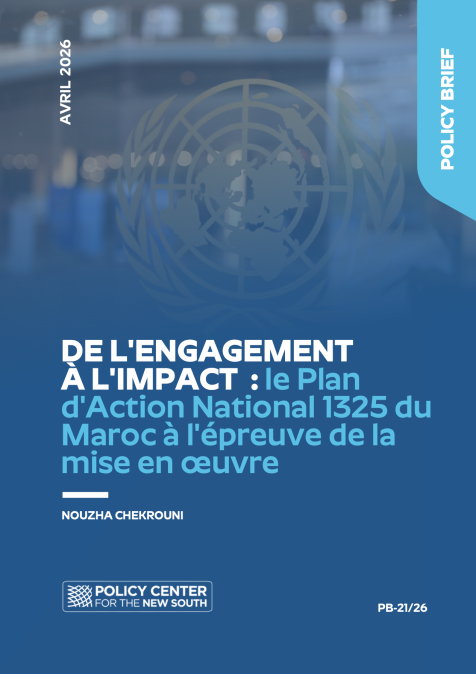
Three years after the adoption of the first National Action Plan (NAP) on the Women, Peace and Security (WPS) Agenda, Morocco has made real institutional progress, but implementation is still inadequate. The extension of the NAP opens a window of opportunity to prepare a second, more ambitious and operational cycle.
This Policy Brief identifies four persistent obstacles: a virtually stagnant female employment rate of 19.1%, less than 3% female representation in peacekeeping contingents, de-radicalization measures insufficiently adapted to women's backgrounds, and the absence of climate change, migration and digital dimensions in the NAP's strategic framework.
The recommendations focus on overhauling NAP governance, strengthening Morocco's regional role, transforming social norms through education, and ensuring the structured participation of civil society, including rural, border and migrant women.
The Policy Brief argues for mediation practices that are culturally rooted in African societies, and for the effective participation of women at every stage of peace design - an imperative that is even more urgent in an international context of growing conflict and the weakening of multilateral security architectures.
INTRODUCTION
The adoption of UN Security Council Resolution 1325 on October 31st, 2000 represented a major normative breakthrough, officially recognizing the role of women in conflict prevention, peacebuilding and post-conflict reconstruction processes. Ten complementary resolutions have since broadened and clarified this agenda, from the treatment of sexual violence as a tactic of war - Resolution 1820 (2008) - to the survivor-centered approach enshrined in Resolution 2467 (2019), gradually outlining a normative architecture whose coherence contrasts with the fragility of its actual implementation.
In March 2022, Morocco adopted its first National Action Plan (NAP) on the Women, Peace and Security (WPS) Agenda, joining a growing movement led by the New South states. This adoption represents a significant institutional step forward. However, it should not obscure the persistence of a structural gap between normative commitment and operational translation - a gap which is precisely the focus of the present analysis.
Since March 2023, the date of the publication of "Morocco and the Women, Peace, and Security Agenda: Goals, Opportunities and Challenges"[1] which helped lay the analytical foundations of the WPS Agenda in Morocco, the national and regional contexts have undergone profound transformations that call for an updated reassessment. The Al Haouz earthquake (September 2023) and its gendered implications, the worsening of Sahelo-Saharan instability, the emergence of new forms of violence linked to digital transformation, and the opening of the second NAP review cycle are all milestones that redefine the conditions for implementing this agenda. This Policy Brief is part of this continuity: it aims to analyze these developments, diagnose persistent structural obstacles and formulate operational recommendations for the second cycle of the NAP.
WHAT HAS CHANGED: A CONSOLIDATING INSTITUTIONAL DYNAMIC
1- From NAP to implementation: between formalization and operationalization
The adoption of Morocco's first NAP, in 2022, represented a substantial step forward in the formalization of the WPS Agenda at national level. Structured around three pillars - preventive diplomacy and peacekeeping, culture of peace and equality, women's economic participation - the document established an institutional architecture consistent with the Kingdom's international commitments, while anchoring the WPS agenda in the priorities of foreign policy and national security.
The evaluation of the NAP nevertheless reveals a limitation: the document remains insufficiently prescriptive, without defining accountability mechanisms or monitoring indicators.
In this way, we were able to provide a rigorous, verifiable assessment of progress. In that sens, the review announced for 2023 represented a decisive opportunity. It was intended to initiate NAP II and move from a framework document to a steering instrument, incorporating quantitative targets, explicit ministerial responsibilities and institutionalized accountability mechanisms. However, as the NAP has been extended rather than formally revised, the question of how to strengthen it remains unanswered. Nevertheless, this extension offers an opportunity to consolidate the implementation framework without waiting for a new planning cycle.
Among the institutional developments since 2022, we can note: the gradual increase in female representation in the Royal Armed Forces, in line with the 2018-2028 UN parity strategy; Morocco's commitment to the Group of Friends on the intersecting challenges of climate change and the WPS Agenda within the African Union (AU); the strengthening of the Moroccan network of women mediators, now linked to the Mediterranean, African and Arab networks; and the deployment of the "Moussalaha" program in a series dedicated to women detained for acts of terrorism.
2- The response to the Al Haouz earthquake: revealing the blind spots in gender mainstreaming
The earthquake that struck the Al Haouz region in September 2023 - causing over 3,000 casualties and major population displacements in mountainous rural areas - was a revealing test of the limits of systematic gender mainstreaming in crisis response mechanisms. Rural women, over-represented among vulnerable populations and households in precarious situations, were disproportionately affected, both in terms of access to immediate humanitarian assistance and in the recovery and reconstruction processes.
This episode underlines the urgency of anchoring the dimensions of the fourth pillar of Resolution 1325 - relief and recovery - in national disaster preparedness plans. It also highlights the need for systematic collection of gender-disaggregated data in emergency situations, a prerequisite for truly inclusive and differentiated humanitarian responses.
3- The WPS Agenda in Africa: Morocco as a key player
On a continental level, Morocco's position in African peace and security bodies has gradually been asserted. Its active participation in African Union mechanisms, its training programs for religious preachers from sub-Saharan Africa, and its diplomatic mediation network are all part of a peace diplomacy that gives the Kingdom a unique transnational legitimacy.
Growing instability in the Sahel-Saharan zone - marked by forced political transitions, the rise of non-state armed groups and intense migratory flows - creates an environment in which women suffer specific and systematic violence. As a stable African state with recognized expertise in de-radicalization and the prevention of violent extremism, Morocco is strategically positioned to reinforce its role as promoter of the WPS Agenda among neighboring states in situations of institutional fragility.
PERSISTENT CONSTRAINTS: THE ANATOMY OF STRUCTURAL OBSTACLES
1- The gap between legislation and social reality
The legislative advances of the last two decades are indisputable: the 2004 reform of the "Moudawana", the 2011 constitutional provisions enshrining the principle of parity, and law n°103.13 on combating violence against women have profoundly reshaped the normative framework. However, the gap between these texts and social practices remains structurally profound. Morocco's female activity rate, set at 19.1% nationally in the third quarter of Womeninbusiness2025 - down slightly from 19.2% a year earlier - reveals not only the persistence but also the worsening of systemic barriers to women's economic empowerment, which is central to the third pillar of the NAP. This gap is even more worrying given that the New Development Model set an intermediate target of 25% FNH by 2025 FNH - a goal that is clearly out of reach.
This situation confirms a reality widely documented by comparative literature: legislative reform is a necessary but not sufficient condition for the transformation of gender relations. Effective implementation requires a coherent policy for transforming social norms, mobilizing educational, religious, media and civil society institutions in an articulated manner.
Key indicator: the New Development Model sets the objective of increasing the female activity rate to 45% by 2035. According to the Direction des Études et des Prévisions Financières (DEPF, March 2022), such an increase would generate an additional 1.7 percentage point rise in GDP per capita over the period 2022-2035, underlining the economic as well as social dimension of this challenge.
2- Participation in peacekeeping missions: a persistent shortfall
Despite Morocco's long and deep involvement in UN peace operations - it is one of the most consistent troop-contributing countries, with contingents deployed in the Democratic Republic of Congo, Central African Republic and South Sudan - the representation of women in these contingents remains below 3%, short of the parity targets set by the UN Secretary-General for 2028.
The gradual feminization of the Royal Armed Forces is a real step forward, but its scope remains limited as long as it is not accompanied by the systematic integration of women officers into operational and command functions. The over-concentration of military women in medical and humanitarian support roles reproduces, within defense institutions, the very gender inequalities that the FPS Agenda aims to deconstruct.
3- The invisibility of women in deradicalization and reintegration processes
One of the most worrying shortcomings of the first NAP is the inadequate treatment of the complex roles played by women in the dynamics of radicalization and deradicalization. Moroccan women have found themselves, to varying degrees and following very different paths, involved in the dynamics of violent extremism - as recruits, companions or relatives of radicalized individuals. This reality calls for deradicalization and reintegration programs that consider the specific nature of their backgrounds, over and above existing mechanisms that remain insufficiently differentiated according to gender.
In its section dedicated to women detained for acts of terrorism, the "Moussalaha" project is a positive first step. It remains insufficient, however, given the scale of the challenge. A systematic gendered approach implies recognizing the plurality of roles played by women in these dynamics - victims, recruiters, fighters, companions, mothers of combatants - and guaranteeing their equitable access to social and economic reintegration mechanisms.
4- The NAP's blind spots: climate change, migration and digital transformation
Three structuring dimensions of the contemporary context remain insufficiently integrated into the Moroccan NAP framework, constituting analytical and operational blind spots.
Climate change: despite the significant rainfall recorded in late 2025 and early 2026, Morocco is one of the regions most exposed to the effects of climate change, with drought, water scarcity and the frequency of extreme events expected to worsen. Rural women, whose livelihood strategies depend directly on degrading natural resources, are the main victims. The International Organization for Migration (IOM) estimates that there could be as many as 19.3 million internally displaced people in North Africa by 2050. The Moroccan initiative to create a Group of Friends within the African Union on the convergence of climate change and the WPS agenda represents a positive political signal that must now be translated into concrete operational instruments.
On migration: Morocco occupies a crossroads position as a country of origin, transit and reception of complex migratory flows. Migrant and refugee women, particularly those in irregular situations, are exposed to specific risks of gender-based violence, trafficking and exploitation in transit zones. While a principled humanitarian approach is affirmed, the explicit integration of the gendered dimensions of migration in the next NAP constitutes an analytical and normative necessity.
On the digital front: the transformation of digital spaces is generating new vectors of violence against women - cyber-violence, online harassment, targeted extremist propaganda - but also new opportunities for female mediation practitioners and civil society players. To date, this field remains absent from the strategic frameworks linked to the WPS Agenda, even though it profoundly reconfigures the dynamics of peace and conflict.
OUTLOOK: TOWARDS A MORE OPERATIONAL SECOND PAN CYCLE
1- Rethinking the governance of the FPS Agenda
The extension of the current NAP opens a window of opportunity to lay the foundations for the second National Action Plan. This new stage should provide an opportunity to rebuild the governance of the WPS Agenda around three guiding principles: accountability, inter-ministerial coordination and sustainable funding. The Steering Committee must be provided with adequate human and financial resources, a strengthened mandate for monitoring and evaluation, and a structured mechanism for consultation with civil society. The integration of qualitative and quantitative indicators, disaggregated by gender, region and context, would enable us to move beyond a declarative approach to one based on measurable results. The pioneering experiences of Norway and Jordan - both involved in the Moroccan NAP development process - offer transferable models in terms of monitoring-evaluation architecture.
2- Capitalizing on peace diplomacy
One of Morocco's distinctive strengths in implementing the WPS Agenda is its credibility as a player at the intersection of the African, Arab and Mediterranean spaces. The national network of women mediators is a strategic asset whose influence needs to be amplified - particularly in regional mediation processes linked to the Sahel and Libya crises. It is essential that the commitment of women mediators goes beyond symbolic presence to translate into substantial influence on the content of negotiated agreements: this implies formalized access to mediation mandates and the systematic integration of a gender perspective into the terms of reference of any special envoy or appointed mediator.
3- Transforming social norms and positive masculinities
The sustainability of institutional advances depends on the transformation of representations of gender equality in society. Integrating the concept of positive masculinities into national education curricula - aimed at building a culture of equality and partnership from the earliest age - is a long-term investment whose effects have been documented in several African and Arab contexts, including Tunisia, Jordan and Rwanda, where similar programs have been integrated into national education reforms with measurable results on young men's attitudes to gender equality.
Moroccan religious institutions, in particular the "Mourchidates" and "Mourchidines" trained by the Mohammed VI Institute, play an irreplaceable role in this transformation, by relaying to local communities a discourse of tolerance, equality and rejection of gender-based violence.
4- Civil society: a player in governance, not just a stakeholder
Civil society played a structuring role in the development of the first NAP. Its involvement in the second cycle must not only be maintained but institutionalized according to a participatory governance model. Women's organizations, human rights associations and networks of female mediation practitioners have a detailed knowledge of the realities on the ground that state institutions cannot reproduce unilaterally. Structured participation of civil society - guaranteeing regular access to decision-making bodies and independent monitoring of implementation - is an essential condition for a credible and effective NAP. Within this framework, specific and deliberate attention must be paid to the representation of women from rural regions, border areas and migrant communities.
CONCLUSION
Three years after the adoption of Morocco’s first National Action Plan on the Women’s Rights Agenda, the assessment is that of a genuine institutional momentum, driven by a strong political will, but one that has yet to translate into concrete changes for Moroccan and, more broadly, African women, given the commitments made. Legislative, diplomatic and military advances are undeniable, but so are shortcomings in implementation, financing and management.
The current context - marked by the humanitarian and gendered consequences of the Al Haouz earthquake, worsening Sahelo-Saharan instability, climate disruption and the digital reconfiguration of conflict dynamics - calls for a second NAP that is substantially more ambitious, more precise in its commitments and more inclusive in its governance arrangements. The revision of the NAP is above all an opportunity to cross the threshold between normative compliance and real impact.
In an international context marked by an increase in the number of conflicts, fragmentation of collective security architectures and a questioning of multilateral norms, the need to anchor peace processes in culturally-rooted mediation practices is becoming ever more acute. African societies have their own resources - traditions of community dialogue, the recognized role of women as guardians of the social bond, reconciliation practices supported by customary and religious institutions - which constitute sustainable levers for peace, all too often ignored in favor of imported formats. Promoting culturally-rooted mediation, which mobilizes these endogenous resources while linking them to international normative frameworks, is a strategic priority for Africa. In this context, women's participation cannot be limited to a symbolic presence in formal processes: it must be guaranteed at every stage of peace design - from preventive dialogue to the negotiation of agreements, from post-conflict reconstruction to institutional consolidation. Only in this way will African societies be able to build a peace that resembles them- inclusive, sustainable and sovereign.
Women can no longer be seen exclusively as victims in need of protection. They are negotiators, mediators, defenders of human rights and architects of peace. It is up to Moroccan institutions to provide them with the means - political, financial and symbolic - commensurate with their role.
RECOMMENDATIONS
For the Moroccan Government
Adopt a second NAP with gender-disaggregated performance indicators, a dedicated budget and an annual accountability mechanism involving Parliament and civil society. Explicitly integrate gender-climate change, gender-migration and gender-digital nexuses into the strategic priorities of the second NAP. Increase the participation of Moroccan military women in UN peacekeeping missions to 10% by 2028, in line with the UN Secretary-General's strategy. Develop gendered and differentiated DDR programs within the framework of the "Moussalaha" program, guaranteeing women involved in extremist dynamics equitable access to reintegration mechanisms. Institutionalize the participation of civil society in the NAP monitoring and evaluation cycle, via a formal, regular and well-resourced consultative mechanism.
For regional and multilateral institutions
Strengthen the operational capacities of the Moroccan network of women mediators by guaranteeing them formal access to regional mediation processes, particularly in the Sahelian and Libyan crises. Support Moroccan leadership within the AU Group of Friends on climate change/PSF convergence, by helping it to develop concrete methodological tools that can be transferred to member countries. Integrate gender-disaggregated data collection protocols into all humanitarian response operations in Morocco and neighboring fragile contexts.
For civil society
Strengthen the capacities of Moroccan women's organizations in terms of advocacy, citizen watch and independent monitoring of NAP implementation. Ensure the effective - and not tokenistic - participation of women from rural areas, border areas and migrant communities in consultations on the second NAP, by developing participation modalities adapted to their specific constraints.
[1].Nouzha Chekrouni & Nihal El Mquirmi, "Morocco and the Women, Peace, and Security Agenda: Goals, Opportunities and Challenges", Policy Brief 14/23 , March 20, 2023.