Publications /
Opinion
Why only globally connected, knowledge-intensive services — not local services — can drive long-term development and productivity growth.
This Commentary was originally published on stimson.org
For decades, manufacturing was considered the indispensable engine of economic development, creating jobs, boosting productivity, and integrating countries into global markets. But automation, robotics, and intensifying global competition have made industrialization far harder for developing economies to achieve at scale. As countries across North Africa and beyond deindustrialize before fully industrializing, the debate is no longer whether services can replace manufacturing — but which services can. This piece argues that only knowledge-intensive, globally connected services — such as ICT, software, logistics, and professional services — can replicate manufacturing’s transformative role. Drawing on examples from Morocco, Egypt, Tunisia, and India, the authors examine why some service sectors generate productivity and integration into global value chains while others remain low-productivity and domestically confined. The article ultimately explores what governments must do to avoid missing yet another narrowing development window.
Can services replace manufacturing as an engine of economic development? For decades, the question scarcely arose. Manufacturing was the proven path: It absorbed unskilled labor, drove productivity, and built the supply chains that lifted entire economies. Services came later, as a byproduct of industrialization, not as its starting point.
That logic no longer holds. Automation, robotization, and intensifying global competition have made manufacturing-led development far harder to achieve at scale. Across developing economies, many countries are deindustrializing before they have industrialized enough to benefit from it. The choice is no longer between manufacturing and services. The manufacturing escalator has narrowed — and for most countries, access is increasingly difficult.
But second-best is not a fallback. It is the only viable path forward. The question is not whether services can replace manufacturing, but which services can. Expanding local services — more retail, more restaurants, more informal activity — can generate jobs, but not transformation. Growth without productivity gains will not close the gap with advanced economies.
What matters is the distinction between knowledge services — such as information and communications technology (ICT), professional services, and advanced business activities — and local services that serve domestic demand. Like manufacturing, these knowledge services are tradable, generate foreign exchange, participate actively in global value chains, and display strong productivity dynamics and knowledge spillovers. Local services, by contrast, remain fragmented, low-productivity, and largely disconnected from global markets.
Knowledge services, however, introduce a structural tension that manufacturing largely avoided. High-productivity activities in ICT and professional services employ relatively few workers — Morocco’s, despite their world-class export performance, account for barely 1.5% of the workforce. Local services absorb far more workers, but at low productivity and with limited growth potential. Developing economies therefore face a dual challenge: creating jobs at scale while sustaining productivity growth. Manufacturing once delivered both. Knowledge services can deliver productivity, but broad-based employment requires deliberate policies to build linkages, expand skills, and diffuse these gains across the wider economy.
This path is real, but demanding. Economies such as Ireland, Singapore, and Estonia have built knowledge-intensive service sectors that contributed directly to convergence with advanced economies. Among developing economies, India has gone furthest. Indian software engineers now write code embedded in European cars without a single shipment crossing a border. Yet even India has struggled to translate these gains into economy-wide productivity convergence. The opportunity exists. Scaling it is the challenge.
Evidence from across developing economies underscores the point. In most countries, services are already large — often accounting for more than half of GDP. But knowledge services remain small. They account for roughly 6% of GDP in Egypt and less than 10% in Morocco and Tunisia, compared with 15-17% in advanced European economies. The problem is not the size of services. It is their composition — and that is what determines whether growth leads to transformation.
The North African cases illustrate three distinct traps.
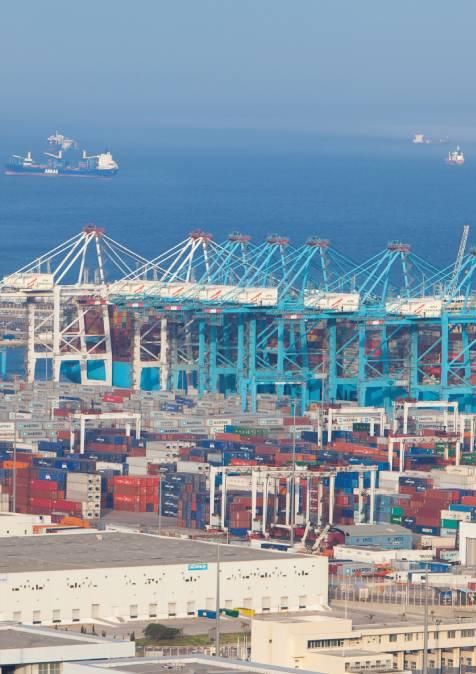
Morocco has come closest to building what works. Its knowledge service sectors show genuine dual integration, importing specialized inputs while exporting high-value outputs. Its IT and software sector is strongly oriented toward foreign demand, and its logistics infrastructure — anchored by Tanger Med — is embedded in global supply chains. But these sectors remain small, employing only a limited share of the workforce and contributing less than a tenth of GDP. Quality without scale is an enclave, not a development engine.
Egypt reflects a different pattern: engagement without learning. Its services are connected to global markets — the Suez Canal ensures a strong presence in world trade — but the economy imports relatively little foreign knowledge or technology in return. The result is a split structure that participates in global production without achieving sustained upgrading. Strategic assets generate revenue, but they can also crowd out the knowledge-intensive activities needed for long-term growth.
Tunisia shows how quickly progress can unravel. In the early 2010s, its knowledge service sectors were sourcing foreign inputs at levels comparable to advanced economies, positioning the country well for deeper integration. A decade of political instability disrupted that trajectory. Firms lost access to not only inputs but also international networks, growth shifted toward less productive activities, and export orientation weakened. The window was open. Tunisia did not pass through it.
That window is now narrowing. Artificial intelligence is already automating significant portions of the work on which knowledge services rely, raising the bar for late entrants. Countries that invest now in skills, digital infrastructure, and globally connected firms can still seize the opportunity. Those that delay may find, as with manufacturing, that the escalator has narrowed again — and quickly.
The policy implications are clear. Expanding services is not enough; composition is decisive. Governments must build the capabilities that allow knowledge services to scale: advanced skills, reliable digital infrastructure, openness to foreign inputs and expertise, and institutions that support firm-level learning and integration into global networks. Without these, services-led growth will remain shallow.
So, can services replace manufacturing? Yes — but only a specific subset can do so. High-productivity, globally connected knowledge services can play the role manufacturing once did. But this requires deliberate policy choices, not passive expansion.
The engine of development has shifted. It no longer resides only on factory floors, but in digital networks, research hubs, and globally integrated professional services. The development map still exists. But navigating it now requires clarity — and the policy discipline to act.