Publications /
Book / Report
In 2025, the global landscape became increasingly fragmented and uncertain. Great power competition intensified, regional conflicts became protracted and exacerbated, while economic nationalism reshaped the rules of trade and development. The mechanisms for conflict resolution and cooperation that have long provided a foundation for international cooperation are now under strain due to polarization and mistrust. Even longstanding alliances, bilateral and collective security architectures at the core of international security system have not escaped these changes. While some attribute these trends to the emergence of a multipolar world order, there is no consensus whether such a transformation is occurring or on the causal link. There is agreement only on the notion that the world is moving beyond the post-cold war order and that, eighty years after the creation of the UN, institutional reform is overdue.
Yet while these challenges and the erosion of traditional mechanisms of cooperation understandably dominate the attention of the public, policymakers and the expert community, they do not tell the whole story. Amidst polarization, unilateral policies and growing calls by political leaders to adopt inward-looking policies, new and pragmatic forms of cooperation are emerging. By keeping sight of the shared interest in coordinating responses to global challenges, these efforts are, in effect, transcending some of the existing divides between nations of the North and the South. They therefore might merit recognition and sustained support, not only for their potential transformative impact but also for the message they convey: that alternative pathways are possible! It is the ultimate acknowledgement that living in a world where an increasing diversity of political, economic, and social models coexists and where differing visions of governance and development are put forward comes with difficulties. Yet this very reality also offers a great opportunity: plurality is key to finding appropriate responses to emerging challenges.
It is in that spirit that leaders and experts from over 100 countries convened in February 2025 for the AI Action Summit. The summit highlighted innovation, real-world applications, and economic prospects of AI, while also addressing wider risks. The signing by 58 nations, including Morocco, India and Italy, and various international organizations of the Statement on Inclusive and Sustainable Artificial Intelligence for People and the Planet demonstrates that a core group of countries willing to mutualize their efforts is emerging.
On the war in Gaza, the High-level International Conference for the Peaceful Settlement of the Question of Palestine and Implementation of the Two-State Solution, held in July, showed that many nations were eager to move past the deadlock in the UN Security Council and take collective action to end the war and discuss the contours of a comprehensive peace plan for the region, before the Gaza Peace Plan was signed by the parties and endorsed by the UN Security Council in early October. The New York Declaration, which is the outcome document of the July conference, was endorsed by 142 nations when they voted in favor of a UN General Assembly resolution backing the document. This stands as a reminder that coalitions can be formed across traditional divides. It is also a testament that when political will converges, pragmatic partnerships can emerge that transcend national interests, regional rivalries, or historical grievances. Unfortunately, at the moment a similar convergence has not yet fully materialized on the Russo-Ukrainian war.
Similarly, on the economic front, at a time when protectionism and economic nationalism seem to dominate the global narrative, it is important to recognize that new avenues for economic cooperation are also developing, as is the case for the Future of Investment and Trade Partnership (FITP), which brings together 14 small and medium-sized economies to support open and rules-based global trade.
In sum, these efforts matter not only because they push back against the perception of an inevitable slide into isolationism or polarization into opposite camps at the international level, but also because they concretely demonstrate that pragmatic alliances that include diverse nations are still possible. Even when they operate outside traditional frameworks, such initiatives serve the broader global public interest by keeping channels of cooperation open. What stands out in these initiatives is the imagination behind them: a willingness to adapt, to experiment, and to work together in spite of differences. They reflect a simple truth: the challenges we face are shared, and the responses will only be effective if they are coordinated.
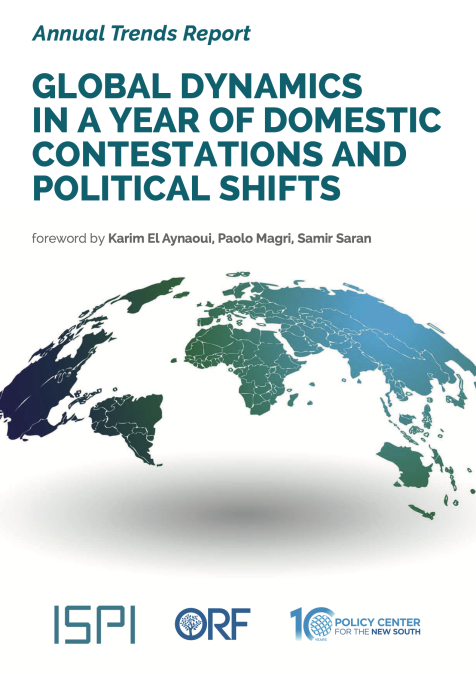
This belief is at the heart of the partnership between the Policy Center for the New South (PCNS, Morocco), the Italian Institute for International Political Studies (ISPI), and the Observer Research Foundation (ORF, India). Our three institutions coordinate a partnership that extends across regions, disciplines, and perspectives. The tripartite initiative that we launched in 2023 frames our strategic deliberations and engagement. It is an avenue for over 400 experts from three continents to meet, exchange, conduct research, and disseminate findings and cross-perspectives. One of the outputs of this joint research, the Annual Trends report, today in its third edition, seeks to provide a forward-looking analysis of global developments, to highlight areas where cooperation is possible, and to contribute ideas for a more inclusive and resilient international order.
This edition explores five key areas: global governance, security, the economy and development, energy and climate, and new technologies and the digital transition, underscoring that in a polarized world where blame and scapegoating consume valuable time, genuine progress depends on constructive engagement that brings together willing partners across regions to move beyond confrontation and build practical paths toward cooperation.
At the same time, even as new initiatives and partnerships take shape, this should not lead us to abandon the frameworks that have long underpinned international cooperation. Reforms are necessary, but they must not serve as an excuse to neglect the preservation of global public goods. These institutions remain the pillars that make cooperation possible, and investing in them is essential if we are to turn shared challenges into shared solutions.