Publications /
Book / Report

Back
Beyond the Arab Risings What Kind of Future?
Authors
Alessandro Minuto-Rizzo
Alessandro Politi
Claire Spencer
Abdulaziz Sager
Mahboub E. Hashem
Matt Herbert
Umberto Profazio
Eman Ragab
Brahim Oumansour
Ashraf Mohamed Keshk
Jean-Loup Samaan
Ahmad Masa’deh
Giovanni Romani
November 11, 2021

Since its very beginning in 2011, the Middle East and Deep Maghreb have been a fundamental priority for the Foundation. As this year marks the 10th anniversary of the Arab uprisings, our Dossier wants to provide a meaningful understanding of the future dynamics of an area that, despite several positive attempts, is still affected by major instability. Gathering the perspectives of a pool of distinguished regional and international analysts, this publication dives into the socio-economic and political conditions that showed the aspirations of a civil society, often stifled by old problems and emerging challenges. Despite the very different outcomes of the uprisings, new ways ahead are possible.
RELATED CONTENT

  • Authors
    Taoufik Abbad
    February 3, 2017
    La réflexion développée dans cet ouvrage part d’un constat alarmant et pressant. Le processus continu et renforcé de l’accumulation du capital, dans lequel s’est engagé le Maroc depuis les années 2000, a permis certes de préserver la stabilité des équilibres fondamentaux et d’amortir les différents chocs exogènes, aussi bien internes qu’externes, mais il n’a pas permis d’insuffler un accroissement plus important des gains de productivité et d’accélérer la transformation de la base p ...
  • Authors
    Prakash Loungani
    November 9, 2016
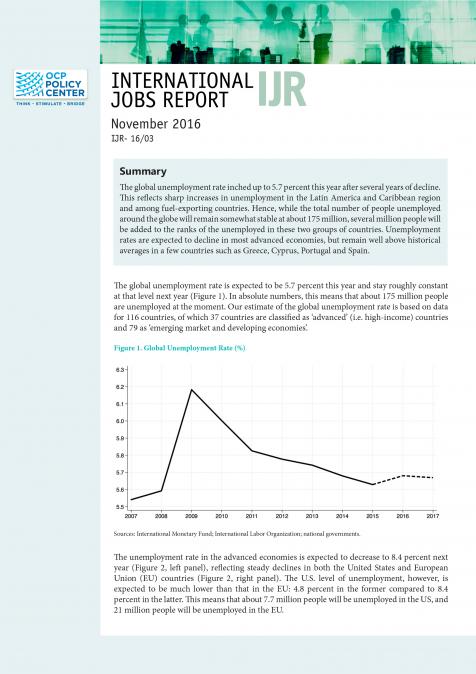
    The global unemployment rate inched up to 5.7 percent this year after several years of decline. This reflects sharp increases in unemployment in the Latin America and Caribbean region and among fuel-exporting countries. Hence, while the total number of people unemployed around the globe will remain somewhat stable at about 175 million, several million people will be added to the ranks of the unemployed in these two groups of countries. Unemployment rates are expected to decline in m ...
  • Authors
    November 7, 2016
    Despite the gloomy tone of much discussion at the just-concluded IMF and World Bank annual meetings, the global economy is not in as bad shape as many think. The concerns about “secular stagnation” in advanced countries are also overplayed, and nor are developing countries directly exposed to such risks. By contrast, the pessimism about the prospects for MENA are unfortunately largely justified. Most importantly, at the global and at the MENA level the biggest concerns are not econo ...
  • Authors
    Russel Dinh
    January 27, 2016
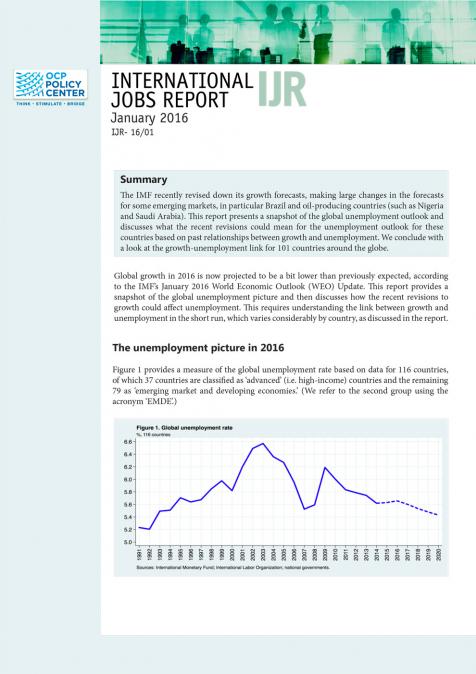
    The IMF recently revised down its growth forecasts, making large changes in the forecasts for some emerging markets, in particular Brazil and oil-producing countries (such as Nigeria and Saudi Arabia). This report presents a snapshot of the global unemployment outlook and discusses what the recent revisions could mean for the unemployment outlook for these countries based on past relationships between growth and unemployment. We conclude with a look at the growth-unemployment link f ...
  • Authors
    May 18, 2015
    Economic integration is crucial in order to achieve rapid and sustainable growth. However, instabilities in the MENA region and the recent plunge in oil prices may stifle the economic progress in some of these countries, and threaten their attempts at integration. Within this context, this note seeks to analyze the efforts of integration that MENA countries have undertaken, particularly through trade agreements; and to articulate some principles that can help guide the ongoing searc ...