Publications /
Book / Report

Back
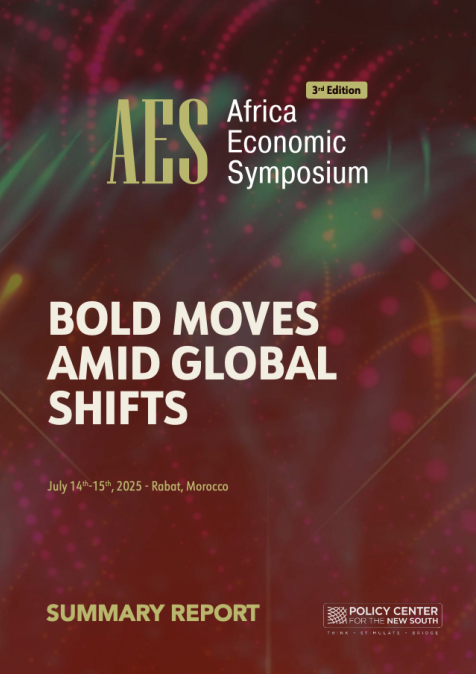
Africa Economic Symposium (AES) 3nd edition - SUMMARY REPORT
Authors
General rapporteur Mahmoud Arbouch
September 2, 2025

The Africa Economic Symposium (AES) has firmly established itself as one of the flagship annual events of the Policy Center for the New South, alongside the Atlantic Dialogues and the African Peace and Security Annual Conference (APSACO). Now in its third edition, AES continues to provide a unique platform for economists, policymakers, and academics from across the continent and beyond to exchange perspectives on the pressing macroeconomic and structural challenges facing Africa. Its mission remains to foster rigorous, evidence-based debates that inform policymaking and support long-term strategies for Africa’s development in an era of uncertainty. 

The 2025 edition, convened under the theme “Bold Moves amid Global Shifts,” explored the difficult policy trade-offs confronting African governments as they navigate a volatile global environment. The continent’s recovery from COVID-19 has been uneven, while debt pressures, supply chain disruptions, and geopolitical tensions weigh heavily on fiscal and economic resilience. Structural challenges such as persistent unemployment, low productivity, and the exclusion of Africa’s youth continue to hinder inclusive growth, even as policymakers are called upon to adapt to deep systemic uncertainty. 

The symposium underscored that many African states are increasingly resorting to short-term stabilization measures—such as accumulating reserves and postponing reforms—that may provide immediate security but risk delaying the structural transformation urgently needed. Against this backdrop, AES 2025 called for a careful balance between fiscal prudence, social investment, and the pursuit of sustainable growth, placing emphasis on reforming governance, improving macroeconomic management, and accelerating structural change. 

The discussions highlighted the urgent need to rethink Africa’s economic strategies in a shifting global order. From debt sustainability and the role of central banks to the promise of financial innovation, digital inclusion, and new instruments such as central bank digital currencies, the symposium emphasized that policy choices must align with long-term transformation goals. The debates also explored the opportunities and challenges of regional integration, trade connectivity, and development finance, all of which are essential levers for Africa’s resilience and prosperity. 

As in previous editions, the Annual Report on African Economies was launched alongside the symposium, offering an in-depth analysis of the continent’s macroeconomic dynamics and structural transformation pathways. More than just a publication, the report reflects the collective intellectual effort of leading scholars and practitioners, providing evidence-based insights to guide decision- makers. Together, the symposium and the report reinforced the Policy Center for the New South’s commitment to fostering forward-looking economic thinking that moves beyond short-term headlines to tackle Africa’s enduring challenges.


RELATED CONTENT

  • October 13, 2021
    Tax revenue mobilization plays a key role in financing the economic and social development of countries. Indeed, tax policy can have several implications on the behavior of economic agents, investment, jobs, innovation, and on the attractiveness of foreign direct investment. As result, ...
  • October 13, 2021
    Tax revenue mobilization plays a key role in financing the economic and social development of countries. Indeed, tax policy can have several implications on the behavior of economic agents, investment, jobs, innovation, and on the attractiveness of foreign direct investment. As result, ...
  • October 13, 2021
    Tax revenue mobilization plays a key role in financing the economic and social development of countries. Indeed, tax policy can have several implications on the behavior of economic agents, investment, jobs, innovation, and on the attractiveness of foreign direct investment. As result, ...
  • Authors
    October 8, 2021
    Annoncé le 16 septembre dernier, l’arrêt définitif de l’enquête annuelle sur le climat des affaires est une erreur. Véritable référence pour l’analyse économique et entrepreneuriale dans 190 pays, c’est un instrument perfectible, mais indispensable. Dans la foulée d’une enquête indépendante menée par le cabinet d’avocats WilmerHale, qui pointait les pressions inopportunes exercées par la Chine et par d’autres pays lors de la préparation de son rapport annuel Doing Business, la ...
  • October 08, 2021
    L'espace indo-pacifique est en phase de devenir le cœur battant du commerce international et le centre de la croissance économique mondiale. Dans cette perspective, la France et en tant q ...
  • Authors
    Mehmet Sait Akman
    Bozkurt Aran
    Leonardo Borlini
    Carlos A. Primo Braga
    Fernando De Mateo
    Alejandro Jara
    Douglas Lippoldt
    October 7, 2021
    The first two decades of this millennium were marked by major political, economic and geopolitical disruptions. This has led many analysts to predict that the world economy is entering a phase of “deglobalization” – that is, a retreat from the globalization process. This policy brief discusses how “deglobalization” affects the role and relevance of international trade institutions and agreements. The basic message is that investing in the improvement of the rules-based multilateral ...
  • Authors
    October 5, 2021
    Seconde nation la plus peuplée d’Afrique après le Nigeria, l’Éthiopie se distingue par un essor économique continu depuis trente ans. Des progrès notables sévèrement remis en question par le conflit avec la province du Tigré, qui dure depuis près d’un an. Pays phare de la Corne de l’Afrique, l’Éthiopie s’est distinguée par une croissance moyenne à deux chiffres (10 %) sur la période 2010-2019. Tombée à 6 % en 2020, celle-ci ne devrait pas dépasser 2 % en 2021 selon l ...
  • October 01, 2021
    The climate crisis is a latent threat that has been brewing for several years. Its repercussions affect both individuals and economies. Since the Paris Agreement, progress has stalled in ...
  • Authors
    Raffaele Della Croce
    Alessandro Gili
    Alin Horj
    Murat Kenanoğlu
    Carlo Secchi
    September 29, 2021
    Changes in global value chains and reshoring trends brought about by the Covid-19 pandemic represent an opportunity for sustainable and inclusive economic development of the Mediterranean region. While the region has increased its participation in trade and global value chains, it remains below its potential due to limited connectivity and the lack of adequate investment in infrastructures. To boost competitiveness and attract near-shoring investments, an upgrade of the Mediterranea ...
  • Authors
    Raffaele Della Croce
    Miguel Vazquez
    September 29, 2021
    In order to close the financing gap in green technologies, finding new mechanisms to enhance the participation of the private sector, combined with that of the public sector, in financing sustainable and climate-resilient infrastructure is a must. In this context, some unlisted instruments are going to be needed to enhance financing of green infrastructure. Besides, the development of properly structured projects, with risks and returns in line with the preferences of the different ...