Podcasts

Back

The EU's challenges post-COVID-19

02
April 2021
Len Ishmael & Abdessalam Jaldi

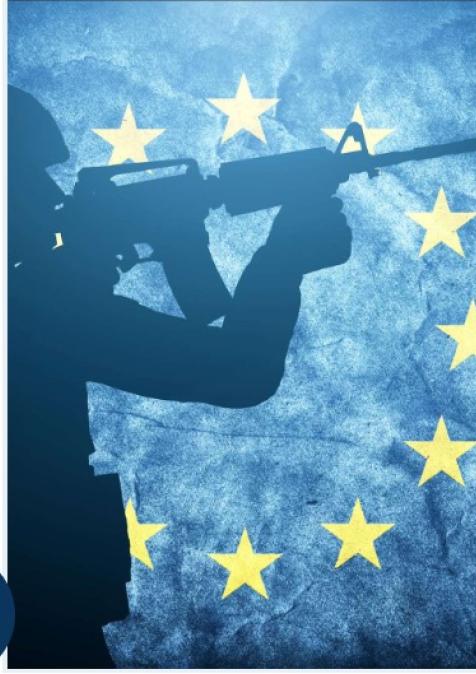
In a world where conventional threats to public safety and international security are increasingly a back seat, the Covid-19 pandemic has opened a new chapter in the discussion on how to address modern global governance. Regarding Europe, it is no secret that the European Union has been teetering on the edge of collapse for years, from the financial crisis to the Covid-19 pandemic. In this podcast, Abdessalam Jaldi, International Relations Specialist at the Policy Center for the New South engages in a conversation with Len Ishmael, Senior Fellow at the Policy Center for the New South to discuss the European Union's challenges post Covid-19, and also the opportunities presented by the actual health crisis.
RELATED CONTENT

  • February 13, 2026
    Le général Olivier Tramond analyse la réduction de la présence militaire française en Afrique comme un changement stratégique profond plutôt qu’un renoncement. Au-delà des coups d’État et ...
  • Authors
    February 12, 2026
    Divergent regulatory regimes for data, driven by different motivations, ranging from privacy protection in the European Union to information control in China, could eventually produce distinctively different, and possibly contradictory, bodies of data. Artificial-intelligence models trained on those datasets could produce differing and possibly even conflicting outputs. To the extent that AI outputs start to shape human perception and to influence decisions, in governments and ...
  • January 30, 2026
    En 2019, Donald Trump a proposé d’acheter le Groenland, déclenchant un refus catégorique du Danemark et une tension diplomatique transatlantique. Cette initiative reflétait l’intérêt stratégique et économique des États-Unis pour l’Arctique et ses ressources. L’épisode a mis en lumière l...
  • Authors
    December 18, 2025
    The return of President Donald Trump to the White House at the start of 2025 was expected to signal an American retreat from international engagement, especially in regions of traditional security interest, such as southern Europe, North Africa, and the Middle East. To the surprise of many observers around the Mediterranean, and perhaps to the dismay of some in the Trump administration’s ideological orbit, this has not happened. If anything, the second half of 2025 has seen a high d ...
  • Authors
    December 16, 2025
    An unusual gesture indeed—the dictator, more often than not a recluse, withdrawn behind his fortress and protected by 1.2 million armed soldiers, finally admitted what had long been seen on the battlefield in Ukraine and by spy satellites far above. North Korean soldiers—possibly 12,000 of them—are fighting on front lines alongside Russian troops, and they are falling or being wounded; some 4,000 men so far, by current estimates.  ...
  • Authors
    Niagalé Bagayoko
    Eugène Berg
    Christophe Chabert
    Thierry Garcin
    Alain Oudot de Dainville
    Florent Parmentier
    Anne Sophie Raujol
    Hassan Saoudi
    October 23, 2025
    Prochainement disponible sur Livremoi & Amazon. Les Dialogues Stratégiques, fruit d'une collaboration entre le HEC Center for Geopolitics et le Policy Center for the New South, constituent une plateforme d'échanges biannuelle dédiée à l'analyse des grandes tendances mondiales et des problématiques régionalesqui lient l'Europe et l'Afrique. Réunissant praticiens, décideurs, universitaires et représentants desmédias, cet espace de réflexion permet de décoder les transfor ...
  • Authors
    September 4, 2025
    This policy brief analyzes the first 100 days in office of Chancellor Friedrich Merz, which have been marked by an assertive foreign policy, ambitious security reforms, and a shift toward economic pragmatism. Merz has sought to reestablish Germany as a ‘leading middle power’, emphasizing closer European coordination, renewed transatlantic engagement, and unwavering support for Ukraine. However, his approach to the Gaza conflict, characterized by alignment with U.S. positions and rel ...
  • Authors
    April 8, 2025
    The Russia–Ukraine war, while primarily perceived as a European security crisis, has triggered deep structural shocks globally, disproportionately affecting the developing world—the “New South.” This essay explores how historical legacies, global economic dependencies, and shifting geoeconomic paradigms have converged through the war to exacerbate existing vulnerabilities in Africa, Asia, Latin America, and the Middle East. It critically examines the war’s impact through four interc ...