Podcasts

Back

Energy Cooperation : a Prerequisite for Sustaining Energy Security

27
August 2016
Marcus Vinicius de Freitas

This podcast is performed by Marcus de Freitas. Energy security is essential for securing growth and development in the future. It is even more relevant than military power. Countries should cooperate and reduce the risk of unstable supply. Current oil price decline is temporary and should represent an opportunity to save for the future.

 

RELATED CONTENT

  • Authors
    April 28, 2026
    Climate policy is increasingly reshaping the conditions under which firms participate in international markets. As some jurisdictions introduce carbon border adjustments, lifecycle emissions standards, and supply-chain traceability requirements, market access is starting to be made conditional on verifiable characteristics of production processes, such as carbon intensity, embedded emissions, and input sourcing, rather than solely on product characteristics or prices. This paper exa ...
  • April 21, 2026
    في هذه الحلقة، نناقش الأهمية الجيو-اقتصادية للمعادن الاستراتيجية كركيزة أساسية للتحولات الطاقية والرقمية العالمية وتأثيرها المباشر على سلاسل القيمة الدولية. ونسلط الضوء على قدرة القارة الإفريقية والمغرب على تجاوز تصدير المواد الخام نحو بناء منظومة صناعية محلية متكاملة تضمن السيادة الاقت...
  • April 9, 2026
    Cet entretien explore le Nexus Eau-Énergie-Alimentation comme un défi systémique majeur pour le Maroc, dans un contexte de rareté croissante des ressources et de pressions sur la souveraineté. Il met en lumière les interdépendances critiques entre ces trois secteurs et les limites d’app...
  • Authors
    April 1, 2026
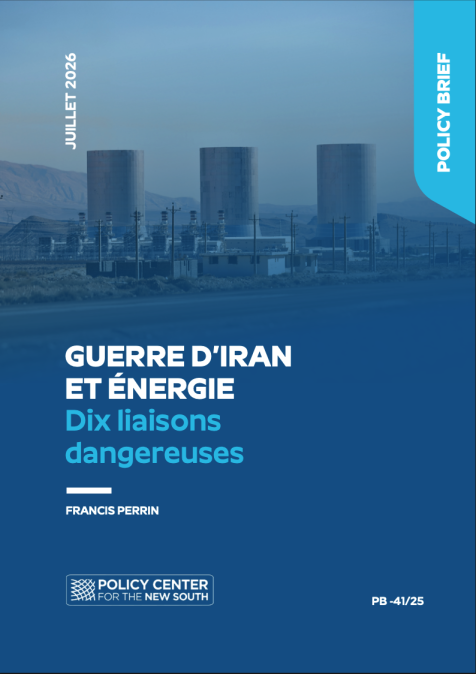
    We are now in the fifth week since the U.S. airstrike that killed top leaders of the Iranian regime, initiating a war involving the United States and Israel against the country. More than a month of mutual bombardments between Iran and Israel has ensued, extending to other Persian Gulf nations, U.S. military installations—and even Cyprus. From a global perspective, the impact has stemmed primarily from disruptions to regional production of goods and the blockade of the Strait of Hor ...
  • Authors
    March 3, 2026
    Sur les marchés mondiaux de matières premières, l’année 2025 s’est inscrite dans le sillage de 2024 : une hausse record des cours des métaux précieux dans le contexte d’incertitudes, toujours plus marquées, et des métaux de base dont la performance a, une fois encore, été largement déterminée par les niveaux de l’offre minière. Du côté des ‘’ softs’’, cacao et café se sont repliés après les records de prix passés, tandis que le marché des céréales a connu une relative stab ...
  • Authors
    March 3, 2026
    On the global commodities markets, 2025 largely followed the trajectory set in 2024, with a record rise in precious metals prices against a backdrop of ever-increasing uncertainty, and base metals whose performance was once again largely determined by mining supply levels. On the softs side, cocoa and coffee retreated from past record prices, while the cereals market experienced relative price stability between 2024 and 2025, against a backdrop of abundant harvests worldwide. Oil an ...
  • Authors
    Fatima Ezzahra Mengoub
    February 20, 2026
    Après plus de sept années de sécheresse, le Maroc a connu durant l’hiver 2025–2026 des précipitations exceptionnellement abondantes, témoignant d’une variabilité hydrique de plus en plus marquée. Cette alternance rapide entre déficit chronique et excès ponctuels révèle le paradoxe hydrique national : un système historiquement centré sur la rareté doit désormais gérer des épisodes extrêmes concentrés et intenses.Les infrastructures hydrauliques ont limité les impacts humains et écono ...
  • Authors
    Fatima Ezzahra Mengoub
    February 20, 2026
    After more than seven years of drought, Morocco experienced exceptionally abundant rainfall during the winter of 2025-2026, reflecting increasingly marked water variability. This rapid alternation between chronic deficits and occasional excesses reveals the country's water paradox: a system historically centered on scarcity must now manage concentrated and intense extreme episodes.Hydraulic infrastructures helped limit human and economic impacts and ensured significant replenishment ...