Webinar : Political Economy in the North-South relations amid COVID-19

May 22, 2020

The COVID-19 pandemic poses unprecedented challenges to the international community and is due to heavily impact the global economy in the short and long run. The virus has infected over 4 million people and caused almost 300.000 casualties globally. During its spreading, mass production hastily witnessed shutdowns and supply chain disruptions, causing worldwide undulation effects encompassing all economic sectors. A steep contraction in household consumption, rising inflation and unemployment rates, and an abrupt halt in global tourism are some of its most visible consequences. Resilience of national economies vis-à-vis the current situation varies widely depending on many factors, including containment measures’ efficiency and effectiveness as well as the economic support governments consider deploying. Yet, the highly interconnectedness of the world means that fighting the virus – and navigating its economic consequences – must include both national measures and global ones. In this webinar, we reflect on alternative options for economic recovery. Trade agreements, debt relief measures, impact investments, green strategies – these are just some of the instruments available in the toolbox. The panel will address ways in which existing and new channels for cooperation between the global north and south can be leveraged to achieve the best possible way out of the crisis, with a long-term outlook on what kind of global economy we want to rebuild.
Speakers
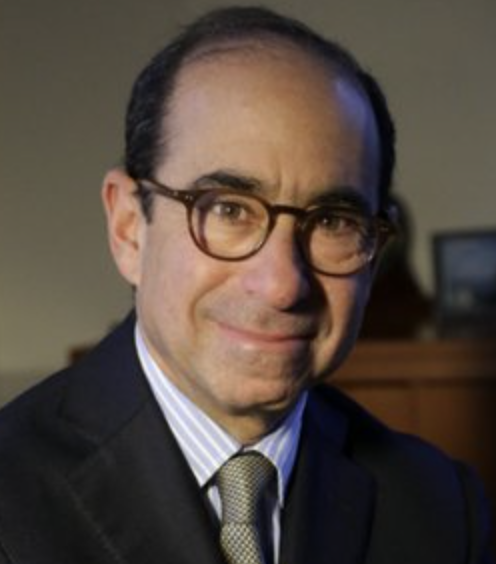
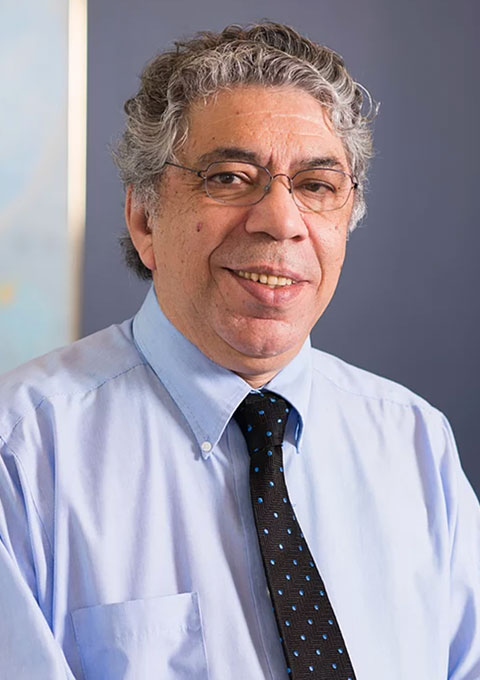
Otaviano Canuto
Senior Fellow
Senior Fellow at the Policy Center for the New South, Affiliate Professor at Mohammed VI Polytechnic University and Non-Resident Senior Fellow at Brookings Institute. Former Vice President and Executive Director at the World Bank, Executive Director at the International Monetary Fund (IMF) and Vice President at the Inter-American Development Bank. ...
Rym Ayadi
Founder and Scientific Director, Euro-Mediterranean Economists Association
Rym Ayadi is the Founder and President of the Euro – Mediterranean Economists Association (EMEA). She is Founder and Director of the Euro-Mediterranean and African Network for Economic Studies (EMANES). She is Senior Advisor at the Centre for European Policy Studies (CEPS); Professor at the Bayes Business School, City University of London and Member of the Centre for Banking Research (CBR); Chair of the European Banking Authority – Banking Stakeholders Group (EBA- BSG). She is also Associated Scholar at the Centre for Relationship Banking and Economics (CERBE) at LUMSA University in Rome. ...
Len Ishmael
Senior Fellow
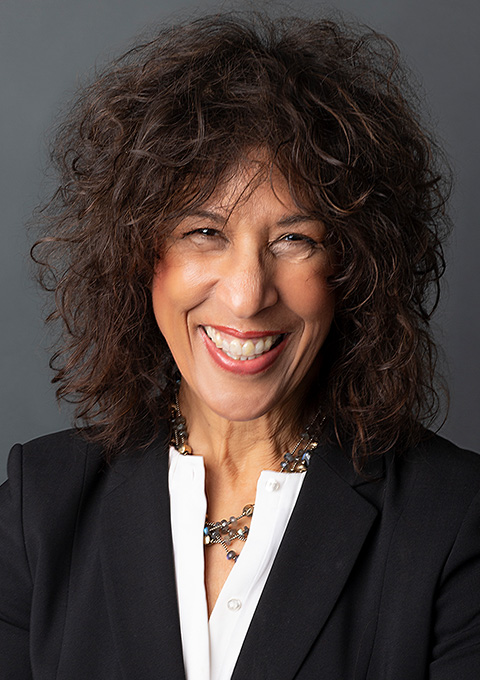
Ambassador Dr. Len Ishmael is an affiliate Professor at Mohammed VI Polytechnic University teaching the MSc course New South Dynamics, as well as Geopolitics and Geo-economics in the Joint HEC Paris/Public Policy School Executive Program. She is a Senior Fellow of the Policy Center for the New South, Distinguished Visiting Scholar of the German Marshall Fund of the United States of America and a Senior Fellow of the European Centre for Development Policy Management. Dr. Ishmael is the Global Affairs Advisor and Head of the Expert Groups of the Brussels Diplomatic Academy of the Vrije Universiteit Brussel (VUB). She is the former Ambassador of the Eastern Caribbean States to the Kingdom of Belgium and European Union, past President of the 79-member African, Caribbean & ...
Ian Lesser
Vice President; Executive Director, Transatlantic Center, The German Marshall Fund of the United States, Brussels
Staff Expert Ian Lesser Vice President, Foreign Policy; Executive Director, Transatlantic Center Brussels Expertise: Policy, NATO / Mediterranean & Middle Eastern Affairs / North-South Relations / Terrorism / Proliferation / International Security & Geopolitics / Energy Related Topics: Security and Defense, European Union, Wider Atlantic, Mediterranean , Mediterranean Strategy Group, Turkey, Grexit, NATO, NATO and the Mediterranean, Understanding America Ian Lesser is vice president for Foreign Policy at The German Marshall Fund of the United States (GMF) and a member of GMF’s executive team, managing programs across the organization. He also serves as executive director of the Transatlantic Center, the Brussels office of GMF, and leads GMF’s work on the Mediterranean ...
Megan Richards
Visiting Senior Fellow, German Marshall Fund of the United States
...

RELATED CONTENT

  • Authors
    Bambang Brodjonegoro
    November 2, 2026
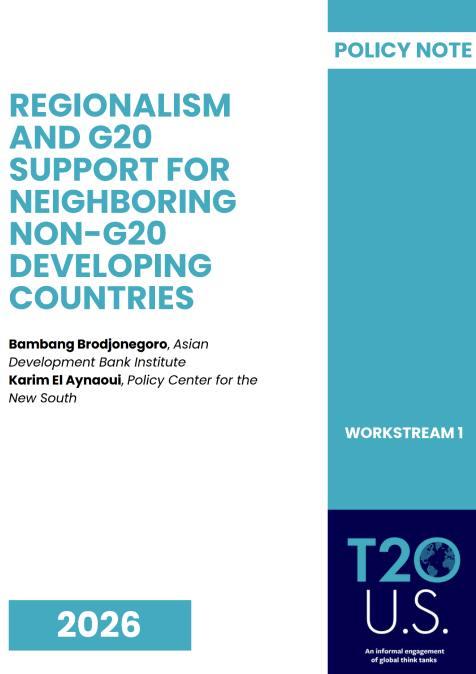
    This policy note was published as part of the T20 U.S. 2026 Workstreams, under the workstream “Fostering Trade and People-Centered Economic Growth,” which brings together policy experts to develop recommendations for G20 policymakers. The Group of Twenty (G20) accounts for most of the world’s output, yet its decisions shape the prospects of 174 United Nations Member States without G20 membership, among them the great majority of least developed countries and small states. Many ...
  • Authors
    October 29, 2026
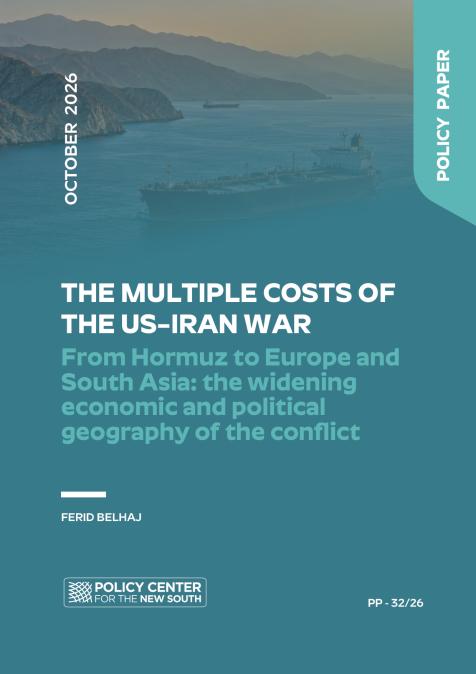
    Wars are decided by those who hold military power, but their costs are increasingly borne by those who have little or no voice in the decisions that start them. The US–Iran war shows this imbalance very clearly. Its economic consequences have gone far beyond the battlefield and have disrupted energy markets, trade routes, food supplies, public finances and investment in the Gulf, Europe, Africa and Asia. The most striking feature of the conflict, however, is not only the size of the ...
  • October 22, 2026
    Strategic hedging is rational when it preserves a worthwhile choice at a tolerable cost while respecting existing commitments. Drawing on the literature on hedging and Latin American autonomy, this Policy Brief examines contrasting illustrations of that proposition. It distinguishes ambiguity about future alignment from uncertainty about existing obligations and explains how clearly bounded commitments can reconcile autonomy with credibility. The cases reveal different vulnerabiliti ...
  • October 15, 2026
    The Policy Center for the New South, in partnership with The Asian Network, is organizing a webinar titled “Emerging Powers and the Remaking of Global Order” to examine the growing role of emerging powers and the Global South at a time of profound transformation in the international sys...
  • October 14, 2026
    في ظل التوترات الجيوسياسية المتصاعدة، تتغير طرق التجارة العالمية وتتبدل معها موازين الممرات الاستراتيجية. تفتح هذه الحلقة من «حديث الثلاثاء» النقاش حول التقاء المسارات البحرية والبرية داخل هذه الممرات، والعوامل التي تتحكم في طبيعة السلع التي تعبرها. وتبحث كذلك في ما يمكن للمغرب أن يجنيه...
  • Authors
    Florent Parmentier
    October 12, 2026
    Cet article soutient que le Chief Geopolitical Officer (CGO) doit être repensé à partir de l’expérience des entreprises africaines. Dans un environnement multipolaire et fragmenté, leur principal défi n’est pas seulement la gestion des risques, mais la préservation de plusieurs options stratégiques simultanément selon une logique de hedging. Trois modèles de CGO sont à distinguer : l’intermédiation (Office chérifien des Phosphates (OCP), Tanger Med), l’intégration régionale (Ethiopi ...
  • Authors
    Paul Isbell
    October 9, 2026
    In the first seven Policy Briefs of this ongoing series of analysis on Pan-Atlanticism: The Atlantic Basin in a Multipolar-Transnational World, we developed the argument that the strategic significance of the Atlantic Basin is on the rise for a range of international actors (states, regions and non-state agents) and from distinct political or ideological perspectives. In addition, in the most recently published Policy Brief -- “The U.S. and the Current International Reconfiguration: ...
  • Authors
    Marie-Noelle Nwokolo
    October 6, 2026
    The author of this opinion, Marie-Noelle Nwokolo, is a 2024 alumna of the Atlantic Dialogues Emerging Leaders Program.In September 1978, delegations from 138 countries gathered in Buenos Aires, Argentina, around a powerful idea: developing countries had knowledge, experience and capabilities worth sharing with one another. The Buenos Aires Plan of Action gave institutional form to what we now call South-South Cooperation, part of a wider post-colonial effort by developing ...
  • October 02, 2026
    Building on his Policy Brief "Latin America, World Politics and the Great Powers", Nizar Messari examines how recent developments are reshaping U.S. influence in the region and affecting ...