The rise of populism in Spain with our columnist Helmut Sorge

November 22, 2019

Questions:

1/ The recent elections in Spain showed a successful right wing party “Vox’’. Is this a sign of more trouble for Europe?

2/ Do we have to fear a strong rise of populism?

3/ Is a more restrictive immigration policy a solution?

Speakers
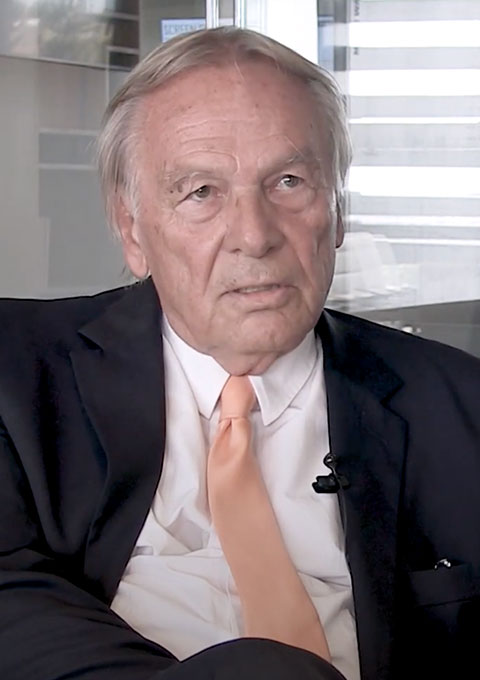
Helmut Sorge
Columnist
Helmut Sorge is a columnist at the Policy Center for the New South, where he publishes opinion pieces in the format of international press reviews of current events related to the Middle East and European affairs, and conducts interviews with high level policy makers and PCNS researchers. He is also a lecturer on journalism and the media. For over 40 years, Helmut Sorge served as a writer, former Foreign correspondent, Foreign editor, and Middle East expert for Germany's leading newsmagazine "Der Spiegel" to Washington, London, Paris and Los Angeles. He reported from Vietnam, the Middle East, wrote about safaris, nuclear accidents, visited prisoners on death row in the United States. The German weekly “Gala” summarized in 2011, when his latest book, a collection of biographies ...


  • March 27, 2026
    This interview analyzes how tariff wars are transforming global power dynamics, disrupting trade systems, and redefining trade policy as a geopolitical tool, while examining the risks and opportunities for emerging economies and the Global South, the repositioning of regions like Latin ...
  • March 27, 2026
    Human rights are central to the legitimacy of legal systems, not only through their recognition but also through the manner in which courts resolve conflicts between rights. Judicial decisions require well-founded reasoning, drawing on interrelated legal sources to ensure coherence, legitimacy, and predictability while minimizing non-legal influences. In EU law, the Court of Justice employs grammatical, contextual, comparative, and teleological methods of interpretation, alongside p ...
  • March 27, 2026
    Sous Trump II, la conflictualité s’affirme moins comme un simple effet de la polarisation partisane que comme un principe d’organisation de l’exercice du pouvoir. À partir des prises de parole présidentielles, ce Papier montre comment des enjeux distincts, tels que l’immigration, la fraude, la sécurité, les controverses culturelles ou les rivalités internationales, sont intégrés dans une même architecture discursive orientée vers la restauration de l’ordre. La conflictualité y appar ...
  • March 18, 2026
    The first BRICS summit, convened at Russia's initiative in 2009, would be followed by sixteen more, the most recent being the Rio summit held on July 6 and 7, 2025. Until 2022, only one enlargement had taken place — the admission of South Africa, which turned BRIC into BRICS. From 2023 onward, however, three consecutive summits — 2023, 2024 and 2025 — transformed BRICS into BRICS+5, admitting five new member countries and introducing a new “partner country” status that now groups ni ...
  • March 18, 2026
    Le premier sommet des BRICS, tenu à l’initiative de la Russie en 2009, sera suivi de 16 autres, le dernier étant celui de Rio dont les travaux se sont déroulés les 6 et 7 juillet 2025. Jusqu’en 2022, un seul élargissement est intervenu, celui accueillant l’Afrique du Sud, transformant les BRIC en BRICS. À partir de 2023, en revanche, trois sommets, ceux de 2023, 2024 et 2025, vont se solder par la transformation des BRICS en BRICS+5, accueillant 5 nouveaux pays membres, en ...
  • Authors
    March 13, 2026
    While acknowledging the centrality of security tensions and potential conflict in the Gulf, this essay intentionally sets aside a detailed treatment of military and hard-power dynamics, concentrating instead on the geoeconomic logics of capital, infrastructure, energy, and connectivity, through which Gulf states now articulate power in a fragmented world order.It examines the emergence of a new tripartite or three-pillar power configuration in the Gulf, arguing that Saudi Arabi ...
  • Authors
    Nizar Messari
    March 13, 2026
    Latin America has had to deal with expansionist agendas of great powers since its independence. To do so, different leaders from the region have adopted different policies. Some have sought to reinforce their relations with the U.S. whereas others mistrusted their big neighbor from the North and tried to multiply their partnerships with other parties in order to keep their autonomy. To this respect, the central role played by U.S.-Latin American relations, epitomized by the1823 Monr ...